Was It Worth It?

Just on the way back from our group’s reading event which was at a lovely venue — the Art Workers’ Guild in Bloomsbury.

I enjoyed the night as a social event but it feels rather like work for me as I stepped into the breach as temporary webmaster and spent ages knocking up a website for the reading (the time taken representing my competence at web design rather than the sophistication of the task itself) and also supplying all the drinks. The latter was a particularly stupid thing for me to volunteer to do in retrospect as it’s going to involve two three and a half hour round trips into London (one tomorrow to clear the stuff out of the venue as we only drunk about half of the wine). So I’m completely mentally and physically burned out now.

Overall,  I think the practice of reading aloud in a social venue like that is great but, I wonder if the preparation for the event has taken such a large part of the end of the course it’s in danger of becoming almost like the opposite of a novel writing course — more like flash fiction where people are encouraged to hone the 600 words or so that might catch an agent’s ear. I think I’d rather end up with several thousand words of reasonably good prose than having spent nine months working on a few hundred – but perhaps I have it all wrong?

A Great Scene for My Novel Happens in 45 Minutes?

I wonder whether today might be an occasion I could use in my novel — pubs should be doing well out of this great weather and the World Cup. 45 minutes to go until England play Germany — that would be a great event to have Kim reflect on English attitudes to the Germans. What would she make of the papers or the massive build up to what’s just a second round game — and exiting it would mean a pretty disastrous World Cup for either side.

I’ve been e-mailing my German friends in the build up — wishing Germany luck but not as much luck as for England. I’m also wearing my new England away strip (the red one) that I’ve worn quite incongruously to a couple of classes at City. I turned up after watching England v Slovenia on Wednesday in the Freemason’s Arms, Covent Garden (where the rules of football were first written down). I was about 6 pints worse for wear and that might have been why my reading rehearsal was rather slow.

I’m also really pushed for time with the end of the month coming up — notably our reading night on Wednesday. I’ve made things worse for myself by volunteering to create a website for the evening — something that took me most of yesterday to do.

Lots of things I need to blog about but haven’t done so far and may not do until the end of the week:

  • A bit of agent reaction to the first few pages of The Angel
  • The antidotes I’ve experienced to the angst that has featured in a few recent posts
  • A write up of Penny Rudge’s visit from a couple of weeks ago (we’ve exchanged a few comments via Facebook in the meantime)
  • The experience of using this blog as the basis for my end of term commentary assignment
  • And much more…

Watch this space…but now it’s time for the football. Come on England — and we’re owed something special from The Big Man and Fat Frank.

Useful, if not Uplifting, Advice

Following a few links from links I came across this blog entry from ‘Help I Need A Publisher’ by Nicola Morgan which has some sobering thoughts on the state of the publishing industry.

There’s a very interesting bullet-pointed list of advice for new writers — a group the author feels might be less disadvantaged than published writer.

Our visits from authors, an agent and a publisher seem to have wised our class up to these economic realities — I find it quite encouraging in a way that there still are authors who can write whatever they like and still feel ‘the world owes them a living’ — though I guess they won’t be around for that long.

Strengths and Weaknesses

For our commentary we need to list the strengths and weaknesses in our writing. I won’t list what I plan to write are my strengths but I came up with a rather long list of weaknesses, although some are the inverse of possible strengths. For example, one person’s superfluous dialogue might be another’s illustration of character or inconsistency of character might also be viewed as adding complexity.

  • Over-explaining — insulting the reader’s intelligence by spelling out what can be inferred
  • Occasionally over-writing — though this depends a lot on the reader’s taste and the genre
  • Lapse into cliché/corniness — in the more emotional scenes I can put in soapy dialogue but when it’s real emotion I don’t think it pays to think of clever ways of having your characters avoiding saying ‘I love you’ or ‘I want you’.
  • Balance of interior/exterior — I often avoid the interior (could be linked with the POV issue)
  • POV not clearly enough signalled (or just inconsistent) — my POVs tend to confuse at times because I’ll allow the character whose POV I am writing from to infer observations (the other character must have entered the room because the POV character assumed she heard the door open — perhaps easier to say ‘she must have heard the door open’)
  • Not ‘listening’ to characters — being an authorial bully — thinking ‘wouldn’t it be a great scene for him to parade this other woman before his wife and provoke an argument between them all’ for the sake of creating a dramatic scene when really the characters don’t want to do that.
  • Lack of conciseness (inc. superfluous dialogue) — the universal reluctance to kill your own babies
  • Consistency of characterisation — readers thinking ‘x or y wouldn’t do that’ — but do I do this badly enough to make the reader give up or would be cumulative effect be to increase complexity if done properly?

Word of the Week…

…from Monday’s workshop and Wednesday’s reading run through is ‘rippling’. I used it right at the end of my reading and it was used to great effect by Rick in his workshopped chapter and by Charlotte in her reading.

I’m wondering what might happen on Wednesday’s run through as it comes on the same day as England’s match against Slovenia — which is ‘must win’ and I shall be in London early in a pub (not sure where) to watch it.

Would You Buy This Book?

City financial wizard and cookery TV show contestant James puts his ex-employer’s ‘Dealing Positively with Negativity’ training course into practice by sinking his redundancy money into transforming his run-down Chilterns village local into a gastropub.

But was it a smart decision, during an impromptu drunken bender round London, to promise the manager’s job to Kim: a struggling German conceptual artist from Shoreditch who makes ends meet as a barmaid?

Both are moves that James’ ambitious wife, Emma, is certain to try to make sure he regrets.

‘The Angel’ is a novel that explores the conflicts between city and countryside, art and commerce, conformity and impetuosity. It’s the story of two people from radically different backgrounds that they both share a passion to escape.

It’s only an early draft version but any comments would be gratefully received. The syntax is a bit contorted (long sentences) but then lots of blurbs tend to be like that.

Writing A Commentary

One benefit of writing this blog is that I thought it would be useful to use to look back on and chart the progress of the writing over the course — and part of the course assessment is for us to write a 2,000 word commentary on exactly that.

This has to be done by Wednesday — pretty easy I smugly thought — I’ll just cut and paste the writing-related entries into a document and edit them a bit. I just did this, along with the content of a couple of e-mails I’ve sent the tutors with my expostulations, and found the document is a mere 24,790 words long.

There’s extra stuff we need to put in the commentary as well that’s not covered in the blog (like consider in depth which authors are in our genre and who publishes them) so it looks like I’m going to have to edit 95% of the words away — probably harder than writing it from scratch. However, it’s useful to go back and have dates associated with feelings of satisfaction and frustration.

I need a blurb too…maybe I’ll post that on here to see if anyone might think it sells the novel.

Red Kites and the Liminal Zone

I went to one of the Bucks Open Studios events this afternoon at St. Dunstan’s Church, Monks Risborough. There was some really fascinating stuff there — a lady had done the most stunning watercolours of (of all things) parsnips and carrots, even salsify. There were some very interesting interpretations of the Chiltern landscape — some were linoleum engravings and others were very vividly coloured abstract views.

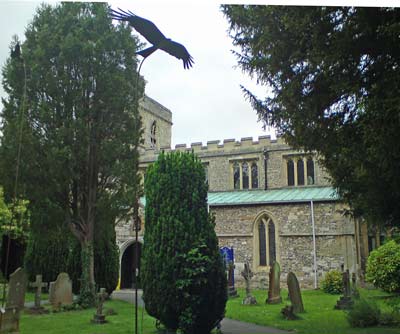
Outside the church were some metal sculptures — and a couple of these were of the famous red kites that I often mention on Facebook. Recently these incredible birds of prey, which have a wingspan of about six feet, have almost constantly hovered overhead. I drove down the M40 after a City class and knew it was time to pull off soon when I saw the birds circling over the motorway at Stokenchurch. There were four circling the garden this morning. The sculpture below is pretty much life sized — it’s by James Sansome. The event has its own web-page with details of the artists.

Sculptured Kite, Monks Risborough
James Sansome's Kites at Monks Risborough

Monks Risborough church is extremely old — there’s been a church there for at least a thousand years. Most of the building is 14th century but the font is 12th century — 900 years old — and came from an older church. The boundaries of the parish are apparently the oldest in the whole country — and the shape of the parish is very long and thin to apportion parts of the contrasting landscape features to the village. These include wooded hilltops, steep grazing on the escarpment, the spring line (where the settlement is) and then the more fertile low-lying flat farmland in the Vale of Aylesbury.

The geography is amazingly varied and makes me think the general location is a great place to locate the action in a novel. I’m going to fictionalise the actual location of The Angel but it will be close to the hills and all their celtic and mystical associations (there’s an ancient cross cut into the chalk of Whiteleaf Hill, which overlooks Monks Risborough) and there are some very large areas of woodland where it’s easy to go for a quiet, contemplative walk. However, turn the other way and you very soon get to some remote farming areas which, while not quite as desolate as the Fens, might not be too dissimilar to somewhere like deepest Devon.

I went for a run through these places today and I ran down one lane for about two miles (which takes me near enough 20 minutes) and didn’t see a single car, just a farmer’s Land Rover and no other humans apart from a cyclist who nearly ran me over and a horsey-looking blonde woman mucking out a stables (not noticeably fat-bottomed unlike the ones I wrote about in my last reading). In fact the whole area is pretty horsey — there are a few studs around and one of the biggest point-to-point events in the country is held just down the road at Easter.

All this made me realise, as I was running, that The Angel’s location re-inforces one of its themes. It will be in a place that in one way is very connected with London (on Wednesday I left the Queen Boadicea in EC1 at 10.45pm and still didn’t have to get the last train home). But go the other way and it’s easy to find isolation and a connection to a way of life that’s still incredibly traditional.

So the novel’s location is on a boundary — a kind of liminal zone. And that’s the point where its characters are too — they’re on the boundary between urban and rural, commercial and artistic. They’re on the edge too and wondering which way to turn.

During the slightly boozy session about ten of us had in the Queen Boadicea after the class, we were all put on the spot to say what our novel was about — and any personal elements to it. I said mine was ‘escape’ — and a lot of the stuff I write seems to share that theme — but both main characters do want to escape their predicaments at the start of the novel. Emily’s suggestion that I take a look at Ann Tyler’s ‘The Accidental Tourist‘ as it’s in a similar sort of sub-genre maybe also re-inforces the theme of reaching an edge and thinking about escape. True as the answer was, it wasn’t the one that some of the class had hoped for, given that I’d read what’s now becoming my notorious sex scene on Monday (of which more in a coming post — no pun intended).

‘Is It Any Good?’

I would guess anyone who doesn’t ask themselves this during the course of writing a novel is not going to produce a very good one.

What’s probably not such a good idea is to include this angst in comments accompanying a chapter sent to a tutor for a tutorial. Asking ‘Is it any good?’ really means ‘tell me lots of nice things about it please to boost my writing ego’. So when I didn’t immediately get that response from Emily my reaction was ‘She must think it’s rubbish’. The tutorial in question has been an odd, long-drawn out affair as it couldn’t take place in person due to illness and we exchanged e-mails instead (Emily now being on maternity leave). I also talked about the issues with Alison last night in person.

There were lots of things that Emily didn’t like in the extract I’d sent — plausibility issues about James’ behaviour, not really seeing into what motivated the characters and so on. In some ways it’s a bit of a Catch-22 in that she said she thought I needed to know my characters better — but the best way for me to do that is to write more and to live with them, which is more difficult to do if your motivation is ebbing away partly because a tutor has said you need to know your characters better.  I think I do know my characters pretty well but perhaps they hadn’t come over that well for a couple of reasons. One is stylistic — I do tend to write much more from an exterior perspective than interior so I only infrequently inhabit the characters’ innermost thoughts. The second is the structure of the novel which starts with two people flung together in crisis and then develops from there. There’s a huge amount of back story that comes with both the two main characters and I’m finding it very laborious to drip feed into the first chapters. I’ve done about 15,000 words and they’ve not really found out much about each others’ backgrounds. I’m tempted to just write a couple of scenes from the past and show them in flashback and be done with it.

On Saturday night I got pretty downhearted — not because I thought the novel was no good — but because I thought I might need to totally overhaul the way it was written. I considered crawling into a hole and not bothering to emerge until after our end of course reading. However, once I’d mulled over the feedback I found it quite inspiring in a way. This is because Emily seems to have high ambitions for the story and characters — possibly higher than my own. Once I’ve got to the heart of the dilemmas and decisions facing both characters then the novel could say an awful lot that is relevant to readers in the modern world. I do think I have thought this through in my head in terms of concepts but it perhaps has to translate to the characters. It was suggested that I place my novel in the bitter-sweet human relationship genre defined by Anne Tyler’s novels. I was flattered that it was thought I operate in that difficult genre myself.

I’m also probably guilty of treating my characters as tools to be pushed around to achieve my own ends in terms of writing. For example, I thought it would be a good scene for James to turn up to see Emma at work to tell her he’s been fired (she won’t answer her phone). I had him bring Kim along principally because I wanted to write a bit of Emma, Kim and James having an argument, which is something I enjoyed doing — lots of conflict and dialogue. However, in reality, even if James had gone to break the news to his wife in a five-star hotel then he would have left Kim in the lobby while he did it.

It seems I’m in a very uncomfortable position but one that is really of quite profound significance as getting this feedback shows that I’ve created characters who demand my respect — it’s their story now and I have to let them get on with it. I can’t force a situation on them just because I want to write it. This is really odd. I’ve seen many authors describe this process but even so, it’s quite disconcerting. This perhaps re-inforces the strong views that have been expressed after my readings on the way the characters have come over.

There were also straighforwardly positive comments in the feedback — strong sentences, good description, good dialogue (when it’s serving a purpose) — and it’s re-assuring to have the quality of the actual writing re-affirmed. I’m very self-critical of my prose as I think I write too quickly — beginning sentences without thinking how they’re going to end. In fact it’s been concerns over my self-diagnosed clunky prose that has put me off attempting a novel before.

In the end I e-mailed Emily back and said that I’d taken the comments on board and on reflection they were very helpful and motivating and she e-mailed back saying that being able to act on feedback, particularly if it’s not all glowing and telling you how wonderful it is, is a mark of a ‘true writer’.

As for the ‘Is it any good?’ factor, I’m reminded of the famous Stephen King story about ‘Carrie’ — that he’d thrown a draft away in despair into the wastepaper basket and his wife fished it out, read it and persuaded him to finish it. 50 books later he’s still going strong.

Artistic Buckinghamshire

Part of the plot of The Angel has Kim leaving trendy Shoreditch to come and work in the pub in rural Buckinghamshire. She’s also going to carry on working as an artist. It might be thought a bit implausible by some people (probably in London) that any serious artist would leave London unless they went to other arty areas, like Brighton, Pembrokeshire, St. Ives, Southwold or Eastbeach (!).

However, there’s an event in Buckinghamshire starting today that shows that there are a huge number of artists working in the county. Bucks Open Studios is an annual event that has over 400 artists open their studios or exhibit work in churches or village halls — it’s between 12th and 27th June this year. There is an exhibition by half a dozen local artists in the village hall half a mile away (and the population of our parish, including four villages, is only about 700). There are also loads of artists’ studios within a two or three mile distance of where I live, which considering that large swathes of that area include  a big National Trust nature reserve and ancient monument and the Chequers estate and most other directions are fields full of sheep or wheat is quite surprising. There’s quite a big village about five miles away called Haddenham (used extensively for ‘Inspector Morse’ filming and the like) that has twenty five artists participating in the Bucks Open Arts scheme.

It’s probably very logical for there to be so much artistic activity here — many people may have also given up a life in the rat race in London and set up as artists at home, but London’s not that far away and there’s enough money around in the home counties to probably sustain demand for the artwork. It’s also probably a very inspirational place for many artists to work — with some wonderful countryside, nature and peace for concentration (except when some of the suburban-minded anal retentives decide to chop trees down and pulverise their remains first thing on a Sunday morning, like today).

I suspect that many of these artists are relatively old and not like Kim but I’m going to try and have a look around their open studios over the next couple of weeks to do a bit of research.

Everything But The Bar Sink…

…but I did get the dishwasher in!

Bearing in mind Judith Murray’s comment that ‘in some sense all novels are historical’, I decided to load my last reading with as many contemporary cultural references as I could think of. ‘Decided’ isn’t actually a good definition — throwing in various things that pop into my head is how I tend to write anyway although maybe I’d decide to delete most of them if a book got published.

I’m rather dreading reaction to the scene I’ve just written because it could go either of two ways. It’s a climactic scene after months of simmering, smouldering sexual tension between James and Kim and this comes to the boil (good cooking metaphors there, albeit cliched). To counter the tension as it rises I start off with the most banal sort of conversations. In one point (a cop out I’m sure I’ll be picked up on) I have the narrator say ‘she didn’t care who was talking’ and then throw in three or four unattributed pieces of dialogue.

The cultural references are quite a bizarre bunch. Remember these are all in a 2,600 word piece which is meant to pivotal to the plot: Amazon, Katie Melua, Charlie Brooker, the Guardian, the Wombles, Mike Batt, William Orbit, Orbit’s ‘Adagio for Strings’, All Saints’ ‘Pure Shores’, Katie Melua’s ‘The Flood’ (which goes on to supply metaphors for the later scene), Virgin TV’s ‘Naked Office’ (see below), Jamie Oliver, a Sky+ box, the Carry On films, ‘The Full Monty’, ‘Britain’s Got Talent’ (and various of its contestants), Amanda Holden, Simon Cowell, Ant and Dec, ‘Sex and the City’, Heston Blumenthal, ‘The Fat Duck Cookbook’ and Heston Blumenthal’s notorious snail porridge. That’s well over 20 references that only someone living in this country in 2010 would really understand. Apart from the BGT references most of these aren’t gratuitously contemporary as they illustrate character and move the plot in some cases. The music is interesting as (it will be interesting to see if anyone picks this up) as Emma has bought the Katie Melua CD as it’s produced by William Orbit, whose works ten years previously (see above) were the soundtrack to a holiday she and James had in Ibiza when they first began their relationship. He’s meant to see the romantic significance in this — but doesn’t and needles her about Katie Melua’s previous association with Mike Batt (of the Wombles). So, a little vignette of their relationship.

I had to rush writing this piece and sent it out late to everyone. I’m still unhappy with the end and may revise it even further before I read it. I was totally knackered once I’d written it. Partly this was because I was determined to write something new and that pushed the boundaries a bit for me in terms of how comfortable I’d be with reading it. It’s also partly because I’m pushing myself to write new material for each reading and tutorial rather than polish up previously reviewed material. I also went to France very early on Tuesday morning partly to buy wine for our course reading. This produced probably a course first — for the first reading ever to be written, partially, on a cross-channel ferry. On the way out I annotated a printed draft then coming back I had the netbook out by the window looking out into the channel. Wonder if any of the nautical flavour comes through?

The piece was also very emotionally draining, which I found quite surprising. As it’s the consummation of a relationship I was trying to imagine and hold in my mind the feelings and emotions of the characters. When this involves scenes of a disintegrating marriage, seriously unrequited love and then some sudden switch into passion between two people who had (on the surface) treated each other as friends then this takes a lot of mental effort. I did this for three or four days and thought about it so much I was more than semi-detached from reality. I don’t know if it will be good for the writing that it felt like I was so intensely involved in their predicaments — your characters can’t do anything much more real than have sex with each other — or whether I might have got too close?

The writing was also difficult as I thought I had to do a sex scene for a reading as this is what the plot of the novel calls for and I wanted to get feedback on it — good and bad. I’m sure this is very difficult to get right and constructive feedback (though not sniggering) in this area would be a lot more useful than on a scene with people walking around London, for example. In the first drafts I had some graphic descriptions and used some very earthy Anglo-Saxon words. In some ways I’d rather these had stayed in as from a reading perspective because I’d like to have made myself read these out, to overcome the embarrassment. However, the word limit chopped any real physical description of the sex — there’s only really the build up but that’s the most interesting bit for the characters.  Even so, I’ve probably laid myself open to bonkbuster piss-taking.

Fascinating Lessons in Writing and POV

We had a visit from another published course alumnus last night — Penny Rudge, author of ‘Foolish Lessons in Life and Love’, as mentioned in a previous post.

I’ll blog later at more length about what she said about the publishing process in general. I was quite relieved that her book deal didn’t follow as a consequence of the end-of-course reading.

I’m quite inspired by the book and our session yesterday. I was encouraged that she had a similar background to me and, curiously, the style of her novel is probably closer to how I’ve been writing than mine is to anyone else currently on the course — contemporary setting, humorous, lots of dialogue, other gender POV, European leading character (s), etc.

I’m quite gratified that ‘Foolish Lessons in Life and Love’ has probably a higher literary breast count (and other intimate body parts) than my work in progress could be projected to have — there are scenes in a strip club and seedy strippers’ pub.  These descriptions are very well done — very witty and frank but never over-graphic, anatomical or crude. I think I’ll  keep the book handy for my own inspiration — seeing as I’m frequently reminded how sex-obsessed my male character is (wait until Monday’s reading).  Penny’s use of the male point of view in these scenes is also very accurate, at least from my own observation, so maybe there’s hope for me to use POV the other way.

Perhaps it’s because Penny also has a background as a computer programmer. I think I may have blogged on this before but I was a programmer for about 12 years, have worked in IT since and am now doing a dissertation for an MSc. in Software Development. I asked her a question about how she organised the files on the computer, as a writer, and she enthusiastically answered.

Perhaps IT workers are one of those professions, journalism being the most obvious one, that equips people with certain skills — being able to use a keyboard quickly is one but also in novelistic terms, putting together a novel with its themes and planning probably draws a lot on the analytical skills required to put together big systems. And the revision process is similar in that one small change can have very big knock-on consequences throughout the system or novel (name, setting, chronology changes, etc.).

The Naked Office

I was doing some ‘research’ today which involved sneaking in the back door of my local pub when it was officially closed up for the afternoon — the landlord had previously told me he’d be staying open all afternoon and he must have felt guilty when I turned up at 4.30pm with the doors shut. So I hung around in there for a quick pint — then had to stay for a couple more when it started raining outside — while he counted up his takings and watched some mindnumbingly sensational programme on Virgin TV on his Freeview TV about car crashes and people falling off motorbikes.

There was a bizarre trailer during the advert breaks about a programme that seemed so ludicrous and prurient it could only ever appear on such an obscure channel — ‘The Naked Office’. It appeared to feature people taking their clothes off in their offices but you couldn’t tell if they actually did because as the trailer was shown at 5pm then Virgin put big labels over any potentially controversial body parts.

I happened to be flicking through the TV guide tonight and came across the actual programme on Virgin+1. I was amazed to see that the programme was being positioned as some sort of business psychology programme rather than the peep show that most viewers no doubt expected. There was some ‘expert’ on who made the specious argument that if office workers stripped off naked for a day then they would be more open and it would ‘enhance communication’. This is the kind of HR bollocks that I’m interested in for ‘The Angel’ — the sort of unquestioning, controlling mentality that assumes people can be coerced into abandoning all dignity just by a few uplifting words from a motivational speaker.

Of course, these same HR consultants are no doubt the people who would come down mercilessly on any sexual harassment in the workplace and, thinking about the Peter Kay John Smiths advert mentioned in a post below, I can think of a very obvious practical reason why ‘The Naked Office’ will find its male participants quite reluctant to join in.

No fear, the whole programme was one flaccid non-event. In the end no-one got naked — a few of them paraded for about ten seconds in their underwear, long enough to display their array of tattoos, but no more titillating than one would see at the beach or swimming pool.

The programme was utter crap but a source of ideas for the novel and I’m wondering whether Emma should do a ‘let’s go naked Friday’. While on this programme the expert sensibly stayed fully clothed, I wonder if Emma might cause no end of tension if she suggested to James that she had to take the lead by stripping off in a copycat event that she might quite innocently organise — she’s going to be into crystals and mysticism anyway.

Charlie Brooker completely skewered an earlier edition of the programme in one of his better reviews in the Guardian.

My Reading Problem Solved

We had a run through of our readings in Wednesday evening’s class. I’m currently second on the bill so was one of the first to get up and read. I chose what I think will be the eventual opening of the book — the firing scene. This is a lively scene but difficult to read as it has three characters and some narration — to do it proper justice I need to read in four slightly different registers. I have a cunning plan to try and help me with this BUT I got some extra inspiration from one of the contestants on last night’s Britain’s Got Talent.

He’s Mark James from Barnoldswick and performed a duet from ‘Phantom of the Opera’ in the auditions — where he had a costume split down the middle — one female side and one male. He stood facing different directions when singing the appropriate part! Complete rubbish — and even worse when last night he did Elton John and Kiki Dee which was a much more interchangeable duet so he was forever spinning round. (I was a bit gutted the extraordinarily talented pole dancer went out tonight.)

But — maybe that’s my solution — perhaps I dress in some sort of split female (for Kate the HR woman) costume on one side and a male costume for James and his boss Will (Will is balding so maybe when I’m James I can put a wig on or something)? Then perhaps for the narration I take the mic and hide behind the lectern — very omniscient.

I’m sure all the literary agents would remember that sort of performance?

Emily was ill, which was bad luck for me as I had a tutorial scheduled with her to discuss chapter 5 and other stuff. However, Emma Sweeney was a very capable replacement — she teaches at various places like Cambridge University and New York University (London campus) — a bit more exotic a version of our curiously named Bedford University Buckinghamshire campus that does nursing teaching, presumably for Stoke Mandeville (see below). To digress even further when I Googled her name, I found a syllabus for a course that someone called Emma Sweeney teaches, or has taught, (could be a different person but it’s not so important as the following goes on to say I found a good idea) at a U.S. university that  includes a module on ‘sex and the body’ — a potentially awkward subject that I’d guess causes writers more anxiety than anything else and I’m really wondering whether I should make myself write something similar for my last workshop reading. It might be difficult but it would be a good learning experience.

Mind you I say that as someone’s whose writing always seems to veer towards the smutty — to the extent that other students like to insist I mention that one of my male characters is ‘sex mad’.

The Oldest Road Sign in London?

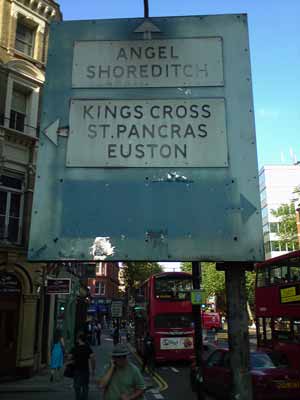
Angel and Shoreditch Road Sign

Walking along Theobalds Road tonight between City Lit and City University I came across this historical anachronism (sorry Guy for the tautology!) of a road sign. It’s rather appropriate for my Angel.

Here’s the whole rather quaint London-Red-Buses street scene below.

Theobalds Road Angel Sign

Visit from Judith Murray

One of London’s leading literary agents, Judith Murray from Greene and Heaton paid our group a visit on Wednesday night. She has a number notable authors on her list, perhaps the best known being Sarah Waters.

Judith mentioned at one point that the part of the role of an agent was to be an author’s advisor and advocate — and she spoke with such enthusiasm and showed such huge knowledge of the publishing business that it wasn’t hard to imagine the excellent job she would perform looking after her clients. I’d be tempted to say the authors on her list are a lucky bunch but that would belie the huge amount of effort that we learned is involved from both writer and agent before Judith represents a writer.

That said, sometimes there has been an element of serendipity in the way that Judith has come across authors — Sarah Waters had been sending off her manuscripts to publishers’ slush piles without success until she mentioned in passing to her neighbour that she was looking for a publisher — the neighbour happened to be a colleague of Judith’s at the time who suggested that Sarah sent the book to Judith — and it all went from there. Apparently the first few chapters of ‘Tipping the Velvet’ were published virtually unchanged from how they’d appeared in the first manuscript — requiring next to no editing. That the novel went on to great success makes a couple of related points: firstly, the opening pages of ‘Tipping the Velvet’  must have languished unnoticed on various publishers’ slush piles; secondly, the later success of both novel and author show the value of an agent who is passionate about the work.

This need for the professionals in publishing to be passionate about a novel was also emphasised by our visitor last week, Francesca Main. Judith receives about  20-25 unsolicited submissions a day — and she reads them all — but is likely take on a smaller number of authors than that in a whole year — less than half a percent.

Clearly, to have a chance of making it into that small number of acceptances, the novel will need to immediately engage her interest. Moreover, she reads the submissions from a necessarily commercial angle — if she can’t immediately think of three or four editors (out of the large number she knows) who would also be interested in that type of novel then it would be uneconomic to progress any further. The book might be a great piece of work but if there’s no market for it then it’s a tough fact of life.

Judith was candid enough to admit that she has passes over books that have later gone on to be published with success — she turned down at least one novel that went on to win a literary prize. However, that book that wasn’t to her personal taste and an agent really has to love a writer’s work for the relationship to be a success.

As we find with our own readings in the class, everyone has different literary preferences, and being rejected by an agent is not necessarily a reflection on the quality of the work. Writers need to develop a thick skin to cope with rejection — a quality that might count as much as many facets of literary ability but, given how novel writing is often so bound up with one’s own personality, then such persistence and self-belief are probably some of the most difficult personal qualities that writers need to develop.

Judith’s tastes, incidentally, tend towards good literary writing — but of the sort that has a strong narrative and engaging characters. She’s not a fan of intentionally self-conscious, experimental writing, which she enjoys intellectually but she says there are other agents who specialise in such genres.

As Francesca mentioned the previous weeks, Judith also re-inforced the tough conditions in the publishing market at the moment — since September 2008 publishers have become much more risk adverse and have erred on the side of safe bets — principally established authors with a good sales track record or the amazingly talented and disciplined celebrity novelists who somehow manage to dash off a novel while appearing in their soap operas or reality TV series. That said, Greene and Heaton had a particularly good year in 2009.

Nevertheless, the market is very tough and publishers won’t invest in a new author unless they’re confident that booksellers will promote it — the 3 for 2 table at Waterstone’s or its equivalent in Amazon. And the publishers are expected to contribute to those promotion so there goes any hope of an advertising budget.

The need to drum up interest in a new author in these straitened times also explains the long lead time often experienced by a novel from a new writer. Any promising work that lands on Judith’s desk now might not be published until early 2012. This is because the publishers will try to create a ‘buzz’ about the author — try to get good word of mouth recommendation, or endorsement by influential bloggers, solicit favourable reviews and so on. There’s a lot of work goes on to attract interest and raise the novel’s profile — and often the author’s personality can make a big contribution to this effort (again, it’s becoming less of a world for shrinking violets).  Literary prizes are particularly important in boosting reputations.

Bearing in mind the long lead time, I asked a question about whether contemporaneously-set novels might be seen to date very quickly. Mine is set around now, or maybe in the last year, but would an agent think that in 2012 or 2013 that readers would think ‘Oh that’s so 2009’? On the other hand historical novels wouldn’t have that issue. The answer was not to worry — the main criterion is the quality of the writing by far.

All the work an agent does for an author was comprehensively outlined — including many aspects that most of us have hardly given a thought to, such as foreign rights. Essentially the agent is the author’s first professional reader and, as such, a good agent can use experience and contacts to guide an author right the way through the publishing process. An agent will offer sound advice throughout a writer’s career – and, given the investment in development of a new author, agents are interested in writers who offer the prospect of a long career (I hope that doesn’t mean that if you’re over 30 you’ve got no chance — let alone over 40).

One thing that authors in our position can’t expect, though, is a large amount of editorial intervention. While Judith really enjoys the process of working with an author to identify what might need to be improved in a novel, time-management pressures mean that she can’t help to substantially rewrite a novel. The writing has to be good in the first place. If it’s not then an agent won’t have the resources to turn prose that’s just OK into something better.

One piece of very useful advice, therefore, is don’t send work out to agents before it’s ready. The novel should be ‘good to go’ before it goes before an agent’s eyes. An agent generally won’t be able to give detailed feedback on novels that are rejected so it would be futile to send a first draft out and expect it to be returned with lots of detailed annotations on how it might be made better. Instead you’ll get a rejection but you’re not likely to know whether it was because the book as a concept was not commercial or because it was just sloppily written. At least if an author sends the best, most complete version of a novel then the chances of it being rejected on pure quality grounds are much reduced.

Similarly, there’s not much point sending in the first three chapters and a synopsis if the novel’s not complete. The agent might love it but won’t sign you up until he or she has read the whole novel — an agent needs to know if the writing can be sustained and developed over the course of a longer work.  We might get some useful encouragement but no deal until the book’s completed. That said, Judith is very enthusiastic about spotting new talent and supports events such as our course reading evening and she encouraged us all to contact her with our work.

So how to contact an agent? The covering letter is important and is the first thing that is read. The quality of the letter will say a lot about the quality of the submitted novel. It should be concise — but should give an idea of what the novel is — just something like ‘thriller’ will often be sufficient. Information about the author is important — and we shouldn’t underestimate the value of writing courses such as ours — saying you’ve written the novel during the City University Novel Writing Certificate course will definitely make an agent take the submission a lot more seriously. Judith will then read the first part of the novel and only if she’s interested will she then read the synopsis — any decision will be made primarily on the writing itself.

So many writers don’t do research on which agents to contact — and the result is that much effort is wasted when agents receive work in unsuitable genres and the like. So how do you find an agent who will love your work? Apart from the Writers and Artists Yearbook, one clever trick is to find a book by an author whose work is similar to your own and then look in the acknowledgement pages — so long as the relationship hasn’t exploded there should be some thanks given by the author to an agent.

Or you could sign up to the City University course and have a few of them come along to listen to you giving a personal reading of your work — more scary than putting an envelope in the post but, fingers crossed, more effective: Judith represents Kirstan Hawkins, a course alumnus, who spoke to us last term after the reading event a couple of years ago.