The Narrative Center

As mentioned in the last post, I just spent a very long weekend in Center Parcs (staying until late Monday afternoon. trying to get most value for money).

I’ve been to all the Center Parcs in the country although the one at Elveden in Suffolk the most often (about four times) — and would go more often if it wasn’t so ludicrously expensive. This is quite odd as I normally like holidays to be as independent and away from hordes of other people as possible — I much prefer self-catering cottages in the wilds of Wales or Gozitian villas to big hotel complexes.

The concept of entering a fenced-off compound, surrendering your ability to ‘escape’ because your car is parked (as in my case) literally a mile away and spending three or four days there with over 4,000 other people hell bent on a good time would normally be an anathema to me. And yet…

Like Disneyland or well-run theme parks like Alton Towers, there seems to be something quite re-assuring about these closed, contained, managed worlds. I can pretty cynical about most forms of entertainment and yet I found myself happily paying out extortionate prices — like £10 for 30 minutes on a pedalo (although I saved £96 for a weekend hiring 5 bikes by strapping our own precariously on the car and spent more time looking in the mirror to check they hadn’t fallen off than I did looking forwards down the A11).

As far as I could tell, almost everyone else that I’ve ever encountered there has a similarly good time — again something that seems to happen at Disneyland, even to the most embittered sceptic. I was prompted to wonder why. It goes beyond the obvious factors like things generally working properly and having good staff who are well trained in customer service (they’re in the company of John Lewis and Waitrose in surveys and have recently undergone a whole company training programme ‘Making Memorable Moments’ similar to the ones I used to do at BA when that company actually had good customer service). (It might be possible to spot my MBA training in the interest in customer service and operations management there — I’d love to write a thesis on how these places work.)

But what does this have to do with novel writing? On a psychological level, I think there are some startling similarities. A comment I wrote up on the blog a few months ago that Francesca Main made  (commissioning editor at Simon and Schuster) seems very relevant. She said of reading the opening of a novel that ‘you must feel you are in good hands’ as a reader — and this is exactly what places like Center Parcs do. Well-written fiction has an authorial assurance (distinct from the narrator) that, ultimately, makes the reader feel safe — part of a contract in the reader suspending disbelief and also a guarantee that the time invested in reading will result in a satisfying experience.

Note that the words ‘author’ and ‘authority’ have the same etymological root. And so this is at Center Parcs and Disneyland — there’s an invisible sort of authority that derives from the exclusivity of the community — everyone’s paid a lot to be there so that’s a social leveller and they are literally gated communities where causes of social anxiety can be excluded. In Center Parcs case various design features ameliorate the fact that thousands of other people are also on the site: the accommodation is cleverly laid out so neighbours don’t overlook each other; the forest setting deadens the noise levels (and mobile phone signals!); and the absence of cars eliminates a source of status and also creates an environment which is a bit otherworldly (a bit like that created in fiction).

Center Parcs is also interesting when considered against Maslow’s hierarchy of needs . The safe and exclusive environment is important as it addresses the knows that physiological and safety needs need to be covered before the higher needs are fulfilled. It brings to mind an interesting quotation that I read recently in the Economist Blighty blog about wider society:  ‘the ultimate purpose of politics and the state [is]: the protection of people from each other.’ I’d argue that the attraction of novels to many readers, especially but by no means exclusively in non-realistic genres, is the sense of escape from anxieties about other people’s actions in the disordered ‘real world’.

Belonging/social needs are generally covered as people are on holiday with family or friends. However, the popularity of activities, like my doing archery or the tree-climbing that I blogged about below, is certainly associated with achieving self-esteem (overcoming fears, demonstrating ability). Some of the activities even inch towards self-actualisation — having a massage in the spa is very nice and I even got up at 6.30am on a Sunday to be educated by a wildlife ranger — going round looking for deer and birds (we spotted a little owl — which is apparently good going).

Also, as mentioned in a previous post in the context of rollercoasters, much of what we choose to do in our leisure time fits a classic narrative structure, which separates the experience from the inertia and continuity of real life — films, plays, music all tend to have beginnings and ends with middles arranged into some sort of anticipated structure. The same applies to holidays — there’s travel there and back and packing and unpacking, acclimatisation and so forth — although holiday companies seem to have been slow to realise the narrative. A subsidiary of my ex-employer, Thomson Holidays, has stumbled in its current TV advertising on the parallels between drama (films/plays) and a perfect holiday experience ‘authored’ by an expertly directed cast.

One re-assuring facet of holidays, planned activities and instances of fiction is that there is a planned end — in real life we never know when the end is.

A need for narrative structure must be somehow hard-wired into the human brain and is no doubt exploited intuitively by effective fiction writers. As a novel has an all encompassing narrative arc and many smaller arcs within that structure, so does the holiday experience. Even such basic events as a meal in a restaurant follow a set structure — and the more satisfying and memorable a meal the more likely it is to have an expectation setting opening and a satisfying resolution.

The more complex activities that I did at Center Parcs are similarly organised. A well-delivered massage certainly follows a pattern that ends with a rewarding, relaxing denouement. The tree-trekking starts with a briefing then has a series of 9 ‘acts’ of rope obstacles to be negotiated between trees (a place to pause) — tension is gradually built up as the obstacles rise higher above the ground. Then there’s the climax of suddenly descending at speed down the zip wire. You negotiate the course yourself (as you would read a book) but there’s always the re-assurance of the authority of the instructors in the background — like a safe, authorial presence — as with reading a book, it can be thrilling and feels perilous but you know it’s ultimately safe.

The Center Parcs Aerial Adventure could be quite an effective, if unorthodox, model for the plotting of a novel as it seems to tap into the same basic human psychology.

Also, many of these participatory activities are a little like a performance and perhaps it’s not surprising that I mentioned in the last post that I was struck that one of the climbing instructors reminded me of my character Kim — both are acting, to an extent, in some sort of artifice. It reminds me of the surreal line in ‘Penny Lane’ (that Ian MacDonald thought was one of the most truly avant garde lines The Beatles ever wrote) — ‘and though she feels as if she’s in a play, she is anyway’.
Zipping Up Kim

It’s a paradox that characters in fiction tend, naturally, to be figments of the author’s imagination but also have to be real and credible enough for the reader to maintain the suspension of their disbelief. Of course authors piece together characters from traits they tend to observe in many different people in real life —  but those different facets need to meld together to make a coherent whole.

I had a moment yesterday, while at Center Parcs Elveden, which was remarkably satisfying because I came across someone who not only looked similar to my character Kim but also seemed to have many of the exterior character attributes that I’d pieced together, which is great because Kim is probably the most complex and contradictory character in the novel.

Kim is able, for a while at least, to be something of a chameleon and be an efficient but sympathetic barmaid (or bar manager) whilst also having the disclipline and concentration needed to work on her artistic pursuits.  She’ll have a curious outward mixture of empathy and assertiveness whilst also combining an outwardly approachable, friendly  humour with a sort of inner-steeliness. (And she’ll also show anger and vulnerability to those who get to know her more closely.)

It was this unusual fusion of personality traits that I thought I recognised in the Center Parcs instructors working on what they called the Action Company Challenge Aerial Adventure. It’s like Go Ape ! which, ironically, James enjoys doing — maybe he sees something of the instructor in Kim? (I’ve done three Go Ape’s myself including the one in Aberfoyle in Scotland with the country’s longest zipwire at 426m that dangles you over 150 feet above a valley.)

In the Center Parcs Aerial Challenge participants follow a course ascending through a stand of conifers by negotiating about about nine obstacles placed between the trees (wooden beams, rope swings, rope ‘spiders’ webs’, wobbly bridges and so on).  You eventually end up about 40 feet up on a tree and have a choice of getting down by 120m zip wire or just jumping off with a rope breaking your fall (you hope!).

In fact, the whole course is incredibly safe as, unlike Go Ape! there’s a safety wire permanently fastened and a high staff to customer ratio. Despite knowing it is safe, some people tend to get irrationally terrified even a few feet off the ground, partly as being elevated off the ground and swinging by a rope is such an alien environment.

So the qualities needed by the instructors are both assertive — I was shouted at to perch on a little wooden step to give my safety rope a yank to get it round a corner and also when I somehow tangled my safety line by going through a rope bridge the wrong way. On the other hand,  some panic stricken people need a lot of encouragement to jump off a platform and swing across a gap of several feet hanging to a rope. It’s interesting as these people aren’t performing a straight pleasing-the-customer role, as might the waiting staff in one of their restuarants, as they also need to be able to try and generate a sense of cheerful confidence to get people around (although they sometimes have to lower people down on ropes who can’t face going further).

They also need to be very fit, professional — and probably a bit unusual. The woman working on the course managed to scramble up a 40 foot vertical pole to get ready to kit me out for the zipwire in the time it took me to get walk over a rope bridge. I was having a zip wire attached to me and had the strange experience that the person who was doing it was behaving exactly as I anticipated my main female character would act when at work meeting new people. Then I had to step off the edge and whizz down the wire.

Clearly, there are many dissimilarities — Kim is a German artist, which I doubt this climbing instructor was — she had a touch of Australian in her accent, although it may have been a very prononounced version of Estuary English. However, she also looked fairly like I imagine Kim to do, as much as you can tell under a safety helmet — she had quite a number of ear piercings.

Kim is meant to be quite distinctive looking — having fairly prominent facial features that she can either accentuate or soften — she’s an artist so she knows what effects she can achieve with her hair and make up should she be so inclined. James finds her at the start of the novel looking quite unattractive — and this disarms Emma to some extent — but she soon develops into someone whom Emma would like to see safely paired off (see comments under previous post).

I suppose if a character is synthesised using some imagination and lots of different sources, then there’s a decent enough chance of bumping into someone who can reflect that mixture of attributes at a certain time and circumstance — it verifies that those sort of personality attributes can plausibly combine together in a character — but it’s odd to discover this standing on a tiny platform up a tree 40ft high off the ground.

Now I only need to worry about how well I transfer the character out of my head on to the page and recreated in a reader’s mind.

Addressing Deficiencies

Getting back to ideas for The Angel, I think I may have plugged a bit of a hole in the plot and balanced out the characters a bit by considering introducing a male admirer of Kim when she moves to The Angel. This chap will be actively sought out and encouraged by Emma (in some matchmaking activity reminiscent of her Austen namesake). Emma won’t rest until she’s paired Kim off with someone. Of course, the person she tries to pair Kim off with will be totally unsuitable, although the relationship will develop to an extent which will make James terribly jealous — and when James thinks they’ve slept together then he’ll be extremely agitated. It will be something of a dip in their relationship when he sees Kim having some sort of a relationship with someone who he used to think of as a friend but, in this context, sees as something of an arsehole. He’ll realise how trapped he his himself.

This person will probably have been a friend of James’ but they’ll fall out — and, because James is ostensibly a happily married man — he’ll have to find some other reason to vent his fury. Emma will try and coach the relationship on regardless — she’s the sort of person who thinks any outcome is possible, given the right sort of motivation.

Kim will confide a few things to James about how this chap is an utter philistine but that she’s initially flattered by his attention. Then Kim will start to notice a few suspicious danger signs that maybe the new boyfriend’s attention is beginning to wander — perhaps to someone who’s more receptive of his charms?

I’ll need to flesh this chap out — any suggestions as to his name and other personality features would be gratefully received. Perhaps with this character another piece of the jigsaw is falling into place?

Arts Bloodbath?

The Guardian reports today that the Department for Culture, Media and Sport is preparing to inflict cuts on itself of up to 50% as part of the forthcoming government spending clampdown.

This reduction in its own staff is in keeping with the cuts it is anticipated the department will make in its funding of the arts and sport. With the big expense of the Olympics relatively protected and big tourist draws relatively safe (such as free entry to major art galleries and museums) then the axe is going to fall particularly savagely on less high-profile spending.  Bodies such as the Arts Council in England, which funds 850 organisations, are going to find they have a lot less money to give out in grants. I know of many small enterprises, such as poetry magazines, that struggle along even with the help of a small amount of money from the Arts Council. Similarly, this is the source of the already meagre funding for many students who study arts or creative writing at postgraduate level.

The government has expressed what seems like a somewhat naive hope that private benefactors will step in and plug the funding gaps — as happens in America. I remember when I lived in the US for a year in the mid-80s how mystified I was to see the PBS channel regularly soliciting its viewers for donations — something at the time I found quite shocking but, like TV sponsorship, would not be quite so alien in the UK nowadays.

One of the governments other big targets for expenditure cuts is higher education so it’s not difficult to predict what’s likely to happen to the arts in education over the next few years. I would expect creative writing courses to be put under very tight scrutiny. One point in the courses’ favour is that they’re popular and accessible — people are quite willing to pay to do postgraduate and continuing education courses in writing. They also don’t involve much capital spending on the part of the university — just a room to sit in — unlike courses that require neutron colliders that cost billions, as at Oxford. However, as Emma, who taught us briefly at the end of last term, pointed out — to teach creative writing properly there needs to be a fairly low student to staff ratio — the teaching is interactive. I remember when I was doing my MBA at Kingston being quite astonished at the size of the audience for the undergraduate business course lectures — there were hundreds of them to one lecturer.

Also, a school leaver is going to have to be pretty confident of their future ability as a writer to do creative writing at undergraduate level — passing up the opportunity to get a more ‘marketable’ qualification.

One consequence is that I’d suggest anyone who wants to get a creative writing qualification, like an MA for example, might be better applying sooner rather than later. It’s too late for universities to cancel courses for the next academic year but they will certainly review them carefully for the year afterwards. I can’t see them disappearing but there may be fewer to choose from and perhaps the teaching will be less individual. However, it was Emma’s view that the standard on our City Novel Writing course was MA standard anyway and that the only reason that any of us would find it advisable to take an MA would be if we wanted to teach — and perhaps having a published novel would be more credible in that case anyway.

What might have more lasting consequences is that universities will cut staff in creative writing departments and postgraduate and doctoral students will find it a lot more difficult to gain funding. Many university courses, such as those at City, are taught by lecturers who aren’t full time academic staff (at least at that university anyway) and are working themselves on PhDs and the like while also working on their own novels, poetry or other writing. I guess this route into getting some financial support while developing a writing career is now going to be pretty difficult to follow. These people also give time and support to the large network of ‘underground’ publishing, such as e-zines and small circulation magazines, that nurture the careers of more experimental and literary writers.

With government grants drying up and a major source of financial security (in higher education teaching) likely to wither away then both writers and the outlets they currently use are going to feel the pinch with disproportionate severity unless some private funding can replace that cut by the government. With some exceptions, commercial funding is not likely to support writing that is experimental or provocative. This might have a peculiar knock-on effect as the pursuit of literary prizes might take on even more prominence. Perhaps a new author with literary ambitions might be taken on by a publisher with the sole intention of being submitted for a prize — and if the author doesn’t win or get shortlisted then they could be dumped straight away?

The effect of the ‘new austerity’ is going to be pretty bleak right across the writing spectrum. While the more commercial genres tend to have no need of government subsidy, new authors in these genres may well have benefited from some subsidised support. Also, any author with a literary bent who finds the traditional means of support to be dwindling may decide to switch into a commercial genre, at least temporarily, in an attempt to pay the bills by publishing a work that will sell in large numbers — thus making that market more crowded?

Angelic Countryside

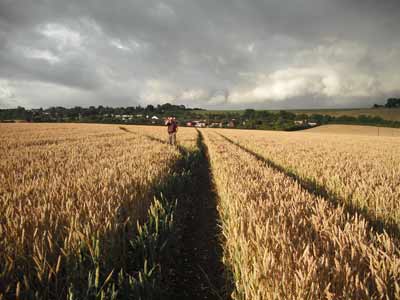
I went for a longish walk on Friday afternoon between a few villages that may influence ‘The Angel’ and took a few photos. This one was immediately after a heavy, thundery shower had passed over a few minutes before.

Slicing Wheat
Slicing Wheat

The light is very unusual — it was about 8pm so the sun was low and the light was diffused by the atmospheric conditions. The texture of the wheat is interesting — with the footpath and tractor tracks a very dark contrast. Also the expanse of the wheat contrasts with the village (Loosely Row) on the hill in the distance. (The photo is just off the A4010 close to the highest point on the pass through Saunderton — somewhere that can be surprisingly bleak in winter.) Perhaps just the sort of inspiration for an artist?

Visit from Penny Rudge

I posted briefly, about a month ago on our final visit from  figure from the publishing industry — one of our course’s published alumni, Penny Rudge. She came to see us on 9th June and I’ll try to summarise the many interesting points below that she made in her hour or so with us.

(I’ve been very slow in writing up this and a few things from the course as I’ve been so busy with the reading and also the writing of the commentary and submission of chapters two to four (or three to five in my case — about 11,500 words)).

With our reading only three weeks away, many of the class were interested to know if Penny’s book deal for ‘Foolish Lessons in Life and Love’ had been precipitated by her year’s equivalent event (as had been the case with Kirstan Hawkins). A few of us were relieved when Penny said that, while one agent showed interest at the time and a couple asked to see the final book, that this wasn’t out of the ordinary for her cohort and that the novel, while started on the Certificate course, had largely been written when she moved on to do an MA (I think this was at Royal Holloway — and she later went on to do a PhD ).

(The further study yielded an endorsement from Andrew Motion for the novel which can’t have harmed its marketing.)

Penny’s agent (Caroline Wood at Felicity Byron) picked up ‘Foolish Tales in Life and Love’ from the anthology that was produced at the end of the MA course.  So no short cut from the Certificate course reading but Penny said that it was all valuable experience, a nice night — and a well-organised event.

It was also Penny’s view that the City course was more appropriate for the focused development of the novel — the MA being better for experimentation. Practically the whole novel had been workshopped chapter-by-chapter with ex-students from City University because they continued to meet after the course had ended. Penny puts down the fact that the manuscript required fairly little editing once accepted for publication to the feedback received in this way.

As well as the academic courses, Penny had biological deadlines to meet when completing the novel: finishing it just before the birth of her second child. The overall chronology was graduating from the City course in 2007, completing the novel in 2008 and then receiving the final proofs of the novel in the summer of 2009 — for publication in trade paperback in April 2010. A mass market paperback format is due for publication in June 2011.

A combination of managing to get a grant for full-time study and the need to take time off to start a family led Penny to give up her previous job in IT and become a full-time writer — or at least as much as child-care commitments would allow. In this sense the City University course was part of a life-changing experience. Aspiring writers might be well advised to look into Arts Council grants and similar (but don’t expect a champagne lifestyle from one).

Once the novel had been sold, there were a few changes made in response to the publisher’s feedback:

  • A character’s nationality was changed as it was too reminiscent of a recent best-seller
  • The publisher came up with the title of the book — Penny had a different one while she was writing it but was happy to take on the publisher’s suggestion of  ‘Foolish Lessons in Life and Love’ as she thought it summed the book up well
  • Historical anachronisms, particularly indoor smoking, had to be removed (how the world changed during the gestation of the book!)
  • Quotations from pop songs and films were removed — not at the insistence of the publisher but because it was pointed out that getting the permissions costs a not insignificant amount of money
  • The ending of the book was made a bit more hopeful than it was originally — apparently readers like that (I shall have to remember this advice myself if and when I get to the end of mine)

Nevertheless, the novel remained remarkably unchanged from the original synopsis.

One point that intrigued some of us was that Taras, the main character in the novel, was male — and a number of our class were narrating from the point of view (at least partially) of someone from the opposite gender.  In Penny’s case that was quite helpful for the first novel as it dispensed with any obvious autobiographical parallels and allowed her imagination to be more free. Her second novel is likely to have more autobiographical components. In the end, it was her view that imagination is at the core of fiction — an author must be able to enter a character’s thoughts (or at least give a convincing illusion of doing so).

I’ve touched in previous posts about how Penny has demonstrated a knack for marketing her work — such as providing material for publicists to try and place in a newspaper (as happened with an article in ‘The Independent’).  Publicists tend to have bigger clients than debut novelists so they are not likely to spend a huge amount of time generating this kind of story but, if the author takes the initiative, publicists can be quite effective in finding the best outlet to take it.

Self-promotion is probably something that doesn’t come easily to most writers but it’s something that authors increasingly need to do. As well as thinking of good stories to prime publicists, events like signings in bookshops are ways of increasing profile and flogging the copies of books that need to be sold to increase the chances of getting subsequent publishing deals. The author has to take the initiative in arranging book signings, doing readings at festivals, walking into bookshops and trying to sell them your book (this seemed to have worked for Penny in Waterstone’s in Piccadilly as the novel had been spotted on the shelves near the door by one of the class) — and so on. Lots of support from literary friends also pays dividends.

All the marketing, while hard work, tends to have a snowball effect. For example, a when a book crosses a threshold of something like twenty reviews then Amazon then it becomes more prominent on Amazon.

Cyberspace promotion is also now expected — Penny is intending to start up a web page or blog when she has time (in between all the readings, signings — with a bit of writing squeezed in as well). In the meantime, there’s a Facebook page that publicises the book and allows readers interaction with the author.

Penny has now sat in enough bookshops to be able to observe buyer behaviour — which includes the surprising revelation that hardly anyone browses the fiction shelves. They probably never get past the infamous 3 for 2 table!

The England of ‘Long Shadows on Cricket Grounds, Warm Beer and…’


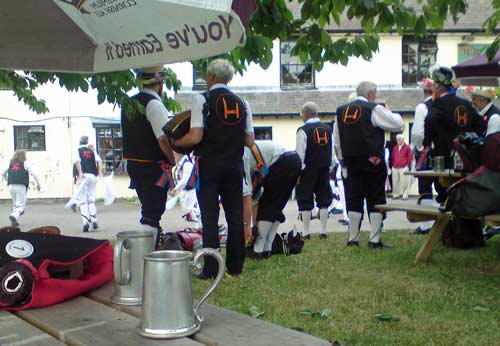
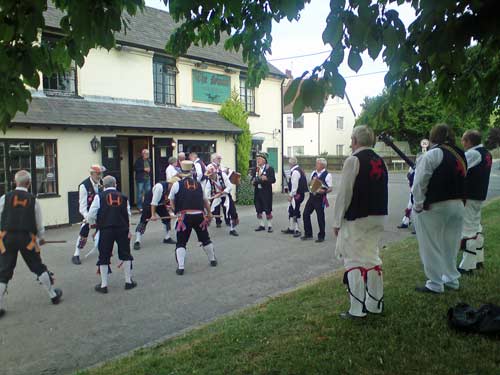
Morris Men at Swan, Great Kimble
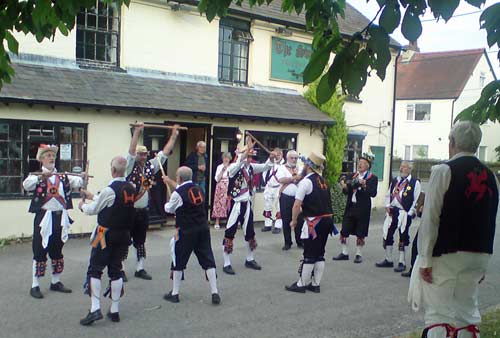
Morris Men Brandishing Sticks at Swan, Great Kimble

…I’m sure John Major in his rather risible but memorable speech would have included Morris dancing in his wistful list of unchanging Englishness. That speech is a particular bug bear as beer should NEVER be warm — the belief that real ale is best drunk tepid has allowed bad landlords to get away with serving undrinkable crap. It should be cellar temperature (about 10-12 C) and it’s sometimes so difficult to keep it that way in unrefrigerated cellars that even usually reliable pubs might be wisely avoided in temperatures of the upper 20s and even 30s C of the sort we’re forecast now.

Morris Men at Swan, Great Kimble
Morris Men with Their Traditional Tankards at Swan, Great Kimble
Morris Men at Swan, Great Kimble
Towersey Morris Men Look On At Their Aldbury Rivals at Swan, Great Kimble

I wonder what Kim would make of Morris Dancing. I’ve actually e-mailed one of my German friends  one of the pictures below, which I took yesterday of the Towersey Morris Men (relatively local) in a joint display with the Aldbury troop.

‘The Angel’ will certainly be a pub where the tradition carries on flourishing.I don’t know how often Morris dancers perform in London — there are no doubt some — but I doubt most Londoners ever see them. There are quite a number of sides (I think that’s the correct technical term) in the local area.

Aldbury is in the Chilterns and would actually be quite a good model for the village where ‘The Angel’ is to be located. It’s a decent size, with a picture postcard village green, fairly affluent as it’s not far from a fast train service into London (via Tring station — to which it’s probably closer than Tring itself) and has a couple of pubs, including the CAMRA regional award-winning Valiant Trooper, which is old and historic and quite a model of a community pub. There’s a nice review on the Telegraph website which points up some of the idiosyncratic charm that I’d like to achieve with ‘The Angel’.

Positive Feedback from Agents and A Publisher

I’ve been so busy preparing for Wednesday’s reading that I haven’t had time to blog about other events that may have more eventual significance.

I went to the Winchester Writers’ Conference last Friday and had three appointments — two with agents and one with a publisher.

The agents had both read work that I’d supplied in advance and gave me useful feedback. I sent the first fifteen pages of The Angel (about 5,000-6,000 words) to someone from one of the biggest literary agencies in London (A.P. Watt). She was very complimentary about what she read — said she’d ‘really enjoyed it. She praised the evocation in the sense of place as she lives in the Hackney/Shoreditch area herself. She gave some constructive comments about perhaps changing the opening around a bit — which were quite intuitive in a way as what she suggested was the original way I’d opened the novel before changing it to reflect what I read at our showcase on Wednesday. It was a bit too late for me to change the reading. The two points of view worked well for her and also the genre — which she described as on ‘the border between literary and commercial fiction’ which is a good place to be apparently. I asked if this was the type of novel that she would represent and she said that it was. I seem to remember her complementing me by saying I ‘could write’.

I also pitched the novel completely cold to an editor from a huge publisher (I happened to get a spare slot in her schedule on the day). I had to show her my blurb and my reading for the City reading as that was all I had available. But she was also very encouraging — saying it was ‘funny’ and something that people would definitely want to read. In the end she took away all the improvised material I showed her and it’s now at the publishers.

The other agent I saw only asked for the first ten pages and he had a different take on the novel which, I suspect, might have been influenced by not seeing the missing five pages that the other agent had read. While she thought it would appeal very widely as it was, at heart, a love story I think that’s because the extra part had a lot of Kim and her interior. The first agent complemented the quality of the writing but wasn’t sure where it would be positioned in the market — although one of the other delegates later told me that this agent wasn’t a fiction specialist — but perhaps that was because he hadn’t seen enough of the book? Certainly, the majority opinion out of the three was that it was very marketable.

After these sort of events, it’s probably natural to wonder if the agents really meant what they said or were they just being polite but it’s not really in their interest to say something’s good if they don’t like it — it just means wasted time for them in the office. So I think that’s pretty encouraging — everything was read and submitted as it would be for a proper agent submission when a novel’s finally ready and they were quite lengthy samples of the book so weren’t taken out of context.