‘It Was So Fun’

Just been watching the second half of Eurovision while trying to start writing Chapter Five. I’ve convinced myself that it’s good research for the novel as it shows the pervasiveness of English across Europe — or actually the Eurovision area which stretches as far as Israel and Azerbaijan.

At least three-quarters of the countries sang in English and, so far, every single country has given their votes in English (we’ve not got to France yet). It shows the way that a younger generation of Europeans, possibly those who started secondary education after the fall of the Berlin Wall, have almost appropriated a version of English as their lingua franca.

I’ve been in a reasonably good position to follow this as I’ve worked for the last eight or so years in a job that has involved frequently meeting colleagues from all over Europe — and travelling pretty extensively. While bearing in mind my own, and that of the British overall, pretty dreadful mastery of language skills (only exceeded by the Americans), I’ve found that English speaking ability is a bit unpredictable in people over around 40 — some very educated people can struggle. However, younger people, at least those I’ve met in a work context, are almost exclusively excellent at spoken English. There’s no hestiation or nervousness — just fluency, albeit often marred to British ears by an American accent.

One reason for this is that many Europeans spend a time living in this country to help their English skills. I’ve been doing a writing course at City Lit in Covent Garden for the last few weeks and fellow course members include a German, an Italian,  a Dane and a Japanese. The Europeans are so fluent at English that if you were to transcribe the words coming out of their mouths there would be very little difference to a ‘native’ English speaker — perhaps they would be slightly more formally accurate. While the Japanese student has quite a strong accent, she took one of the Londoners to task about her grammar — saying she was trying to learn English and couldn’t understand how the sentences had been constructed.

All this is, of course, is my self-justification for writing much of Kim’s dialogue in fluent English — but I think that’s the most accurate thing to do. I don’t think she’ll feel or behave like a foreigner at all when she’s in London — as London really is such a cosmopolitan city. (Bren Gosling’s novel about an immigrant in London is another example.) Yet, when Kim leaves, she’ll just about cross that almost tangible border between the influence of London and that of rural England. I tend to think of it in terms of motorway junctions — J5 on the M40, J12 of the M4 — but the motorways extend London’s influence out along their corridors. I see The Angel pub being the other side of London to Amersham and Wycombe — and so really in another world culturally. Kim will feel like she’s in another country then, to begin with.

But she’d be celebrating tonight with Germany having won Eurovision in the end. As the (over 30) Executive Supervisor of Eurovision said of the big flash-mob dance — ‘it was so fun’.


Avalon

I’ve yet again been amazed by how all these weird connections come tumbling out while I’m writing — things I don’t realise until perhaps a day or two afterwards. 

I don’t know whether the digression into cultural references would make it into a finished novel but I’ve put a few things in for my own amusement. 

In a part I’ve just written, James and Kim are walking through an uninspiring part of Hoxton towards City Road and they see a view of the City through a gap created by a building site. The heat on the concrete shimmers and Kim thinks of Avalon — or, more specifically, an image based on Glastonbury Tor rising up over the flooded Somerset levels (as they would have been in Arthurian times).

What James associates with Avalon is the Roxy Music album from 1982 which Kim knows too, with its wonderfully mythological cover. James, being on his way to being half cut, starts humming and singing tracks from the album while Kim is mulling over the imagery of the City as a citadel. The song he ends up singing is “Take A Chance With Me” (not to be confused with the Abba song of a similar title). This is a non-too-subtle portent for what both of them choose to do later.

But what was so strange is that Kim has just asked James what he did at work and he responds that he ‘made money out of nothing’. Now a very similar quotation has always stuck in my mind by a musician — that the concept behind a particular album was ‘making music out of nothing’, which I’ve always thought was a great description of the music. The musician was Bryan Ferry and the album, of course, ‘Avalon’.

Many critics have described Avalon as one of the most romantic albums ever made and it was interesting that it came to mind while I was writing this scene (they’re just an odd, platonic couple at the moment). At the start of the chapter the two walk past the plaque marking the location of Burbage’s ‘The Theatre’ — where the first Shakespeare plays were performed — and Kim tells James that he’s standing right where Romeo and Juliet was first performed. Star cross’d lovers indeed.

Here’s a performance of ‘Take a Chance With Me’ that I found on You Tube.

A Meeting with ‘God’

Last Wednesday, as mentioned in a previous post below we had a visit from a real-life commissioning editor — Francesca Main from Simon and Schuster. I think I’d been expecting a visitor from ‘an editor’ so was quite awestruck when Francesca described one large component of her job as being THE person who decided whether to publish a novel or not. I didn’t go quite so far as one of our group who made the blunt, but fairly accurate, observation from our side of the table — ‘You’re like God’.

It turns out that, while aspiring novelists might see the commissioning editor as a deity, that within the publishing house there appears to be a hierarchy of the gods worthy of Greek mythology and that a large part of the editor’s job is to convince the supernatural beings in other departments, notably the marketing department, that a novel is worth taking on.

I won’t go into a great deal of detail about the insights Francesca gave us, fascinating as they were. (I’m conscious these meetings are one of the attractions of the novel writing course so join up for the course next year if you weren’t there and want to find out more). However, I did check with Francesca if it was ok to write up the general drift of her comments on this blog.

There are a few sobering points to mention up front about the commissioning editors job, as it relates to up and coming novelists. Firstly, she almost exclusively deals with agent submissions — and not unsolicited manuscripts. This is an important quality filter that works to the advantage of the writers represented by agents as Francesca will endeavour to make a decision based on the whole of any manuscript that she receives. It’s not judged on the first few pages or chapters — the whole lot is considered. Of course this means the author has to have a completed novel to put forward in the first place — which again is a filter of quality and commitment.

Another sobering aspect is the ratio of novels considered (even those filtered by agents) compared with those published. She receives between two and five novels a day but will tend to only see six to eight novels a year through to publication — which works out at a list of about 25 authors. So in a working year of perhaps 200 days that means she must publish something under 1% of the novels that cross her desk. How much those odds sound depressingly pessimistic depend, I suppose, to the quality of targeting of editors by agents (perhaps some that are rejected are not her genre and so on) and also to the number of other editors also on the lookout for novels (the closer that number gets to 100 then the slightly less glum those odds start to look — once you have an agent).

With such a small percentage selected it’s clear that the editor has to be passionate about the work — something mentioned in the previous post. One comment stuck in my mind — “you must feel you are in good hands” as a reader (i.e. the author has a confident, clear and consistent style and that the reader feels the novel is going somewhere). She also re-iterated the point about avoiding florid prose — the famous over-use of adverbs and adjectives marks out authors trying too hard — but general pretentiousness shows through as well.  Originality and quality of the authorial voice are also clinching factors.

The editor needs to champion the work to the marketers, accountants, publicists, foreign rights department and so on. That’s why throughout the process the people involved have to be completely committed to the novel from the start — author, agent, editor and it helps to have reviewers, booksellers and so on as advocates too.

That’s why the temptation to ask someone like Francesca a question like ‘tell me what I need to write to get published’ needs to be resisted at all costs — not that any of us did — as if we don’t believe in what we’ve written as writers then we can’t expect anyone else to.

And at the end it’s a commercial proposition and it was salutary when the subject of subsequent novels came up. Perhaps surprisingly, debut authors are reasonably attractive to publishers — they’re more newsworthy, possibly more original, perhaps easier to work with and, a factor that seemed surprisingly important, they’re eligible for more literary prizes! There are perhaps as many barriers for the many published authors whose sales figures for their first or second novels haven’t set the world on fire — and they end up dropped from the list. There’s not much an editor can do in that case — even if they have a passion for the works — your books don’t sell and the bookshops won’t buy them. Tough.

The second part of the commissioning editor’s job apart from performing Herculean efforts to get the book published in the first place is to work with the author to improve it. This isn’t a case of checking the spellings — proof readers do that and other readers can also check for continuity and historical consistency and so on. Francesca tends to develop her writers’ novels at a more abstract level. Common issues that might be addressed include the following.

Are the characters real? A writer can write all the great prose in the world but if no-one cares about their characters on an emotional level then they’re in trouble. Structure: writers are ok at beginnings and ends but the middles of novels often need work. It’s also Francesca’s experience that good dialogue is very difficult to write. Also, don’t underestimate the reader — they don’t need every action explaining and, quite often, would err on the side of using their own imaginations where possible — don’t describe everything and every character in great detail.

As for first-time novelists, there’s a temptation to throw everything but the kitchen sink into their debut — the editor will tend to murder quite a few of the debut-novelist’s babies. That’s why the relationship between the editor and author needs to work — good writers will always value constructive feedback.

It was a fascinating hour and Francesca was answered all our questions with a really useful combination of general advice to us and anecdote from her own experience. In the end, as mentioned previously, there’s no magic bullet — at least beyond the one that gets you through the door called ‘getting an agent’ — and we will meet a real one of those tomorrow evening.

Some Pleasant Research

I went up to the Eight Bells in Long Crendon today — the local Campaign for Real Ale’s pub of the year. (I wrote its entry for the forthcoming 2011 Good Beer Guide.)

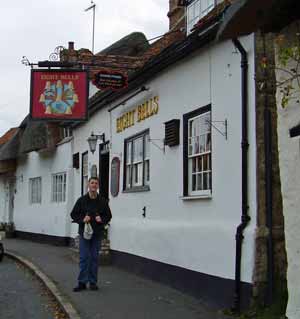
It’s interior is very much like the sort of pub I imagine The Angel to be — all hundreds of years old chequered flagstones and so on (interestingly there’s another pub in Long Crendon actually called The Angel, which gave me the idea for the name, but it’s more of a restaurant). It’s such a beautiful, olde world country pub that Helen, the landlady, was telling me that, contrary to what I’d recently written, it’s been on Midsomer Murders at least three times — with a yet-to-be-broadcast episode filmed in the garden and in the street outside. Long Crendon and nearby Haddenham are used as locations for nearly every classic English countryside TV programme — Morse, Lewis, Rosemary and Thyme — the lot. Even if you’ve never been there you’re bound to recognise the places. Here’s a photo of my friend Andy stood outside a couple of autumns ago.

Outside the Eight Bells, Long Crendon

It was good research to see a bit of the every day routine. We had to wait around a while, talking to the barman about the World Cup, until she returned with a load of meat from the local butcher’s. Then a little later she and one of the locals had a table covered with loose change — bagging it all up — which had been raised for by a pub running team for breast cancer research. They’d done a half-marathon in Edinburgh at the weekend. All invaluable stuff.

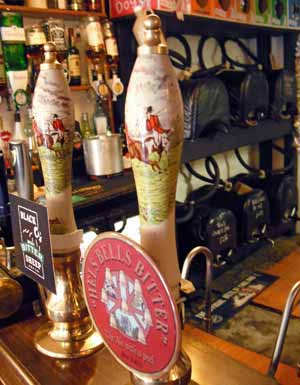
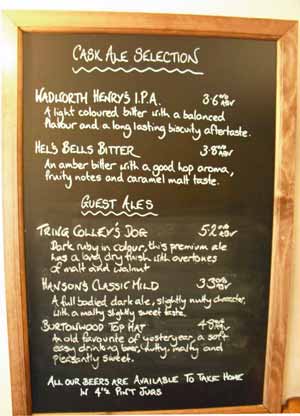
The pub has a little alcove dedicated to the local morris-men and offers plenty of traditional real ales — the back of the bar was knocked through to provide a stillage. Helen also has a house beer brewed in her own name — quite wittily called ‘Hel’s Bells’ — see photos below.

Bar at Eight Bells, Long Crendon
Beer List, Eight Bells Long Crendon

Wenlock and Mandeville — How’s About That Then?

Yesterday London 2012 introduced its two mascots, partly created by Michael Morpugo, who are called Wenlock and Mandeville. They look like metallic teletubbies.

Given that our City University group is based right in the centre of London, it’s quite interesting that not too many of us have set our novels in the city — it’s only the main setting for three people, if I remember rightly. There are two more of us who will use London as a partial setting, including me. Of those five, two people are setting their novels fifteen or twenty years in the past. Only three of us are writing about relatively contemporary London. This may be quite relevant as we look ahead a couple of years as the Olympics are going to make this country, and London in particular, a real focus of attention throughout the world. This has its good and bad aspects but there could be a big cultural knock-on effect as we’re already starting to see to a lesser extent with South Africa and the World Cup.

I’ve already written a passing reference in The Angel to the 2012 Olympic logo but I’m again quite intrigued by the serendipitous names that these mascots have been given in the context of my novel. Wenlock is apparently based on the Shropshire town of Much Wenlock. However, it’s also the name of a spit-and-sawdust real ale pub on the fringes of Hoxton and Islington that I’ve used as a setting — the Wenlock Arms. It’s the pub where Kim works — and I’ve just written a scene where she and James turn up there. I’ve slightly changed the pub name in the novel.

And Mandeville? It’s derived from the village of Stoke Mandeville, just up the road from me, which gives its name to Stoke Mandeville Hospital (strictly speaking that’s in Aylesbury) which was made famous for its spinal injuries by Jimmy Saville in the 70s. It’s apparently the biggest hospital site in Europe, although the Medizinischen Hochschule Hannover which is opposite the offices I frequently visited seems pretty huge to me (Kim was born there!). However, Stoke Mandeville is no doubt the only hospital that has a huge sports stadium. This is used for paralympic events — it was where they started — and has to be seen to be believed. It’s bigger than many football league grounds. I had a wander round the hospital buildings a couple of months ago when I had to find my way from A&E to the pharmacy, which are at opposite ends.

Stoke Mandeville is also the nearest hospital to where The Angel pub is set so I’m sure that one or two of the characters will find reason to end up there — I’ve already got a good plot opportunity for poor old Kim to be taken there.

No Magic Bullets

Just on the train back after another fascinating visit from a guest speaker in one of our sessions — Francesca Main who’s a commissioning editor at Simon and Schuster — and a very successful one too as one of her books ‘The White Woman on the Green Bicycle’ by Monique Roffey has been shortlisted for this year’s Orange prize. I’ll blog at more length about some of the points she made when I’m not balancing a laptop on my knee going at a rate of knots through the countryside.

One interesting point seems to be, however, that the more insight we get into the processes of the publishing world then the more the simplest, most universal advice rings true: there are no silver bullets and, moreover, trying too hard to write something with the objective of being published as an end it itself is probably the most likely route to failure.

That’s because any agent or editor will only take on a piece of work that makes them passionate enough to champion it against all sorts of obstacles and adversity. The agent needs to have the belief that will sustain getting the novel into a marketable shape and then go through the process of selling it to editors. Then the editor needs to champion the novel within the publishing house — of which more later.

So paradoxically, what probably marks out a novel that’s worth publishing, at least from a new author, is the fact that the writer believes in it so much that he or she complete it as an end in itself — regardless of worrying about its commercial potential.  If an obsessive, compulsive belief in the work itself shines out of the text then it’s that which will convince other people to believe in it and to invest their time and resources in its further development.

Probably the most daunting conclusion of all is that other people’s advice is very helpful but they can’t do the work — it’s all down to yourself.

Penthouse and Pavement

We ran on past our finishing time last night in our workshop — so late that the university building was locked up before Guy and I had our tutorials with Alison. These then took place on an amenable table outside the Queen Boadicea pub on St. John Street (quite apt for my novel). More of the consequences of the tutorial in a later post. This meant I missed a meeting I was hoping to pop into in High Wycombe (also in a pub) and got home quite late. However, I stayed up to watch a fascinating documentary on Heaven 17’s 1981 album ‘Penthouse and Pavement’.

This came out around the time I did my ‘O’ levels and, while I loved the Human League and Soft Cell and others, I wasn’t quite old and trendy enough to have bought ‘Penthouse and Pavement’, although I think I knew of its existence. When I went to university I got to know the album pretty well. I even think I played tracks off it, like ‘(We Don’t Need This) Fascist Groove Thang’ when I did the Friday night disco a couple of times at the student union. (It’s hard to believe, I know, but I did a bit of DJ-ing when I was 18 and then did a weekly show with my friend Hog Head on the student campus radio station when I was at UC Santa Barbara.)

Watching the documentary made me realise how much of a subconscious influence it must have been on me as many elements seems to have already turned up in my novel so far. It was said on the programme that ‘Penthouse and Pavement’ was actually a concept album for the 80s — obviously contrasting the disparity of wealth in the Thatcherite early 80s of the penthouse dwellers with those living on the pavement: the vinyl LP had a ‘Penthouse’ side and a ‘Pavement’ side. The brilliant cover, ‘like a cheesy company annual report’  as I think someone commented, was an ironic, arty comment on capitalism with the suited, pony-tailed band members striking yuppie poses — handshaking, on the phone doing a deal — which anticipated the Loadsamoney culture by five or six years.

The part of ‘The Angel’ that I’ve written so far has remarkable similarities — James starts high up in a gleaming office block, coming down to street level to meet grimy, struggling Kim. A stretch of pavement also plays a big part in one chapter. Thematically the characters represent the tension between penthouse (James) and pavement (Kim). The vocals on the title track, my favourite, are also an interplay between Glenn Gregory’s world-weary, deep male tones and sparky, soulful female vocals on the chorus (someone called Josie James, who’s not the woman on the video). That’s similar to the exchange of points-of-view I have so far in the novel. I’d also like to achieve a similar effect (for the City part of the novel anyway) with the prose as Heaven 17 achieve with the music — quite fast, sparse, sly, unpredictable — but not taking itself too seriously.

I guess I could elaborate further and speculate that the first track off Heaven 17’s next album, ‘The Luxury Gap’, becomes the next theme of the novel — ‘Temptation’. This track has been released in several different edits — and often turns up on compilations. My favourite is when Carol Kenyon’s ooh-oohing is allowed to run its full length (just before ‘step by step, day by day’). This is another track with a male-female dynamic and is relevant to the next part of The Angel — particularly the lines taken from the Lord’s Prayer ‘Lead us not into temptation’. In fact the next two singles off The Luxury Gap also fit my story — ‘Come Live With Me’ and ‘Crushed By The Wheels of Industry’ — this is now starting to get worrying.

I looked up the video of Penthouse and Pavement on Youtube after the programme, which I vaguely remembered — and in another stroke of perhaps unconscious serendipity the actress who plays the spying secretary is almost the spitting image that I hold my mind of Kim — once she’s got herself healthy in the countryside — she’s even got green(ish) eyes. (The actress is called Emma Relph — who was in the 1981 Day of the Triffids and is now apparently an astrologer.) The video is embedded below — take a look at the typewriter and photocopier — yet other artefacts don’t seem to have changed too much in 29 years.

‘Mad’ Frankie Fraser, Jack ‘The Hat’ McVitie and the Bulgarian Carrot

For various reasons I’ve been incredibly pushed for time over the last week — principally related to a suspected outbreak of an unpleasant type of virus in the household. While it didn’t affect me directly, it had quite a knock on effect but I won’t go into the gory details. I was also quite addicted to watching every news programme and political discussion going that read the runes of the post-election negotiations — and I got most indignant at times about one potential outcome. Also, while it’s wonderful at this time of year, especially where I live, to see the trees coming into leaf and the days lengthening, it brings all kinds of tedious jobs in the garden like lawn mowing and weeding. I got nearly 200 little bedding plants delivered in plugs during the week which needed potting up, which I couldn’t do until this evening, so I lost quite a few. I also got five chilli plants delivered — one has the great name of ‘Bulgarian Carrot‘.

While I was otherwise occupied time was running short all week and I had a couple of novel course related pieces to produce. Most worrying was my looming tutorial with Alison on Monday for which I needed to send up to 3,000 words ‘by Friday’. I also have a major stage looming in my MSc dissertation and had to postpone my regular Skype chat with my supervisor by two days. I hastily revised the ‘problem overview’ section of the dissertation (2,000 words in all) and sent that off for review by Thursday afternoon (I’m very behind on that). This meant I had about 300 words written by about 3pm on Thursday for my tutorial. With the liberal assumption that ‘by Friday’ would mean by about 5pm on Friday I sat down to write a chapter as quickly as I could.

I wasn’t particularly well disposed to writing towards the end of the week. In Emily’s class we were reading extracts that we had potentially chosen for the evening event in June. I wasn’t sure what to use and hadn’t had time to write the Prologue idea (see previous posting). Alison had helpfully responded to an e-mail that I’d sent out bemoaning my inability to choose and she suggested a section from Chapter Two where Kim pelts Nic with paint from the roof of Village Underground. I quite like that bit too but it was over 900 words. I managed to pare it down to just under 700 in an editing session on Wednesday afternoon and then read it a few times for timing — marginally over 4 minutes.

Because of the virus issues, I had to miss the class I’ve started doing on Wednesday afternoons at City Lit and drive instead to London. I set off late and got stuck in traffic, due to an broken down horsebox, and then it took twice as long as on Monday to get from Finchley to Islington. So I arrived about 25 minutes late for a 90 minute class.

We had quite a few readings to hear and I happened to sit at the end of the row and was last in the reading order. I spent most of the class wondering if time would run out before it was my turn as well as being very impressed with the quality of the material that everyone else was reading. Some people read familiar stuff we’ve already heard and others read out reworked pieces that were significant improvements on the originals. A couple of people read completely new material — and it was all good — frighteningly so.

We ran out of time before Simon and I could read. I wasn’t in a particularly good mood anyway but I knew people had to have their tutorials so I asked Emily if I could mail the piece to her as I really wasn’t sure whether it was the right one. She then took pity on the two of us that hadn’t read and let us run on late. Simon read his novel’s opening of his — which had impressed us all the first time he’d read it.

I read mine but found what seemed to work ok on the page tripped me up as I read it out, although I’d generally managed it ok when I practised it — mainly stumbling over tongue-twisting alliteration. A few people in the class had read this chapter but most hadn’t — including Emily — so the location and situation were new to them as well as one character. I got a few laughs as I read, which was good, but the feedback afterwards seemed to be somewhat underwhelming. People seemed to think other scenes might be better. Emily said it was a good scene — very visual — but perhaps I should use something about when James and Kim go on a bender together — had I written that yet?

I came back home in a pretty foul mood. I think Emily had a good point about the choice of scene — I want something that features both my main characters — but I brooded over whether that meant I’d not yet written anything good enough to read out yet. The readings had also shown me how much progress other people were making on the course and made me think that somehow I was regressing. Almost as soon as I got home I went upstairs to bed and wouldn’t talk to anyone.

So I wasn’t in too much of a hopeful mood to set down writing for the tutorial the day afterwards — but nothing focuses me like a deadline. I wrote most of a first draft on Thursday night — about 2,000 words — then got up at 6am and added another 500 or so — and I added in the 300 I’d previously done. By 10am — when I Skype’d my MSc supervisor, I’d got a first draft of 2,800. I printed it out and made many corrections on hard copy then revised in Word. I then printed it out again, read it out loud, and did a further revision. By 3.45pm I was able to e-mail it off to Alison.

I was very pleased to have been able to write so quickly although in retrospect I think the piece is flawed by a few misjudgements about plot and tone more than there are problems with the writing. I ran the risk of planting issues in Alison’s mind before she read it by asking ‘is it too melodramatic?’, ‘are the main characters sympathetic?’, ‘is the balance between humour and dramatic action ok? ‘.  Some of the description is a bit clunky but what can I expect?

Part of the reason why I feel happier with the writing is that it’s moved back into a situation where I’m very at home — a pub. Kim works at a pub that I’ve based very closely on a spit-and-sawdust boozer in Hoxton that I’ve visited a few times, the last being a couple of months ago. I’ve tried to describe the varied clientele and the down-at-heel ambience. Before Kim goes in to work she winds James up by telling him he’ll be unwelcome if he looks like ‘a City arsehole’. He then asks her if it’s the Blind Beggar that she’s taking him to. This, unknown to Kim, is a pub notorious for its connections to the Kray twins (it’s also where the Salvation Army started, which is ironic for a novel about a pub) — click on the link to find out more.

This immediately made me think about how the Krays and their associates are such an ingrained part of popular folklore — but something that’s probably not very well-known to people who’ve only been in the country for the last few years. Even though the events were 45 years ago and these people were in reality unpleasant, violent criminals, the exotic names of some of the players in the Kray story have entered a collective cultural consciousness — Jack ‘the Hat’ McVitie is my favourite but also ‘Mad’ Frankie Fraser and ‘Nipper of the Yard’ (though he was on the good side).

In a section that no-one but me will probably like, but that cheered me up writing it no end, James reels off these bizarre nicknames to Kim, who is utterly bewildered. It also brings to mind the brilliant ‘Cockney Wanker’ cartoons in Viz which features some hideous East End boozer — which has two framed portraits on the wall — one of Winston Churchill and the other of Hitler.

Prologue?

Rick from the course had a look at some of the first chapters of The Angel. He made quite an interesting suggestion regarding the selection for the reading event that’s had me thinking.

At the moment I have an opening with the two principal characters facing up to some life-changing events but James’ scene is the one that is most dynamic — we  see him getting fired — but there’s not so much action in Kim’s scene — she wakes up feeling crap and sends and receives a text message. I’m quite happy with writing a scene in which so little action happens but I’m now having doubts if that should be the opening.

We were talking about openings on the way back to the tube station on Wednesday in relation to the piece we should select for the reading and the consensus was that your opening should be the best part of your novel — to grab the reader (and commissioning editor/agent, etc.) — and that the best part of your novel should obviously be what you read out at our event.

Rick suggested it might be worth writing the events that cause Kim’s evident grief at the start of the novel as a counterpoint to the James scenes.

I noted that Bren Gosling had written a prologue to his novel which he read out for our feedback on Wednesday, which received positively, and which he intends to read at the event at the end of June.

So I’m seriously thinking of writing my own prologue which captures Kim’s source of dissatisfaction at the start of the novel. I know in my mind exactly what happens but it will be something of a challenge to distill this down into the 600 words that I’ve timed myself as being able to deliver in our allocated four minutes. One major problem is that I don’t have much use (at the moment) in the rest of the novel for the character that precipitates Kim’s distress — and if I read this out then it may raise expectations that he will be a major character.

The obvious answer to my dilemma is to write it and then see how it turns out. However, time is at a premium at this time of year — with the election intrigue, running five miles in Marlow plus planting a bunch of beetroot, lettuce, celery, cabbage and spring onions earlier today.

Marlow 5

Not only do I have the election to distract me from writing at the moment but this morning I also ran the ‘Marlow 5’ — a race of 5 miles (or 8km in the more runner-familiar distance) around the streets of the extremely affluent town of Marlow in Buckinghamshire — part of the route goes up the High Street past Paul Costelloe’s boutique.

Marlow is a town with quite a literary heritage (see Paul Wreyford’s book ‘Literary Buckinghamshire’). Mary Shelley wrote ‘Frankenstein’ there apparently and her husband also write much of his poetry here. It’s also associated with Jerome K. Jerome’s ‘Three Men in A Boat’. I’m familiar with the place where T.S. Eliot lived, near the Two Brewers pub by the river, when he was commuting to his banking job in central London around the end of the First World War on the so-called Marlow Donkey (which is the railway branch line but also a pub). The Shelleys also lived on the same road.

I didn’t exactly prepare myself like an elite athlete for the race. Yesterday I went on a ‘brewery tour’ of Loddon Brewery (between Reading and Henley) where the very pleasant proprietor, Chris Hearn, allowed us about two and a half hours to sample as much of his excellent beer as we wanted while also having a really informative discussion about the licensed trade — great research, of course, for ‘The Angel’. (Loddon supply a lot of Wetherspoon pubs in London and the South East and their beer is well worth seeking out — particularly ‘Ferryman’s Gold’, ‘Hoppit’ and ‘Bamboozle’.

With this preparation the day before, I was quite pleasantly surprised with my time — 44 minutes 47 seconds (all electronically timed with a chip embedded into the race number — click here to see it) — which is about 10% faster than I normally run. I came 932nd  out of about 1,650. This puts my achievement in context: pretty rubbish compared with the ‘proper’ runners from clubs (like my friend Simon who was disappointed with his 33 minutes) but not quite as bad as the fun runners.

Occasionally I see running as a bit of a metaphor for writing a novel. I don’t really enjoy it while I’m doing it but it’s one of those things that gives you a sense of achievement when you complete something you set out to do. I’ve sent in an application to do the Prestwood 10k next weekend and then will do a much harder race towards the end of July — the High Wycombe half-marathon — no brewery visits the day before that one I think.

‘I Agree With Nick’

Seems to the new catchphrase of the moment — and very apposite as both Cameron and Brown desperately try to convince Clegg that they do agree with him just enough to get him to drop his core demands and prop up their minority parties.

I find politics absolutely enthralling, especially when politicians aren’t in control of events, as in elections, and are unable to spin their way out of setbacks, compromises, about turns, revelations of hypocrisy and duplicity and so on. Election night coverage is fantastic as the politicians have to constantly adjust their positions to the results as they unfold. They normally have to try and pretend they’ve understood the will of the people and accept defeat gracefully through gritted teeth or try not to sound too triumphalist or relieved if they’re winning. Normally by the weekend after the election we’re into some refreshing honesty with the new government trying to dampen the expectations they’ve just spent weeks raising and some public back-biting and candid blame allocation in the defeated parties’ ranks. Not this time, though — the intrigue continues with plenty of politicians petrified of what their party leaders might sign up to and some coded warning shots coming out in interviews.

The aftermath of the election promises to be more fascinating than the election night itself. I stayed up for the whole duration of the BBC Election programme — 9.55pm until 9.30am the next morning. I caught myself nodding off only once or twice for five minutes at a time around 5.30am. I wanted to stay up to see if the Greens won their Brighton seat (who I probably would have voted for if they’d stood in my constituency — which was had no serious candidates as boundary changes have put me in John Bercow’s speaker’s seat). I set myself up with two laptops streaming Sky and ITV’s coverage and which I used in conjunction with the BBC and Guardian websites to do my own analysis on the seats as the counts were announced. (I used up all my remaining mobile broadband allocation for the month by using it to watch the Sky pictures).

Election Night 2010
Jeremy Vine augmented by Two Laptops -- Election Night 2010

Here’s the scene from my sofa with Jeremy Vine on the BBC with Sky on the laptop and ITV on the netbook. (Jeremy Vine is in my academic year — he shares a lot of cultural reference points with me when I hear him on his Radio Two show).

Those on the City Course and close readers of the blog will know that I have about 50,000 words written of a political novel. It’s gone on the backburner a bit for two reasons. One is that I’ve used parts of the City course to develop a new idea — and that’s gone pretty well as ‘The Angel’ is probably a better structured novel. The other is that I’ve been aware of events making my political angles in the novel obsolete or dated — one point being that it involves a New Labour minister. Politics isn’t the main driving force of the plot, though, and a rewrite could probably have made it appropriate to a Tory administration.

But a traditional change of government isn’t what we’re going to get — which means the legacy of Labour is likely to be felt for quite some time, either through their participation in a Lib Dem-Labour coalition or in their machinations if some alternative arrangement works. We’re also likely to have another election sooner or later.

Another interesting factor is the resurgence of interest in politics — with increased turnouts demonstrating the evidence.

So I’m quite encouraged that my political novel isn’t going to be obsolete or dated and might actually have something to say that’s going to be quite relevant to whatever happens in the next couple of years. Also, Oxford East, the constituency that my MP’s is based on stayed Labour against the odds. I just have to get writing the two novels — great fun as the election was it meant I wrote nothing myself.

Top Bombing

A friend of mine sent me a YouTube link to the new John Smiths’ Peter Kay advert. His observation in sending it was that it picks up a subtle difference between the sexes in that often women try to guess which other women men find attractive — glamorous celebrities often being cited. This advert shows that this view is often very wide of the mark.

The advert is a model of economy but crams an awful lot about a relationship into its thirty seconds. It’s very much a case of ‘be careful what you wish for’ in terms of being honest with a partner (‘I won’t get upset. It’s only a game.’) Peter Kay’s character is very well behaved ‘There’s only one lady in my life’ until he’s pushed three times by his partner.

The setting is also quite subtle — some upmarket restaurant pub and the other couple’s presence, although they don’t speak, is essential to the drama. It also cleverly bridges the gap between the fantasy of showbusiness and celebrity (Kelly Brook, Tess Daly) and people’s own lives: ‘Clare from work’. (Great choice of name to bring out the northern vowels — Peter Kay’s from Bolton, not too far from where I come from — Rochdale.)  The shot at the end with the photocopier is one of the truest representations of interior characterisation I’ve seen for a long time. ‘Oh aye’.

Some of the books that examine men’s and women’s different behaviours in relationships from an evolutionary psychology perspective make the point that availability and proximity are  often more prescient factors in a typically male assessment of a mate than the attractiveness. (And this tendency is amplified by alcohol — the infamous ‘beer goggles’).

It’s very much in the vein of James’ point of view in The Angel in the scenes I’ve written with Emma and Kim. These promoted one coursemate to suggest that the log line for my novel should end ‘can James keep his mind off sex for long enough to stop the business falling apart’ — a line that everyone found rather hilarious though I’m not sure if poor old James would.

Wordles


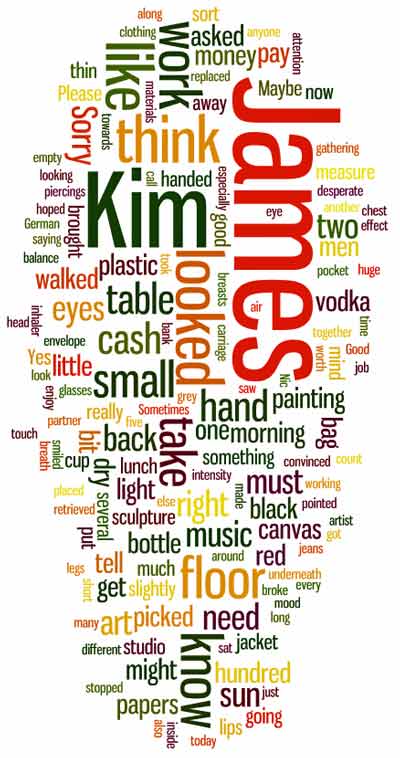
Wordle Chapter Three
A Wordle for Chapter Three of The Angel

A fellow student on an online course I did last year with Lancaster University (and now a Facebook friend) introduced me to Wordle. This is a bit of Java code that runs on websites (doesn’t seem to work with Firefox but works for me on IE) in which you paste in a load of text and it counts the frequency of words and then redisplays the individual words in a random order with the most frequently used words having the largest font size. They can come out very artistically and there are options on the site to play around with colours and formats.

I produced the above Wordle from the 2,550 words of my Chapter Three reading.

The most commonly used words like ‘a’, ‘the’ and contractions like ‘nt’ are removed by default. Sadly my extract seems to fail the literary fiction test as most of the words are pretty common — ‘looked’, ‘cash’, ‘think’, ‘hand’, ‘floor’. It allows analysis of the most frequently used words and the two that stand out for me are ‘sorry’ and ‘work’ — even though I edited a few of these out while redrafting there are a lot left. I think ‘sorry’ is perhaps good as it emphasises their awkwardness in initially meeting. ‘Work’ is understandable in two ways. I think the word must be currently something pre-occupying my subconscious and it’s coming through in both the plot and the character’s diction — James has obviously been fired but there’s a lot of reference to creating art as being Kim’s work. I’m perhaps reflecting on my own view of the novel writing process in this too?

I put the text of the first two chapters as well into Wordle so it had about 10,000+ words to work with. The graphic below is what resulted: rather sadly most of the words would be appropriate for a reading age of about seven years old– ‘might’, ‘something’, ‘table’, ‘street’, ‘time’ and so on. There are a few that set the location and characters: ‘paint’, ‘Shoreditch’, ‘carriage’, ‘London’, ‘vodka’. The very few there that seem to be interesting are ‘shoes’, ‘metal, the frequency of ‘looked’  and, perhaps my trademark word, ‘hand’. Fortunately ‘sorry’ doesn’t seem to recur too much in the opening two chapters.

I’d be fascinated to see the Wordles that could be generated by the work of others on the course — would they also be so full of ordinary words?

Wordle Chapters One to Three
The Angel: Wordle Chapters One to Three

The less frequent words might be difficult to make out on the web graphics. Wordle can be used free by anyone for any purpose but it is subject to the creative commons licence which means that any representation of a Wordle must also credit the original website — which is http://www.wordle.net/.

Revising Chapter Three

I’ve spent quite considerable time over the past week revising the chapter three that I read at last Monday’s workshop. As previously I’ve had lots of really useful comments written on my manuscripts by the other students. It’s also quite difficult and time-consuming to keep track of the changes marked in a dozen or so annotated scripts but I’ve been careful to go through all of the comments, note the parts where there’s obvious consensus and weigh up the different perspectives.

It’s quite difficult as people have different preferences and in more than one place I’ve had someone cross out a sentence that has been ticked or praised by another person. It’s the fourth time I’ve had the feedback now and I’m coming to know various people’s preferences, which unsurprisingly tend to mirror their own writing style (lean and taut in some cases, lyrical and colourful in others, empathetic and intense and so on). Having had a few days to mull it over, I’ve probably found the harshest feedback the most useful. I eliminated about 100 words out of the original 2,600 mainly by deleting adverbs and unnecessary bits of speech, such as ‘not really’. Some of the mistakes that I had in the extract are pretty obvious errors in retrospect. My thirteen year old daughter saw Rick’s corrections and told me off about ‘stared briefly’ as well — ‘you can’t stare briefly’.

I also managed to restructure some of the more troublesome sentences with some help from people’s suggestions. For example, this long sentence now reads better than previously, although I’m still not sure if I have it completely right: ‘As she breathed, her chest pushed forward and the outline of her breasts stretched the previously slack material, jolting James a little as he realised that hidden underneath her sexless clothing was a distinctly female form.’ (I’ve just revised it yet again while posting it here.) This was the passage was that caused the previously-mentioned controversy about James — whether he was outrageously judgemental about Kim’s appearance or just ‘doing what men do’.

While I’ve pruned it quite a bit I’ve also added in about 50 extra words to address other concerns. One was about emphasising the Kim’s German background. I’ve replaced one of James’ slightly lame phrases of approbation with ‘Wunderbar’ (actually the name of a Cadbury’s chocolate bar on sale in Germany). I also had Kim respond to James’ declaration of passion for food’s favours and textures by her saying that it didn’t really apply to German food — all sauerkraut and currywurst. (I’m quite an expert on the sort of food Germans eat, having had countless meals in the works canteen of a DAX-30 listed company and eaten in restaurants all over Germany as well as eaten plenty of beer-soaking-up food in Biergartens and Weinachtmarkts.)

One question I have that I’d be interested in having answered is whether if you’re writing a German noun in an English piece of writing whether you retain the initial capital letter — as in Biergarten.

While revising Chapter Three, I went back to Chapter Two of ‘The Angel just to check for continuity and it’s a good job that I did. Alison marked this over the Easter holidays and perhaps it’s no wonder she commented that the payment of the money for the painting was too long and drawn out in  Chapter Three: it had already happened in the Chapter Two that she’d read. She must have had at least a sense of deja vu.

Alison and a couple of other people also wanted Kim a little more agitated and stressed. I’m not sure if I’ve achieved that but I wanted to try and give James the effect of disarming other people — being quite good at putting people at their ease, mainly through his ability to not worry too much when he’s making a prick of himself. (I have an inspiration for this in mind — a famous TV presenter whose Tweets I follow and with whom I occasionally converse myself via Twitter.) I’m not sure about whether I’ve tightened up the pace a lot. This was something Alison commented on after hearing it read aloud but others had said it had gone quickly when read somewhere like a plane (good sign perhaps?).

I had quite a strange attitude to workshopping this piece. It was a piece I hoped I’d write past and so have something more filled with action to present to the group. When people were critical of certain aspects I was a bit non-plussed but I’d not had particularly high expectations for it. Perhaps I was hoping to ‘wing it’ a bit and hope that this part didn’t get scrutinised too hard — but found I was being picked up on things I’d tried to avoid thinking about, which was quite uncomfortable but necessary. In the end, I think I’ve got a pretty decent 2,500 now — quite a lot better than before the workshop and something that will better stand on its own rather than be a bit of a dump for setting up plot elements.

I’ve found it pretty difficult to get started again after this — partly events over the Bank Holiday (potatoes crying out to be planted) and the election is an incredible distraction. I’ve been staying up too late after debates and on other nights to take in all the coverage — good research for Burying Bad News, though.