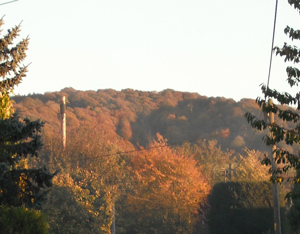
Nice Photos of Autumn Colour in the Chilterns

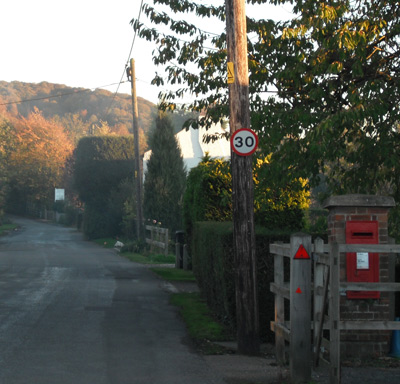
Autumn in the Chilterns

This is where Kim will pitch up, having had a pretty grey time in London. Will she like it? (If she does, she probably won’t be quite prepared for how bleak it gets in the winter.)

And what could be more rurally English than an old post box (and a speed limit sign)?

Rustic Autumnal Post Box

Cardboard Megaliths

Those from the City course who’ve carried on with the monthly workshopping read an extract of mine in the last session where James is struggling to build an IKEA wardrobe.

The piece is intended to cast light on the state of James and Emma’s relationship — both by using the wardrobe as metaphor and also flashing back to his recollections of their trip to the Milton Keynes branch (the new city being somewhere that Emma instinctively detests as she doesn’t like its appropriate of the Celtic mysticism that she has a great interest in herself.)

IKEA also reflects James’s fairly half-hearted attempt at fiscal belt-tightening — he tried to persuade Emma to buy a wardrobe that was a cheap piece of MDF crap but instead they settle for something fairly decent made out of solid wood (that nearly kills him to lug upstairs) — but it’s still not the Heal’s wardrobe she really wanted (see post below — ‘A Solid Piece of Research‘).

I did a bit of quick research in Milton Keynes IKEA after I visited the nearby Open University a few weeks ago but this week I had cause to go there again for the purposes of actually thinking about buying some of their furniture.

IKEA Milton Keynes
Inside IKEA Milton Keynes

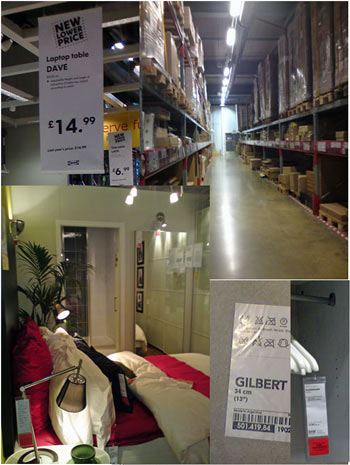
I took a few photos on the way round. Here’s a montage of a few — showing the curious juxtaposition of the nicely-staged rooms upstairs compared to the functional warehouses where you have to get the flat-pack stuff.

The bizarre names of IKEA furniture are staple jokes — see Dave the Laptop Table and Gilbert the furry brown placemat above.

IKEA Kolon
Who Says IKEA products Are Crap?

However, I noticed a floor protector thing with one of the most bizarre names. As it’s a medical term I think the word spelled with a ‘c’ must be the same in Swedish.

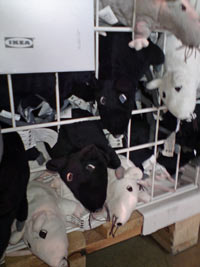
IKEA's Rats
The Welcoming Rats

I also thought it quite surreal that customers were greeted on entering the showroom with a crateful of furry-rats.

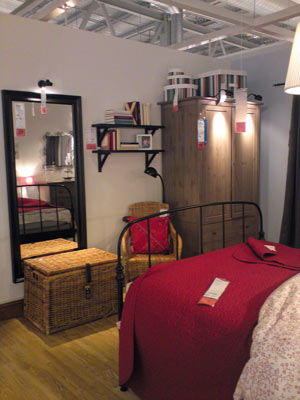
I had another opportunity to inspect the wardrobe that I had in mind for James to build for Emma. In the novel it’s not exactly like this one — I think it may have its drawers inside the doors — but it’s fairly similar.

Emma's Wardrobe
Emma's Wardrobe

It’s pictured here in a trendy looking bedroom that Emma may not even have turned up her nose at.

In the end, I had my own cardboard megalith experience as the furniture that I wanted to buy (including two wardrobes as luck would have it) was in such huge cardboard packages that they wouldn’t have fitted in the car.

In fact, probably they were so heavy (two boxes weighing about 50kg for each wardrobe) that perhaps the easiest way to have got them home might have been to put them on rafts and float them down the Grand Union Canal — in the same way as Stonehenge’s builders transported their rectangular megaliths all the way from Wales?

(And perhaps it might make Emma feel better to know that I bumped into the Minister for Europe’s wife in the IKEA café and said hello — if it’s good enough for ministers of state? Or maybe they’re being mindful of expenses?)

Lip Service

A fascinating aspect of reading fiction is that, sometimes despite the best efforts of the author, every reader must have a different mental image of each character — most likely a synthesis of their own experience and from triggers picked up from the text. Most ‘best-practice’ writing advice tends to suggest the author should leave as much detail to the reader’s imagination as possible — only providing concrete descriptions that are vital to quickly establish character or to provide information necessary to the plot.

When a novel is adapted for film or television this often leads to disappointment for readers of the original novel — an actor or actress may be physically dissimilar to how they imagined a character or, perhaps worse, behaves in an entirely different way. I read something recently in the Radio Times complaining about Stephen Tompkinson not being at all like the writer had imagined Peter Robinson’s Inspector Banks in ‘Aftermath’.

Stephen Tompkinson as Peter Robinson's DCI Banks

(Parts of the second episode of which were filmed on the moors very near where I grew up. Look at those intimidating pylons on the picture on the left. They loomed over me every day. ).

The converse of the reader’s mental image is that a writer must also have a picture of a character in mind when writing fiction. Again this must be a mixture of experience and imagination that rarely transfers directly into a reader’s imagination, although, like screenwriters, if a novelist is writing a series of books that has been featured on film or television then they may start writing for a specific actor. I seem to remember Colin Dexter saying this about John Thaw as Inspector Morse.

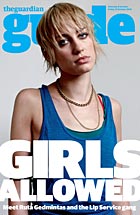
Occasionally, however, writers must have the image of a character in mind and see some sort of very close likeness in the visual representation of a person — a photograph or picture or something on film or television. I recently had that sort of revelation in connection with the new BBC3 drama series, ‘Lip Service‘. It was the publicity photos for the series on the front of, I think, the Guardian’s Saturday Review section that made me take notice: the actress Ruta Gedmintas, pictured as her character Frankie in the series is a very close fit for how I see my character Kim — at least Kim at the start of the novel.

It’s partly the urban-arty clothing (Frankie’s meant to be a photographer) and her gaunt physical appearance — and she has short-ish blonde hair and a nose piercing, even green eyes. I don’t know whether Frankie is meant to portray a particular lesbian style of dressing. Kim in my novel isn’t gay (I think Frankie is actually meant to be bisexual) but Kim certainly comes from a arty-edgy culture in Shoreditch and Hackney where she will mix with and be influenced by a lot of gay people.  (And similarly in my writing experience I have and have had plenty of contact with gay writers and have workshopped gay fiction.)

Ruta Gedmintas as Frankie on the cover of Guardian Guide 9th Oct (Linked to Guardian Website)
Ruta Gedmintas as Frankie on the cover of Guardian Guide 9th Oct

Frankie is, of course, different to Kim in many ways but, the character, as played by Ruta Gedmintas, captures a startlingly arresting attitude. She has a very interesting, expressive face that varies between a the kind of ‘fuck you’ arrogance of an urban artist and a very genuine smile that shows flashes of concealed vulnerability — two contrasting character facets I’m trying to work on bringing out with Kim. Ruta Gedmintas is probably prettier than I imagine Kim to be but that may be because in my novel, Kim deliberately makes herself look confrontational to start with but she will have the sort of understated beauty that becomes increasingly attractive to James.

I was a bit intrigued by having stumbled over such an uncanny resemblance to a character I’ve had living in my head for around a year. I found from a couple of interviews online that Ruta Gedmintas comes from a Lithuanian family (hence the unusual name) — so perhaps her appearance has an Eastern European aspect, which may have made me think of German Kim — but the actress was brought up in Buckinghamshire which, co-incidentally, is where the bulk of my novel is set — in the Chilterns. (This, perhaps, explains why Frankie curiously speaks with an accent that’s pure Home Counties — or maybe her lack of the Scots brogue might be explained in later episodes with further revelations from her mysterious past?)

In the imaginary sequence of events whereby my published novel gets adapted for film or TV and then (possibly the most unlikely of this chain of possibilities) the original novel writer got asked for opinions on who should play the female lead then I think I’ve now found a perfect recommendation — so long as she can do a Hochdeutsch accent.

‘Lip Service’ has attracted controversy as it’s a series about the lives of lesbians in Glasgow. Apparently it’s the first British-made series specifically about gay women (as opposed to men) and the programme makers have to address a dilemma in that they want, on the one hand, to portray the women’s lives as being as ‘normal’ as possible (i.e. not contingent on their sexuality). But on the other hand if they’ve created a unique platform for the portrayal of intimate scenes between gay women characters then obviously they feel it’s something that they ought not to shy away from using — and, in my opinion, this is achieved very successfully — frankly (or, perhaps I should say, Frankily) but not salaciously.

I’ve watched the first couple of episodes and it strikes me as it’s quite like a gritty Glaswegian ‘Cold Feet’ with added sex (sex is something I always thought ‘Cold Feet’ could have explored more) — a comparison I mean as a compliment as I liked ‘Cold Feet’, especially the first few series — and it had some great actors in it. Like ‘Lip Service’, ‘Cold Feet’ also uses music effectively — and quite a lot of my writing throws in references to music (the latest extract I workshopped mentioned ‘Stop Me If You’ve Heard This One Before’ by The Smiths and ‘Big Love’ by Fleetwood Mac — the latter in a slyly filthy context).

I’m interested in that ‘Cold Feet’ genre — tangled relationships between people who are starting to deal with the responsibilities of adulthood — and think that my writing is probably pitched at the same kind of audience. The success of David Nicholls’ ‘One Day’ that I read recently and learned quite a lot from (Nicholls wrote some of the scripts for ‘Cold Feet’). The book gets fervent reviews  on Amazon from the many people who say it’s their favourite ever demonstrates that this is also a commercial genre. I have to say too that David Nicholls is a nice chap as he replied very quickly and politely to an e-mail I sent him about the clever playlist feature he did have on the book’s website — which now seems to have disappeared unfortunately in favour of some of the book’s film adaptation promo material.

Character Names

It always seems to me to be more difficult to think of names for my characters than virtually any other of their attributes. If you look online for any inspiration there are a large number of baby naming websites which handle Christian names and a few that give historic frequencies of names given at birth.

However, I’d not come across much in the way of surnames until I did a Google search and came up with a brilliant site which is apparently part of a website for women called So Feminine. http://surname.sofeminine.co.uk/w/surnames/uk.html

Why it’s located there among articles about fashion and understanding your man, I can’t really explain. However it allows searching for individual surnames and gives an approximate breakdown for most surnames of geographical distribution around the country — I found that my surname is the most popular in Oxfordshire. (Odd as I thought it was most common in Nottinghamshire, although it’s not the overall accuracy that I’m interested in here as much as just a list of names.)

There are also lists of the most popular surnames — 8,500 of them in order should you wish to plough through them all. http://surname.sofeminine.co.uk/w/surnames/most-common-surnames-in-great-britain.html

While naming characters can offer possibilities of investment with some sort of allusion and meaning, this list perhaps throws up a few random bit of inspiration?

Strictly No Sex Please in the British Literary Novel?

After the Facebook campaign that led Tony Blair’s ‘A Journey’ to be involuntarily moved within bookshops to the war or crime sections, there’s much excitement that a passage from the book has been urged for short-listing in the Literary Review’s ‘Bad Sex Awards’.  (Technically it isn’t eligible as it’s not fiction, but the organisers may alter the rules to include it.)

This was mentioned in an article by Susanna Rustin in The Guardian’s book section yesterday in which she advanced the argument (and also voiced some opposing views) that the modern British novel now shies away from anything like explicit descriptions of sex. This probably applies to a certain more literary strata of novels as the article cited the Man Booker Shortlist — there’s plenty of racy action still to be found in other genres of novel, as I found when skimming through a Freya North sort-of-chick-lit book recently.

Andrew Motion was quoted, apparently semi-facetiously, as saying that perhaps authors were scared of being nominated for the Bad Sex Award and the Literary Review’s entry on Wikipedia lists many previous winners as stars of the literary firmament: Sebastian Faulks, Tom Wolfe, Norman Mailer — and John Updike got a lifetime achievement award.

I wonder if all the people who would wish Tony Blair to join this company realise that the Bad Sex Award was invented by Auberon Waugh — whose conservative views were so detested by Polly Toynbee that she wrote a hostile article about Waugh three days after his death. (I would guess Waugh would also have detested the Blair government but for different reasons than most critics of ‘A Journey’.)

The article also had a very interesting Martin Amis quotation which, perhaps, sums up why many people (like me) find his technical ability to be sometimes quite spellbinding but are unmoved, or even repelled in some way, by the tone and attitude of his novels. He’s reported as saying at a literary festival ‘it’s “impossible” for a novelist to write about real, as opposed to pornographic, sex anyway. “Sex is irreducibly personal, therefore not universal,”‘ [he added later]'”It’s not that surprising. Of all human activities this is the one that peoples the world. With that tonnage of emotion on it, if there is going to be one thing you can’t write about then that would be it.’

I can see his argument — that he can write about sex in an ironically, pseudo-pornographic way because the formulaic narrative of most porn is something that is widely, perhaps not universally, recognised. But that seems to suggest a specific intent for a novel — that it exists to provide an ironic, maybe subversive, commentary on society’s mores or literature and other art forms themselves.

I think that’s a valid purpose for a novel, at least in part, but it appears to ignore one of the key differentiators about fiction as opposed to many other art forms. A novel is an entirely personal dialogue between an author and reader. It’s unlike more social forms of storytelling, like plays, films and television — which also provide visual and auditory representations. The personal nature of this dialogue also makes me query whether a public reading of a part of a novel can ever properly represent private, individual readings of a novel — apart from being influenced by irrelevancies like the reader’s public speaking skills, the audience reaction will influence one’s perception of the words and, unlike the private reading experience, one can’t pause to reflect, re-read a sentence and so on.

It seems the form’s ability to connect directly at a one-to-one level gives a novel’s author a unique opportunity to explore the personal rather than the universal. A novel can give its characters experiences that are beyond the knowledge of most, if not all, readers but by building connections between the personal and universal can create understanding and empathy for the most extraordinary characters and scenarios.

Therefore, because emotional experience is often the most personal and, often, least rational of human nature, I would think this is where the novel can explore in a way that is more intense and more insightful than other narrative forms. And there’s nothing that illuminates characters’  most inner emotions than their sexual motivations, attractions and behaviour.

The Guardian article suggests that it might not be the sniggering-behind-the-bike-sheds tone of the Bad Sex Award that’s preventing the literary authors from writing about sexual relationships but because it’s actually very hard to do. ‘But plenty of authors share the view that writing about sex is difficult, and presents particular challenges – and that sex that might be described as ordinary, or even enjoyable, is hardest of all.’  Hilary Mantel says ‘In good sex the individual personality kind of gets lost, people transcend themselves in a way. In bad sex people become hyper-aware of their bodies, the isolation of their bodies, of shame and humiliation.’

Of course, everything depends on the context but, if there’s a traditional ‘romantic’ narrative where two characters are attracted to each other and have a good and satisfying sexual experience I’d argue it’s as necessary to show this (principally as character development) as it would be to describe some sterile or comical failure — although the latter has more potential for dramatic conflict.

On how graphic a writer wants to make their depiction of sex, I think that all depends on the situation, the characters, the tone of the book (is it inclined towards metaphor and imagery), narrative viewpoint  (how would he/she/they/it view the scene?). I’m reminded of Graeme A. Thomson’s interpretation of Kate Bush’s ‘Running Up That Hill’ (see previous post) for how a male and female point-of-view might retell the same sexual experience.

In many cases novels probably work well enough to take the Hilary Mantel and Andrew Motion view that readers can do a bit of work and use their imagination — using hints and implications and ‘closing the bedroom door’. However, if interpreted as writing advice, it seems something of a cop-out. There’s a whole range of behaviour that can only be witnessed, by definition, behind the privacy of the bedroom door — characters may act in a completely different, surprising and uninhibited way. This might not always be relevant to the later narrative but it could be — many an otherwise odd coupling might be held together by what goes on in the bedroom and, conversely, it might doom ostensibly compatible pairings.

The biggest argument against writing explictly about sex is perhaps the range of language available. Colm Toibin is quoted in the article as saying: ‘If you give in to any simile, any metaphor, any set of feelings, any flowery language, the modern reader’s irony will come to the fore.’  So if similes and metaphors are out and you also exclude the sort of vocabulary that would remind you of a doctor’s surgery, you’re left with not many words left — and if you avoid the Anglo-Saxon then there’s even less.

Toibin praises Ian McEwan’s ‘On Chesil Beach’ as the ‘perfect example. “There isn’t one single piece of language that describes anything other than what occurred.”‘ However, I know from discussing this book personally that it’s exactly that clinical tone to the prose that has made some readers detest that final section of the book — as it’s a story of sexual failure and miscommunication perhaps the language is appropriate but it’s not, in Hilary Mantel’s words, about people ‘transcending themselves’.

Oddly enough, while literary authors are (if you accept this article’s argument) backing away from the representation of sex and some concluding it’s perhaps impossible to do properly, BBC1 is now presenting an hour and a half of some of the most sexualised entertainment for Saturday tea-time viewing.

While the likes of Anne Widdecombe and Paul Daniels are about as asexual as one can imagine, some of the more accomplished dance partnerships move in a way that might cause some of the literary novelists to shy away — ‘he put his hand on her what?’ and so on. I’m no expert of the various dances but clearly many have highly eroticised Latin roots. Many of these dances, with their close physical contact and outfits that are more bare skin than material, are actually transcendent representations of people having the sort of good, enjoyable sex (with hints occasionally of some less wholesome variations) that Mantel and Motion believe is difficult for the novelist to represent.

I know a number of writers who enjoy dancing — either something like Tango or other types as well as getting into ‘Strictly’ — so I think there’s something quite deep-seated in this between dancing and uninhibited self-expression.  It’s also interesting that so few professionals on ‘Strictly Come Dancing’ are British (less than a third, I think, with the rest being Italian, Australian, Russian, American and Eastern European’) — perhaps the Guardian article’s concerns are very specific to the British novelist — it does seem that one might learn more about genuine sexual attraction by watching Bruce Forsyth’s programme than reading the Man Booker shortlist.

Photos

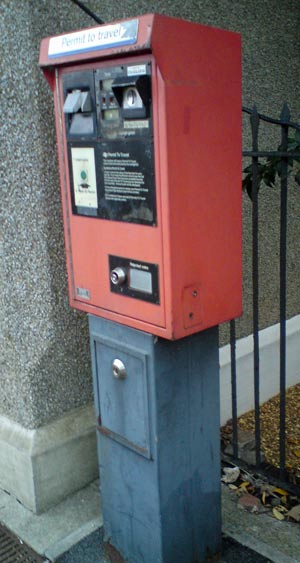
Here’s a couple of photos of places that I’ve mentioned recently in the blog and happened to have gone to in the meantime. Firstly, here’s my very own photo of the world’s most famous Permit to Travel machine at Little Kimble station. Unlike the Metro and Daily Mail’s photos it doesn’t feature a few cute edible dormice poking out but that’s where they were.

Permit to Travel Machine at Little Kimble Station

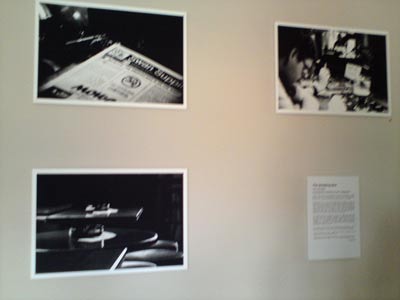
The other is of the art gallery in the Belle Vue pub in High Wycombe. The resolution is a bit poor but I think I may have written the article that’s featured in the photo on the top left. (The current whole photographic exhibition is a before and after of 2007’s smoking ban and the article was some comment on that subject.)

Art Gallery at the Belle Vue, High Wycombe

Poetry Reading Today

Don’t forget, anyone who happens to be near High Wycombe this lunchtime, that I’m going to be reading six poems (of my own) at the Metroland Poets reading at the Oak Room in the Swan Theatre at 1pm. Free entry too — what a bargain.

http://www.wooburn.com/Web/lunchtimeP2.htm

Then I shall dissipate the after-performance stress with a poetry installation tour of the hostelries of Wycombe with my friend Jon — all in the name of research for my pub-based novel, of course.

Why The Permit To Travel Machine Was Dead As A Dormouse

…because it was inhabited by a family of them.

The Metro today plus the Daily Mirror and Daily Mail have a story featuring Little Kimble station, which I can see across the fields out of our back windows. A family of rare edible dormice, also know as Glis Glis, have been inhabiting the permit to travel machine. The ticket collector discovered them when investigating why the machine was frequently out of order. They are a rare and protected species and tend only to be found in this area of the Chilterns. They have been rehoused in St. Tiggywinkle’s animal hospital a few miles away in Haddenham, also famous for rehabilitating injured red kites.

Here are the links to the stories. There are some nice pictures of the mice.

http://www.metro.co.uk/weird/843266-nesting-dormice-to-blame-for-broken-ticket-machine

http://www.dailymail.co.uk/news/article-1318403/Rare-dormice-make-nest-ticket-machine-Little-Kimble-railway-station.html

Little Kimble Station in the Snow in January 2010

I often use the permit to travel machine as Little Kimble station is far too small to have a proper ticket machine, let alone a ticket office. It’s taken quite a lot of my 5p coins when I’ve travelled into London recently, although the mice have left it out of order on many occasions.

We have mice all over the place here — they invade the garage in winter and once polished off an entire Christmas pudding I was maturing and are always running around in the garden. I’ll need to take a look to see if they’re the edible variety.

It’s quite interesting to hear a quirky tale of rural life as last night I made a visit to Dibley — more accurately The Bull and Butcher in Turville, which is the location where ‘The Vicar of Dibley’ was filmed, as well as countless other TV series and films (like Midsomer Murders). The pub is a lovely old village local with a massive fireplace and even a well inside one of the rooms (it goes down about thirty feet so it’s fortunate it’s covered over with glass).

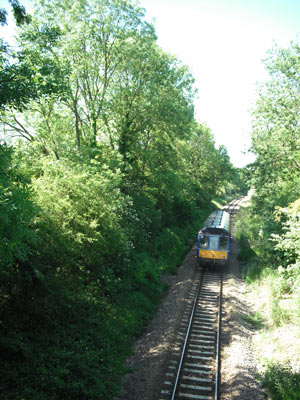
'Daisy' Shortly After Leaving Little Kimble

Maybe the mice can burrow their way into The Angel? Anyway, it’s a Good excuse for not having a ticket — ‘Sorry but it was illegal for me to disturb the dormice’.

Solid Piece of Research

I’m currently in a state of limbo, having sent out my extract for the first extra-curricular workshopping session with my now ex-City University coursemates. We meet up on Saturday and we’ll now be reading each others’ pieces.

Mine starts with Emma’s sadness that James has persuaded her out of buying the wardrobe for the spare room that she really wanted and has persuaded her to go to IKEA instead.

I’d looked up a designer wardrobe suitably grand enough for Emma on the web on the Heal’s website and, in the interests of accurate research, I happened to be walking past their Tottenham Court Road store this afternoon so popped in to do some physical research. It seems they don’t have their most expensive ranges on display — they just have them on the web. But I found that the ordinary ones that were in the shop were pricey enough.

Heal's Wardrobe Price Tag

My photo is pretty indistinct but a 20% discount on one model still makes it £1,595.

A Heal's Bedroom
A Heal's Bedroom

There’s a mock up of a whole bedroom that might be to Emma’s taste. I dread to think what it would all cost —  with the four poster, armchair and large Christmas baubles hanging over the bed.

Spooked at City University

I was watching Spooks last night and jumped up off the sofa, not at any cliff-hanging drama, but because the terrorist from ‘Azakstan’ who was after a deadly nerve agent that could kill everyone in London in a week, was walking up the stairs at the entrance of City University in Northampton Square. He wandered off down the long corridor towards the small snack bar in the direction of the lecture room in the Drysdale Building we used with Emily in the spring term!

Then the Section D cavalry charged in after him and the action had transferred to the Tait building where I’d had my Intermediate Fiction class with Heidi James in summer 2009. A shootout then followed around the long corridors that we had to walk around to find the toilets when we turned up on alternate Saturdays between January and March this year for our workshops with Alison. In fact, in one scene Sophia Myles looks like she’s about to burst through the door of the gents, which would have been interesting. The bad guy eventually finds the scientist he’s looking for in the actual room where we had our tutorials — or at least an identical one on a lower floor!

City University provided a good 5 or 10 minutes of locations for the programme, including a number of sinister looking stairwells and fire escapes (that are normally used to access the library!). In the end the suspect climbs out on to the university roof.  It was quite a novel experience to see such familiar surroundings used in a plot that involved Russians, chemical weapons, separatists and as much else as is normally crammed in. It can be seen on the iPlayer for the time being. The City University locations appear at just over 22 minutes in.

It underlines the point in an earlier post that fast-paced editing can make almost any location appear intriguing or exciting.

I thought the episode used a few devices which were the wrong side of implausible. The power of the resident computer geek to rescue the plot from impractical dead-ends and to keep it speeding along has often been pretty unbelievable but a separatist from a ex-Soviet state got off a Eurostar unnoticed (of course French intelligence were far too slow off the mark) and all Tariq needed to do find him in central London was to run some sort of ‘probabilty algorithm’ and then some face-recognition software against hundreds of live CCTV cameras to locate him within a few seconds.

This begs the question that if it’s so easy to identify and locate the bad guys then why do they keep popping up and threatening world civilisation in episode after episode — surely they could run a few algorithms and feed a few intelligence photos into their face recognition software and they’d be able to pick them all of the streets at will?

I doubt whether there’s enough computing power in the world to carry out the identification that tracked down the suspect immediately to Charing Cross tube station — which apparently has 6 platforms. I thought this was an error because it only two lines serve the station (Bakerloo and Northern) but I forgot about the disused Jubilee Line that terminated there until the extension was routed via Westminster in 2000. However, seeing as they’re closed off from the public (and you’d guess from Azakstani terrorists too) then it seems likely that this line in the script was probably just thrown in from a tube reference book without much thought.

According to Wikipedia these very platforms are likely to have been the ones used in this episode for filming the tube train scenes (quite handy as they wouldn’t have even needed to alter the signs!).

Belle Viewing

In another example of truth following what I’ve written as fiction, I’ve discovered via our excellent local Campaign for Real Ale magazine, Swan Supping, that an art gallery has opened in a pub in the local area.

It’s not a twee country pub either but the Belle Vue, which is right next to the London bound platform exit at High Wycombe train station and overlooks the railway lines.  It’s a friendly place with good real ale.

The art gallery was set up by Alan Hedgecock, who has run the pub himself, but is also a photographic artist. The first exhibition is of Alan’s photographs and is called ‘Smoking Ban’ as the photos were taken at the time the ban was introduced in 2007.  The gallery will be made available to other local artists for exhibitions of up to 8 weeks.

To underline the importance of pubs in a community, the Belle Vue also runs a monthly book club, a knitting circle (!) and will soon start a film club.

So my premise of having a pub run by an artist and using some of its space to show her work is not only plausible, it’s happening in High Wycombe — although I must add for posterity that I’ve been writing my fictional version of this for the past nine months. (I have been to the pub at least a couple of times in the intervening time, though.) The art gallery idea actually came from a piece of feedback from a City coursemate who assumed that was what Kim would do.

On a more worrying note, I found that a remote pub in an idyllic location in the Chilterns (in fact very close to my fictional village where The Angel will be) closed over the summer and is now up for rent as a 4-bed private house at £3,000 a month. It was the Rising Sun (now set forever) in Little Hampden,

The Sun Has Set on the Rising Sun, Little Hampden

quite close to the spot where I fell over running in the woods last weekend and limped down to wait for help outside Chequers with my hands and knees covered in blood. This is the fate that may befall the Angel if James and Kim fail.

At the pub quiz in my local last night I was shocked to find out that the traditional firework display that the pub has laid on for going on for the last 20 years will not happen this year — here are a couple of pictures from the 2006 display.

November Fireworks at the Village Pub
November Fireworks at the Village Pub That May Be Seen No More

It’s always been a superb firework display for a pub and has been funded by in part by a quiz, a small donation from the parish council and a few quid chucked in a bucket on the day. However, with over £1,000 of fireworks the pub made by far the lion’s share of the contribution. With the current economic situation and the prospect of the VAT rise putting up the price of beer by another 10p a pint then I can’t really blame the landlord. The pub has always been busy on bonfire night but one hour of the bar being packed out won’t make the profit required and many people stand outside to watch without even buying a drink. To be generous to them perhaps they think it’s all laid on by the council or something.

The event used to last longer with a big bonfire on the village green but that had to be discontinued due to ‘health and safety’ — more specifically some parents were letting their children play unsupervised too close to the fire and the organisers thought they were on a hiding to nothing — either be sued after an accident or face the minefield of supervising other people’s children. They could no doubt have put a big fence round the fire but that’s all extra expense for the pub — and, frankly, why they should they.

More Village Pub Fireworks

One of my fondest childhood memories is of standing round a huge bonfire in November but this seems to be another dying tradition — but I will try and revive it at The Angel.

Dein and Ihr Confusion

I had an e-mail from my ex-manager in Germany today. I sent him the first few chapters of ‘The Angel’ to read and he’s told me that he took them on holiday and he really enjoyed them. He’s a pretty fluent English speaker and, as is quite common now in Europe, the artefacts that he largely works with (meetings, presentations, documents) are all in English but there’s still a lot of German spoken between colleagues. The language often marks the boundary between work and social interaction, formality and informality.

So that’s really encouraging — a native German speaking endorsement of the start of the novel — so Kim must be plausible.

He’s also helped me with a bit of German translation. The bit of German at the end of the ‘Linguaphone’ posting wasn’t exactly wrong but it was confusing as it changed the familiarity of the ‘you’ mid-sentence — so it should be ‘Ihr Englisch ist sehr flüssig, aber Sie sprechen’ or ‘Dein Englisch ist sehr flüssig, aber du sprecht’. And I’ve been given a choice of two phrases for another line: ‘”Kommen Sie aus Deutschland?” or may be better just “Entschuldigung, sprechen Sie deutsch?”‘

Course Junkie

Not satisfied with having recently finished the City University Certificate in Novel Writing while also doing the dissertation of an MSc in Software Development at the Open University, I’ve now taken the plunge and started an MA in Creative Writing. This is with Manchester Metropolitan University (MMU), although I’m doing the online route which can be done entirely remotely (they do offer some campus based activities and priority on their courses in association with the Arvon Foundation but they’re not compulsory). Due to my personal circumstances I can’t commit to physically travel to any particular place over the next year, let alone the two years a campus based MA would involve (the online route is three years).

Also, having travelled into central London two nights a week (or the weekend equivalent) for the City course during the last academic year, I think I pushed past the limits (in various senses) of physical course attendance, so won’t do more, at least for the time being. However, I will be meeting with most of the City cohort every month in London to continue workshopping — so that will mean some welcome human face-to-face interaction in addition to being a virtual student — and also, hopefully, a few sessions in the pub afterwards.

Ideally I might have taken more time out between courses but various doom-laden predictions of the axe currently being taken to higher and further education put a doubt in my mind about whether there would be the same level of choice of course available this time next year. I read a headline in the Times Education Supplement that a third of further education jobs would be cut. (Of course, this has the knock-on effect of reducing the usefulness of an MA in Creative Writing as one of its benefits over and above courses like the City Certificate and Arvon-style courses is that it increases one’s employability in the academic sector — something that would be figuratively academic were there a lot of unemployed creative writing teachers.)

There are a few online courses available but I liked the description of the MMU course as, for two terms a year, it employs as a teaching method a virtual chat room teaching method at set times with a tutorial led by a tutor. I was interested to see how this would work and, last Monday, I found out.

For the first term we look at examples of other novels, starting with ‘Old School’ by Tobias Woolff. This book is so well written that it has thoroughly depressed me, especially when at the same time as reading it I’ve been trying to revise some of my own first draft material, which seems so pedestrian and uninspired by comparison. However, it’s a very concise book (under 200 pages) and I suspect that Woolff’s superb prose was assisted by countless revisions and re-draftings.

The online tutorial seemed to work really well. It was led by Dr Jenny Mayhew, who’s the tutor of this module. The novel ‘route’ of the MA appears to be fully subscribed — with 12 students. (The selection process for the course was quite rigorous — with references required, a submission of both critical and creative work and an interview.) I was pleased to see a couple of students are based near me — in Berkhamsted and Hemel Hempstead — ironically places that I drove past on the way to Finsbury for the City course. There are people based in Spain and the Czech republic as well as elsewhere in the country. I’ve picked up a new blog reader already — Anne who’s from Denmark but lives in the UK and writes flawless English as far as I can tell. (I’ve already told her about having a fluent European ex-pat as a character in my novel.)

As well as criticism of a novel each week, we are expected to do a creative writing task inspired by the text — and I’ve got until Sunday to do one. I was pleased to discover this aspect as I enjoy writing exercises.

So now I can add Manchester Writing School (comprising the MMU department and its associated activities) to the lengthening list of universities where I’ve done creative writing — Open University, City and Lancaster. In case it appears that I’ll just end up with a bunch of certificates rather than a novel at the end of all this, the Manchester novel route carries something of a big stick that appeals in a masochistic way– you don’t pass until you’ve finished the bloody thing.