Jonathan Franzen’s new novel ‘Freedom’ has been causing a stir among reviewers — one Guardian Books blogger is already calling it the novel of the century.
Time magazine a couple of weeks ago gave Franzen the honour of being on its cover — something achieved by very few authors and was the magazine’s gesture towards placing him in the canon of ‘The Great American Novelists’.
The accompanying article was, compared to most of these profile pieces, long and thoughtful and had some comment on where novel writing might be heading in the future:
‘Early readers of Freedom, including this one, have found that the book has an addictive quality, the kind one usually associates with mysteries or thrillers. This isn’t by accident. Franzen is very conscious that people are freer than ever — that word again — to spend their time and attention being entertained by things that aren’t books. That awareness has changed the way he writes.’
Franzen, suggests the profile’s author, Levi Grossman, argues that this need to work to engage harder with the reader by implication means that to avoid becoming an obsolete and arcane art form the novel needs to avoid intellectual novelty-seeking and boundary stretching. Perhaps the self-indulgent aspect of literary fiction might finally be exhausted:
‘A lot of literary fiction strikes a bargain with the reader: you suck up a certain amount of difficulty, of resistance and interpretive work and even boredom, and then you get the payoff. This arrangement, which feels necessary and permanent to us, is primarily a creation of the 20th century. Freedom works on something more akin to a 19th century model, like Dickens or Tolstoy: characters you care about, a story that hooks you. Franzen has given up trying to impress with his scintillating prose (which he admits he was still doing in The Corrections). “It seems all the more imperative, nowadays, to fashion books that are compelling, because there is so much more distraction they have to resist,” he says. “To me, now, to do something new is not to develop a form for the novel that has never been seen on earth before. It means to try to come to terms as a person and a citizen with what’s happening in the world now and to do it in some comprehensible, coherent way.”‘
As I decided to develop ‘The Angel’ during the City course, I’ve not done much bar think about my political novel since a I wrote a piece for a workshop in the spring which could have slotted into either novel.
Leaving it for a while was also a sensible decision in retrospect given the turmoil after the election and extraordinary way that the coalition was formed and has, so far, held together. Mandelson’s memoirs and the increasingly fratricidal Labour leadership election have also served to make the dog days of New Labour seem like an oddly far away era that most people would probably sooner rather forget — especially once the hullabaloo about Blair’s memoirs dies down (to be published on Wednesday).
So where does that leave a novel with a theme that was fairly contemporary about a year ago? Fortunately the way I approached the writing was to make the politics rather peripheral to the plot and it’s mainly the generic issues about politics that apply to any MP or government minister that affect the characters.
I had a run this morning and thought through a few interesting possibilities that wouldn’t involve a huge amount of rewriting and might also make the story very contemporary. Given that I have about 50,000 words already and I can come back and revise these having got months of safe distance away then I have hopes I’d be able to reshape and finish that novel relatively quickly — he said with the most naive levels of boundless optimism.
It may also have more of a hook for agents and publishers too if it’s tuned right to the new zeitgeist. Might need a new title, though.
Not the Roxy Music album with the famous cover (that James no doubt sneaks a look at from time to time in his CD collection)Â but some ‘research’ I did yesterday.
I’ve done a lot of research into the London settings of ‘The Angel’ and most of what I’ve written is set in the heart of the city so I redressed the balance and went to the Bucks County Show, just north of Aylesbury– which is one of the biggest agricultural shows in the country.
Unfortunately the show this year was held on possibly the most depressing and dark summer days I can remember — cars had headlights on at 5pm — and it followed 24 hours of continuous heavy rain. The showground was a complete quagmire — a mudbath of Glastonbury proportions. (Apparently the Reading festival is already in a similar state.) It didn’t seem to bother most of the visitors — who were wearing wellington boots almost to a person, no doubt the green variety might be their footwear of choice.
The event is so thoroughly immersed in rural and agricultural pursuits and activities that it’s almost incredible that the showground is less than 20 miles from a tube station. (In the 1930s the London Underground extended past Aylesbury and ran within about 5 miles of the show.)
Part of the show is judging the best in breed of sheep, cattle, goats, horses, flowers (a couple of the prizewinners grew their blooms just down the road from me), giant vegetables and so on. Â One may also inspect the many tractors, sprayers, fertiliser hoppers, the new high-lifting vehicles that farmers increasingly use to carry around huge straw bales (not sure what they’re called) and even combine harvesters. It’s more Borsetshire than Buckinghamshire.
There were various rings for showing the animals and the main ring had show-jumping and even, apparently, camel racing.
Tractors, Combines and Saddles in the Mud
I’d expected all the above but wasn’t expecting quite the broad representation of country life that made up the many exhibitors — like the many arts and crafts stalls, car dealerships, estate agents, solicitors, local newspapers, councils, charities, environmental groups and so on. There was also a sizeable military and police presence — mid-Bucks has a surprisingly big RAF presence with Strike Command in a huge bunker under a hill near High Wycombe and RAF Halton, whose Scottish pipe band performed at the show, is a huge base that trains most of the RAF’s new recruits. Marking the 70th anniversary of the Battle of Britain, a second world war Hurricane fighter aircraft was on display.
There was even a bookshop, although the titles on display didn’t include the latest Guardian books page recommendations — instead I noticed a whole book devoted to making your own compost among the many gardening titles plus a good selection of books on steam locomotives and the second world war.
Naturally, this being a huge farmers’ marker in itself, there was a great selection of wholesome, locally produced artisanal produce in the food tent. From the farmer P.E.Mead and Sons, I bought a bottle of locally grown (and pressed) rapeseed oil. It’s apparently better for you than olive oil — rape is a strange plant as it looks stunning when flowering in the late spring but the plants are pretty ugly later on with their scruffy little horizontal seed pods. I had a chat with one of the Jenkinson brothers from Chiltern Brewery who recognised me and I bought a couple of bottles of their excellent Lord Lieutenant’s Porter.
All rural life was represented and there was hardly a reference to anything metropolitan or, perhaps worse, suburban, even though the show was in a region that’s officially classified as one of the three most densely populated in Western Europe. Yet there was evidence that one organisation was as effortlessly at home in the muddy fields in Buckinghamshire as it was in the heart of the city when I visited its coffee shop on Monday on Oxford Street in London — John Lewis.
John Lewis and Waitrose had a marquee which was well worth visiting just on account of the food samples they were giving away — strawberries and some very nice cheeses. A few of their suppliers shared the tent, including a fascinating beekeepers’ display of a glass-walled hive.
The presence of John Lewis was interesting because, like the tube and commuting, it brings together the two apparently disparate worlds of city and agricultural show rural yet it’s by no means a universal denominator — its customers are almost completely middle-class with a comfortable income, they need to be if they buy their groceries at Waitrose.
I’ve already used a couple of references to John Lewis in what I’ve written so far and perhaps I’ll consciously carry this on as a bridge between the two ostensibly very different worlds that my characters inhabit. But under the surface there are a number of similarities between inner-city existence and the rural life. There’s the same economic polarisation between rich and poor and, as I found with the Bucks Open Studios fortnight, there are as many, if not more, artists working away in rural areas (not just the obvious places like Cornwall, the Suffolk coast and Pembrokeshire) as there are in Hoxton or Hackney Wick.
Two Indomitables of England -- the Hurricane and John Lewis
It’s quite a surprise to have  what seems an innate appreciation of an artist (in the general sense of the word) explained by reading some analysis that explains possible reasons behind a latent, unconscious bonding  – or at least have light cast upon it. On holiday I read Graeme Thomson’s recent biography of Kate Bush – ‘Under the Ivy’  (Omnibus Press) – which bills itself as ‘the first ever in-depth study of one of the world’s most enigmatic artists’.
It’s a curious book – mostly biography gleaned from interviews with figures relatively peripheral to Kate Bush’s life and from press interviews with Kate Bush herself. She’s certainly a fascinating and enigmatic subject but what lifts the book above the levels of most music biographies is Thomson’s critical interpretation of her music, somewhat in the vein of Ian MacDonald’s classic about The Beatles, ‘Revolution in the Head’.
There were a few passages of analysis in the book which suddenly grabbed me and made me think ‘that concept is similar to what I’ve been trying to get over in my writing’.
One trait I have is to tend to throw in all sorts of cultural references and allusions, which is what Kate Bush tended to do in her lyrics – almost to the level of self-parody in ‘Them Heavy People’ but there’s far more – think of Molly Bloom’s speech from ‘Ulysses’ in ‘The Sensual World’ (my favourite Kate Bush track of the lot), or the obvious ‘Wuthering Heights’.
Yet Thomson points out that these cultural references are a paradox and something of a deliberate obfuscation because her work is impossible to fully appreciate solely by academic analysis:
‘Bush’s music takes us somewhere else, somewhere deeper…It’s a very inquisitive, giving quixotic thing…there is no need to join every dot, or explain every reference. That is a game for those who can’t trust their own responses without first looking for an intellectual hook on which to hang it. Kate Bush is all about emotion: the things she uses to get to those emotions aren’t necessarily important. You either hear it and feel it – and trust what you’re hearing or feeling – or you don’t.’
I particularly like the last sentence: you’re either the sort of person who trusts your emotional reaction or you aren’t. This ties in with some current debate about writing, especially of the more literary genre – does it work on an emotional level or does it solely exist to perform intellectual gymnastics?
No-one who’s seriously listened to Kate Bush’s music can underestimate its sensuality. The candid attitude towards sex, even in songs released in the 1970s, is quite revelatory and far more insightful than many of her female successors (think of the relatively crude shock-tactics of the likes of Madonna or Lady GaGa). However, even knowing the song for 25 years I hadn’t fully realised (shows how closely I read the lyrics) what she was trying to suggest in one of her most well known singles, ‘Running Up That Hill’. To quote Thomson:
‘Originally called “A Deal With Godâ€, the song spoke passionately of Bush’s impossible wish to become her lover, and he her, in order that they could finally know what the other felt and desired. It was a sobering comment on misfiring communication and the impossibility of men and women ever really understanding one another, and yet – in capturing the basic human need to strive for compatibility – it was not without hope nor optimism.’
I’d say that many novelists also try to set out to achieve this ‘impossible’ ambition (trying to fully understand the experience of the other gender) – to know ‘what the other felt and desired’. It’s certainly something I’m fascinated with – as I have a novel that switches between male and female POVs in a putative relationship.
It’s pretty evident that these songs have lodged themselves quite deep in my psyche and bits of them seem to come out when I’m writing. I had a playlist of ‘quiet stuff’ on my laptop which featured a lot of Kate Bush songs and I have listened to this over the past few years at very low volume as I fell asleep in work trips in various hotel rooms around Europe.
There’s another aspect to Kate Bush’s work that makes it more approachable from a male point of view which I’d never realised until reading this book – and yet it’s so obvious. She likes men. Thomson says of one of Kate Bush’s most touching songs:
‘Aside from its luminous melody and swooping chorus, “The Man With the Child In His Eyes†is one of the first example of the extraordinarily positive ways in which Bush views men. She is surely unique among female songwriters in that her canon contains not a single song that puts down, castigates or generally gives men the brush off. She has been feminist in the bluntest sense – she wants to preserve and embrace the differences between the sexes and understand the male of the species. Many songs display a desire to experience fully what it is to be a man; she invests them with a power, beauty and a kind of mystical attraction which is incredibly generous. “It’s not such an open thing for a woman to be physically attracted to the male body and fantasise about it†she once said. “I can’t understand that because to me the male body is absolutely beautiful.â€â€™
I knew that Kate Bush had a large gay (male) following but it was only after reading the above interview quotation that I the penny finally dropped. On a similar vein I’m wondering about buying ‘Adventures in Kate Bush and Theory’ which is full of analysis (as it says in the publisher’s press release) ‘written by a queer woman in her late 20s, its answers are delivered in a unique way…showing that theory can be sordid, funny and irreverent’. I wouldn’t mind too much if those three adjectives were applied to my novel, at least in part.
After our reading at the Art Workers’ Guild, Alison was very forthright in her collective praise of the class and she seems to be expecting some big things from us as a year group, although she might perhaps have been surprised at the progress of at least one of our number over the six weeks or so after the event.
I looked at Facebook page a couple of weeks ago to see a picture of Michael Braga, one of my coursemates from the City Novel Writing course holding a sheaf of papers with a very satisfied expression on his face. In an incredible burst of productivity, he’s finished his novel already – achieving an incredibly impressive 93,000 words – and all this while doing a demanding, full-time job. Amazing.
I always found his readings to be tremendously entertaining, humorous and colourful and the excerpt he read at the Art Workers’ Guild showcased these qualities very well. I look forward to following the progress of the novel and wish him the best of luck with it. He’s set up a blog recently, which is another testament to his productivity – it can be accessed from the sidebar.
Alison sent out a news update to all course alumni a couple of weeks ago mentioning that Simon Holmes from the course had been taken on my Simon Trewin, an agent at United Artists, whom Alison previously described as ‘a big cheese’.  (His photo is now on the agency’s web page.) Simon’s writing is very intelligent; in passages it can be quite beautiful, creating a highly imaginative surreal world with a most intriguing central character. I wouldn’t be surprised to see his novel in the running for a literary prize in the near future.
A few students from the course have taken interesting initiatives. A couple of people have been on an Arvon foundation retreat up in the Black Isle near Inverness – something I’d like to do but for various reasons probably won’t get the opportunity for a few years. I’ll be looking forward to hearing how that went.
Another route is one-on-one mentoring, something that Bren Gosling, has taken up. He’s talked positively in his blog (linked to from the sidebar) about his sessions with Emma Sweeney – who stepped in as a very capable substitute for Emily at the end of the course and helped us with our readings.
Emma marked our last assignments for the course – our reflective commentary and blurb – and made some nice comments on mine. She also gave some very helpful feedback on material for my tutorial in the last term – which was the bulk of chapter five.
I’m mulling over another course of action that I might undertake this autumn in relation to keeping the writing momentum going – if I make a decision to then watch this space and all may be revealed.
The second reason why the blog has been quiet is that I’ve been in France – nearly nine days without any internet access whatsoever, which must be my longest non-on-line period for several years.
We stayed in a gîte on a pig farm, of all places, in the Côtes d’Armor on the north coast of Brittany, fairly near to St. Brieuc. It was a lovely location – the accommodation was quite modern but the farm was a slightly ramshackle collection of buildings and an almost stereotypical evocation of the rustic French rural idyll – vegetables growing in the garden, ducks and geese by a pond, a goat by the farm entrance – and I saw a farmer relieving himself against a courtyard wall on Sunday in full view of our front door.
Not really very near St.Brieuc – about 150 kilometres away and actually in Normandy – is Mont St.Michel. I went there probably over 25 years ago and all I can remember is crowds and an abbey on the top – the sort of sight that I’ve since thought is probably better seen from about five miles away and anything nearer tends to destroy the experience.
From a distance it’s probably the closest actual modern structure to look anything like the mythical structures of romantic Arthurian legend – the Isle of Avalon. Perhaps this stuck in my mind as I’ve written a reference to Avalon rising out of the waters in an early chapter of ‘The Angel’.
On returning after such a long time I had another serendipitous experience. We struggled up the steps to the abbey on the top of the mount just as the ticket office shut at 6pm. If we wanted to see the abbey then we had to come back later as there was a special evening opening starting at 7pm. I couldn’t see why they didn’t keep the abbey open for the duration.
So to kill time we went back down to the base of the mount which, for anyone who doesn’t know the place, is about half a mile of one narrow street lined with hotels, restaurants, crêperies, gift shops and anything else designed to part tourists from all over the world from their money (the place was full of Americans and Japanese as well as the normal British, Belgians, Germans and Dutch that tend to visit other places in Normandy and Brittany.)
Standing among these palaces of tat built into largely medieval stone buildings I was perversely reminded of visiting Disneyland (the mount itself looks very like Disney’s Sleeping Beauty castle from a distance) and theme parks — particularly Legoland’s castle with the dragon rollercoaster.
After buying extortionately priced ice-creams and looking at souvenir rubbish like snowstorms – I actually saw boxes of the stuff being delivered to shops with ‘Made in China’ in big letters on the side – I was ready for a similar rip-off experience at the abbey.
But I needn’t have worried. Just ahead of us walking into the abbey was a jerky Scandinavian on his own who was photographic everything. As soon as he entered the first big room and then ran out again to grab a photo through the narrow door, which framed a woman playing a harpsichord.
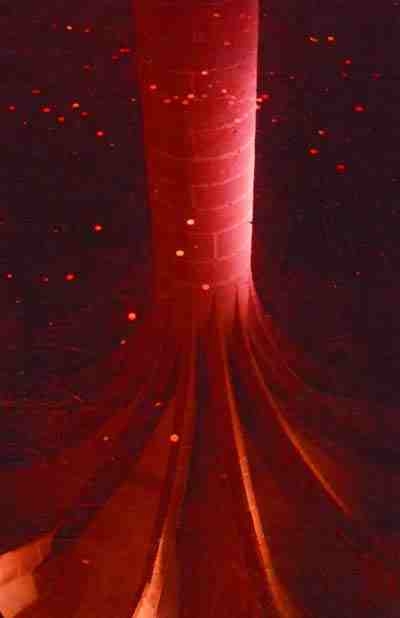
I’d read something in the Rough Guide about the evening openings having music and ‘installations’ but I didn’t realise it was such an elegantly organised event that made superb use of the alternately vast and claustrophobic plain spaces of the abbey. Occasionally artworks and sculptures were arranged along the route – making great use of atmospheric, coloured lighting. See the photo for an example of how a vaulted stone ceiling was lit from beneath and reflected into a pool of still water.
These were interspersed with other musicians – a cellist playing a Bach piece, a flautist beautifully playing Gluck’s ‘Dance of the Blessed Spirits’ in a darkened crypt and, in an almost magical touch, as we climbed out of a crypt up a narrow stairway and emerged into the huge space of the abbey’s nave, the emptiness was filled by the music of a harpist.
To walk through the abbey with the art, music and lights was to luxuriate in the appeal to the senses of art, music, light within the feel and smell of a building that, in parts, dates back nearly a thousand years. It confounded my expectations and was a complete contrast to the touristy clatter below. I read in the guide book that only a third of the hordes even make their way up the mount to the abbey’s walls – far fewer will have been so rapt by it as I was.
There seemed to be something quite understatedly European about the use of art and classical music – I know my German colleagues tend not to think of opera and classical music as somehow elitist – until fairly recently ‘Last Night At the Proms’ was broadcast live on German television. I’d like to try and convey some of this non-self-conscious appreciation in The Angel.
There are two reasons why the blog has been a little quieter than usual recently. One is that an element of my ‘other life’ intruded – hopefully the side that will continue to pay the bills in future. I had to submit an assignment for my Open University MSc in Software Development. I’d set aside a fortnight or so to concentrate on this but I ended also producing going on for 7,000 words of ‘The Angel’, which diluted my efforts somewhat.
I ended up sitting at the laptop in the end from 6am one day until 2am the next morning to try and complete the assignment before the deadline. The way this OU course works is to build up the final dissertation of about 15,000 words in incremental assignments so you start off with a proposal and then add the literature review and the draft research before submitting the whole thing at the end all polished up and with a conclusion.
What I had to complete was the literature review – which isn’t an enjoyable account of a few choice novels read recently but an attempt to track down academic literature relevant to your subject and assess its contribution to the body of knowledge. My topic is Enterprise Architecture, which is basically how one organises the many IT systems within an organisation to work effectively rather than, as usually happens in practice, allowing IT to re-inforce the warring sectarianism and factionalism within any large organisation.  The term ‘architecture’ has been appropriated by the IT industry to the annoyance of some of the building variety but the analogy transfers quite well. (And I believe that the same sort of skills used in this line of IT work transfer well into novel writing — being able to see the underlying structure of plot, pace, character and so on which lie beneath the surface detail and complexity — I think some of the feedback I gave in the City course owed something to these skills.)
In this area, where IT interacts deals with the corporate strategy of an organisation, it’s quite difficult to find any contemporary academic literature in the first place. This is probably because, despite IT all being based on the work of very clever people in universities, many contemporary practitioners are militantly anti-academic – wanting to prove) how macho, hands-on and problem solving they can be to ‘the business’ (a meaningless and self-loathing term that is used to elevates the status of anyone in a company NOT in IT the IT department as doing the real work).
In ‘The Angel’ James is motivated to leave his City job by this sort of philistinism. Despite his outward gaucheness  and blokey good nature, he’s actually a very bright chap – he has some Masters degree in Finance – his (ex-)job is in the application of clever computer systems which few people (including Will, his boss) can understand. He wants to learn – except now about art and cookery – and he’s pretty appalled by the crass anti-intellectualism of those around him.
So I’ve been finding recent academic papers in my area from places as diverse as Venezuela and Taiwan and I’m a little guilty of not really reading them properly – just finding a quotation which illustrates a point I’ve wanted to make. Doing the novel writing course has made me aware of the main criticism I’m likely to get from my supervisor for what I submitted – the narrative coherence could be improved.
There are a reasonable amount of references and it’s all pretty much on-topic but there’s probably far more work require to relate these to my own argument and research question (and the vagueness of exactly what it is what I’m meant to be analysing in my own research is another bigger flaw).
Even so, this is exactly why the OU structures these dissertations as it does — so when you make a cock-up of the first attempt you have plenty of time to improve it before the eventual submission deadline. Hopefully!
It’s an interesting time management challenge to juggle a serious MSc project and trying to complete the novel started on the City course — a distillation of the question about what I need to do to make a living against what I think I’d like to do. Â However, I read a few writing magazines on holiday which gave some information about average published novelists’ earnings suggests that no matter how successful the writing goes, the day-job is likely to be needed for a while yet.
I’ve just had an e-mail from Amazon asking me if I’d be interested in a certain selection of titles by one of their best-selling authors. The titles include: ‘Crystal’, ‘Sapphire’, ‘Paradise’ and, oh this is a bit worrying, ‘Angel’ and, even more so, ‘Angel Uncovered’. The author concerned, as probably 95% of the book-buying population knows (the exception being the sort of people who are enrolled on, or maybe otherwise involved with, university creative writing classes), is Katie Price (aka brand Jordan).
I had actually recently become aware of this unfortunate co-incidence  — but only several weeks after our course reading had touted the title of my novel to the great and good of the London literary agency world as ‘THE Angel’.
I was pulling up weeds in the vegetable patch when I was listening to Dale Winton on Radio Two — who was making a more entertaining stand-in turn than Steve Wright normally manages (why is it that EVERYONE Steve Wright mentions always ‘Loves the Show’ — and that Steve Wright feels it necessary to tell us that?).
Dale Winton was interviewing Katie Price — as one can imagine it wasn’t really a Jeremy Paxman style grilling. After they exhausted the topic of how the media were for some inexplicable reason always invading her privacy (she’s only done three interviews all year so who on earth is promoting the constant coverage of her in the tabloids?) they discussed her writing career. I was mildly interested until I heard the name of the main character of the series — Angel –who’s oddly enough a glamour model.
I was pretty mortified by this at the time. Partly it was because I’d not done my research on names and, had I done so, then I may have avoided using any angelic references in my title. That said, many books have similar titles and Katie Price is the kind of author (if that’s the right word) whose name is in far bigger type on the book cover than the title, which is almost incidental. However, even though the literary agents we invited to the reading would certainly not have expected me to launch into a carbon-copy bonkbuster (I hope) then they may have been unfortunately reminded, even subliminally, of the connection.
I still like my title, though, as it has a lot of meanings and connotations — apart from the religious guidance, protection and revelatory aspects it’s also the name of the nearest tube to City University — it just has an extra association now.
What I’m a bit more unsettled about is Amazon sending me an e-mail suggesting I might want to buy the whole Katie Price canon. I may once have browsed briefly at her book after I heard the Dale Winton interview although I remember more clearly flicking through the new one (‘Paradise’ I think in W.H.Smith) and having to wait as long as page five to get to a sex scene. I can understand them sending me mails about creative writing books or boring IT strategy texts that I buy for my MSc in Software development but I’ve hardly, if ever, looked at the sexy adventures of Angel. I do have a lot of files on my computer’s hard disk with Angel in the title, though, and I may have sent a lot of e-mails with Angel in the subject line. Makes you wonder.
I’m currently trying to write the part of the novel that follows on from what I submitted at the end of the City course. I’ve approached it in an odd way as I’ve written mainly dialogue for about six different scenes — all on in the afternoon and evening continuing on from the same day as the first five chapters. I’m already up to about 4,500 words so, once I’ve added in more description and context I guess I’m going to get at least two chapters of 3,500-4,000 words out of the material — but at the moment it’s slow going and without a deadline for workshopping I’m able to flit from one scene to the next adding a bit in here and there.
I would like to get this finished asap though as I’d like to send it out to get a couple of well-respected opinions on it — but I’m also up against a deadline in just over a week to do a literature review for my MSc project.
Perhaps all this is churning round in my subconscious as I had a rather strange dream. I dreamt for some reason I had gone back to our old house in Twickenham and the postman arrived with some ridiculously huge parcels — I think one may have been a bed all wrapped up. Among these pieces of post was an envelope with my marked assignments from the last term at City University (which I’m yet to receive) — chapters 3 to 5 in my case and a commentary and blurb.
As well as the marked assignments the package from City also contained a pepperoni pizza (rectangular shape like the envelope) and two garlic baguettes.
I had great difficulty reading the marked assignments for some reason — perhaps my contact lenses wouldn’t focus?. They were covered in remarks written in large green felt tip pen. Somehow I ended up trying to read the feedback in a car near my old dentists in the terraced houses on the edge of Rochdale town centre. Eventually I made out the words ‘poor’ and I turned over a page of my writing to see that the marker had written ‘KILL’ in huge great letters right across the whole page — the letters were filled in with fluorescent stripes from different coloured highlighter pens and were rounded — rather like psychedelic worms. Obviously that passage of description hadn’t gone down well.
I saw on a cover sheet that I’d been given 60% — and that’s when I started to wake up a realise it a dream as we’re not given any quantitative marking like that on the course.
If anyone is good at dream interpretation I’d be intrigued to know what this might mean — especially the pizza and the odd locations.