Transmission

In the last post I mentioned the ‘Transmission Project’, which according to the Manchester Metropolitan University student handbook is ‘an independent research unit, undertaken at the end of the taught element…to explore a specific area of the transmission of text.’  This basically means students have to submit work in a form that’s not the chosen ‘route’ of their MA (be it novel, poetry or children’s writing).

Some of my course mates have devised original and innovative ideas for their own Transmission Projects. Anne devised an experimental website to examine readers’ reactions to discontinuous, interrupted narrative styles (using embedded hyperlinks, for example) that modern technology can enable. Kerry has produced an e-book of 51 pieces of fiction (Fifty One Ways to Leave Your Lover — click here for Amazon link) comprising ‘short stories, flash and micro fiction pieces which reflect and explore some of the problems, issues and triumphs faced by women and girls’. Sales of the ebook raise funds for the charity, Platform 51, which assists women in disadvantaged areas. It’s not only an original project but helps a very worthy cause — and a bargain at only £1.02.)

Originally I had a plan to develop my project in an unorthodox literary form but I was deterred from that particular idea by the course director on the basis that it was content that might eventually form part of the finished novel. My next idea, a screenplay adaptation was thought a better alternative. While it is based on the same characters and roughly the same scenario (I hesitate to say plot), the ‘transmission’ of the text is very different. (I wonder if I should have done a screenplay for TV as that would be ultimately the best match for MMU’s curious transmission terminology.)

As I’ve only just submitted the project for marking, I’ll deliberately make no further comment on the specifics of my screenplay or explanatory essay. (But should any of the English faculty at MMU be reading this, I must stress my summer of dedicated research into the form and months of locking myself away in a darkened room to draft and redraft the project.)

One very obvious general point that I made in the accompanying essay is that a screenplay is a working document, which others in the creative process use to make the final artefact. It’s not intended to be a work to be enjoyed directly by the viewer, as would a novel by a reader.  This difference in approach proved surprisingly useful to me with the novel at its current point of development.

A screenplay passes responsibility to intermediaries for execution of the pleasurable details — actors nuancing their lines with gestures, expressions and inflections; a director and cinematographer developing its visual styling; designers creating costumes, sets, make up and so on. The writer provides the framework for others to use their talents.Virtually all exposition must be external: with rare access to the characters’ inner thoughts; description of character and setting is minimal.

Components of a film that chiefly within the control of the writer are character, plot, setting, scene selection and dialogue. With the possible exception of dialogue, these elements also provide the structural ‘scaffolding’ which holds a novel together. The difference is that it’s also the novelist’s job to evoke all the other elements too: the imagery, detail, sensory appeal and inner character exposition are hung with evocative prose on the structural framework that the reader should never obviously notice.

Another factor that belongs in the specialist subject of the bleedin’ obvious is that a film (or even TV serial) takes less time to ‘consume’ (is there a better word for this?) than a novel. Although the standard feature length screenplay is 120 pages, this equates to around 100 minutes of screen time. I doubt even the fastest readers can get through an average 80-100,000 word novel that quickly (although I’m often dumbfounded at the number of books some people claim to get through — maybe I’m a slow reader).

So, depending somewhat on the source material and the approach of the adaptation, it’s inevitable that a fair amount of the novel’s content is omitted. Anyone who’s ever watched a screen adaptation of a novel they know well has the experience of noting changed or absent characters, plot twists or settings.

Books on screenplay technique encourage the writer to work within what, compared to prose fiction, appear to be limiting constraints: to produce work that emphasises the visual and fast-moving and to use short, snappy dialogue. (When dialogue is written in a thin column down the centre of the script, it’s easy to spot verbosity and talking head scenes stand out immediately.)

Advice is also concentrated around the structural aspects of plot. A separation of a script into three acts, divided by plot points, is given as practically a natural law of the genre.

The project meant I finally read Robert McKee’s Story, a screenwriting guide recommended by many as the best work on plotting for almost any dramatic or fictional form. It takes a scientific approach and, in places, it’s more like physics textbook — with lots of diagrams with arrows about how different levels of conflict within characters intersect with the structure of the plot and many other factors.

It’s drawn from fundamentals of storytelling that have endured from time immemorial. These follow, roughly, a pattern that goes: introduction to a character and setting; then a source of conflict that the protagonist(s) need to overcome; finally an event which triggers a resolution (which can either be complete or not).

It’s argued that this basic narrative pattern is something humans are either born to respond to or that it becomes ingrained in us from an early age. Whilst most people aren’t explicitly aware of the fundamentals of story structure, it’s said that most readers (or viewers) will feel react with innate dissatisfaction when a story lacks this shape.

The Transmission project, while delaying the revision needed on my novel, may have been opportunely timed. The research I’d carried out into the screenplay form focused on the mechanics of plot, making the story work, ensuring pace and rhythm, distilling the essence of a scene and so on.

Applied to novel writing, these are all very useful aspects to consider after completing a full draft, compared to the original plan (however sketchy and flexible); has the novel lost its balance, become bloated in some sections, under-developed in others and the task of revision is to sharpen the novel, omit extraneous material and add in any necessary additional material required to make the novel work as a whole.

Assembling the screenplay from the manuscript has been fascinating. I’ve pulled scenes pulled from chapters in very different parts of the novel, often brutally extracting small portions of the action or dialogue and redeploying it in a quite different context — and it’s surprising and pleasing to see how often these small sections then work on their own terms.

(For this type of task I may, unusually, be able to call on skills I use in the day job — which requires me to often deconstruct complexity and draw out underlying themes and causes. I’m also experienced in constructing sophisticated solutions from orchestrating many component parts (if this sounds jargony and baffling you should see my CV — I have an MSc in this). Perhaps this background is one reason why the novel hasn’t been written in sequences but largely slotted together around its most fundamental parts.)

I relocated part of a scene that appears about a third of the way through the novel into part of the opening section of the screenplay. I needed to write a new, short sequence of dialogue to knit the two together but the effect seemed to work so well that I’m considering putting the new dialogue into the novel. Play around with the material and discovering how it works in different configurations gives a refreshing new perspective, but one that’s also scary in opening up many new opportunities to tinker around. This is where deadlines are useful, as I had with the screenplay project itself.

I’m confident that The Angel has a sound structure. It’s not fundamentally changed since I first mapped it out with Post-It notes on a conference room wall — see post here from two and a half years ago. (Two and a half years, blimey, I really do need to get it finished and over with!). However, since then I’ve inevitably ladled in lashings of sub-plot, themes, brought in the odd new character and so on.

While people who’ve read parts of the novel tend to say that it reads easily and quickly, I know that I’m going to get a more favourable response from agents if I send in a manuscript of a length that doesn’t scare them off. I went to the September meeting of the London Writers’ Club in Clerkenwell last week. During a break I had my opportunity to buttonhole the guest agent speaker and asked whether agents made a snap judgement on manuscript length: would a ‘typical’ agent look more kindly on (i.e. read) a file of 90,000 words, say, as opposed to one of 120,000. While she said a lot depended on the quality of content and the genre, she recommended avoiding any extremes and mentioned an old-school agent she used to work with who would refused to read any submission that wasn’t between 70,000 and 100,000 words (although this isn’t common nowadays).

If it’s wise to err on the side of brevity when revising that raises a latent paranoia I have that I may discover, after trimming my work down to a sleek and concise 70,000 word draft, that this might only represent the innards of the novel — a prose version of the skeleton of the story represented in a screenplay. All the distinctive parts that might mark it out as individual might be squeezed out — the humour, observation, reflection, insight into the characters’ internal thoughts and so on. I worry that I may end up with a story that might work very efficiently but wouldn’t the novel that I originally set out to write.

This is a concern I can’t resolve without getting on and doing it — and now the Transmission Project has been safely bound at Rymans and delivered to Manchester I can completely focus on finishing the novel — from both a personal and an MA perspective. The only remaining piece of assessed work is a finished draft of the novel itself. We get another year to complete this — although I may try and submit mine in the spring (surely it will be done by then?) so I can have an earlier graduation date.

With the other coursework over (unless my screenplay is so bad it fails and I have to resubmit) and with the nights rapidly drawing in, I need to settle back into writing mode — or, more precisely, editing mode. And on that valedictory note to the summer of 2012, it might be appropriate to post this rather sad photo of Horse Guards Parade, now restored to its original state. (This photo was taken only about five weeks after those on this post that show a 15,000 seater stadium on the plot.)
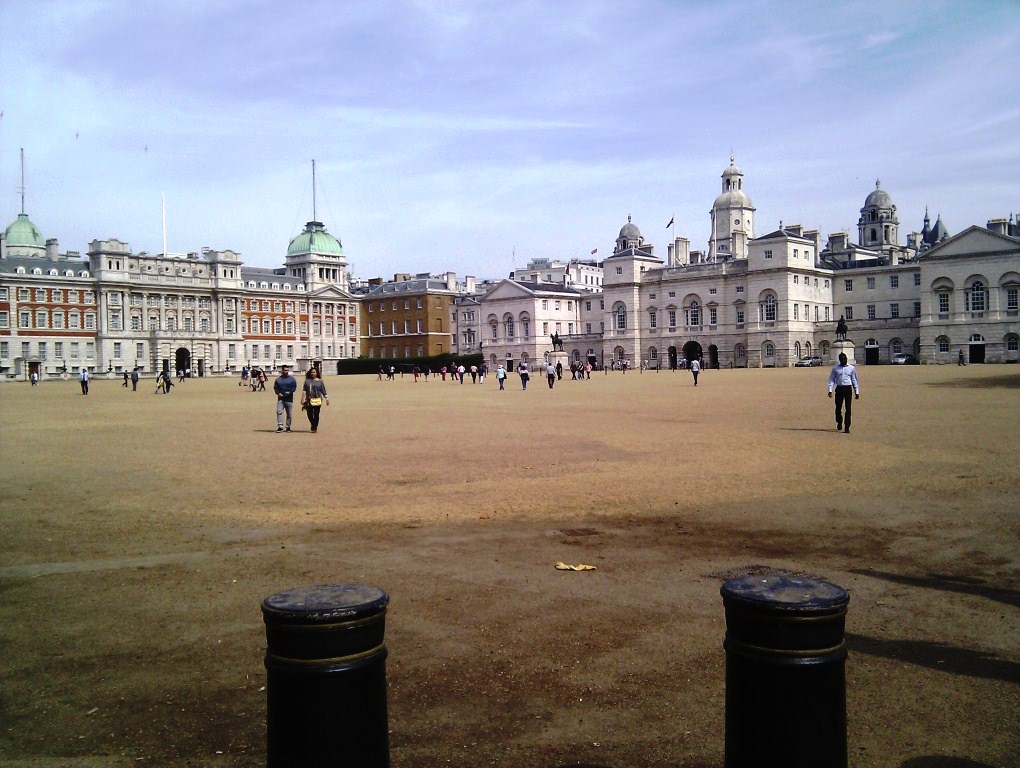
 

London 2012 -- Horseguards All Gone 070912
Not a Grain of Sand Left in Horse Guards Parade

By the end of September, virtually all the other temporary infrastructure had been removed from the Mall and St. James’s Park (as I saw when I walked across the park to the Mall Galleries to view the entries for this year’s Threadneedle Prize, one of which was by my artist reader Adeline de Monseignat — see previous post).

Incidentally, I was very pleased to manage to finally visit the Olympic Park itself, during the Paralympics. I’ve posted a few photos of the park on this blog page.


York Festival Of Writing

Apologies for the absence of recent updates: writing time has recently become increasingly hard to come by, although mostly in a good way, via holidays and other enjoyable events that I have hopes of getting around to writing blog posts about eventually – I’ve got a nice batch of photos to upload, if nothing else.

In addition to this summer activity, the MMU MA has crept up on me. The enigmatic Transmission Project needs to be submitted very soon (perhaps more of this in another blog post). As far as the MA course goes, once that project has been completed then it’s just a case of completing The Big One – handing in a 60,000 word minimum manuscript of a novel.  Regular followers of this blog will know that hitting that word limit isn’t likely to pose me any problems in itself as I already have a completed manuscript that comfortably exceeds that length (rather too comfortably as it currently stands).

Despite my best intentions, however, the novel still needs a degree honing and polishing before it’s ready to submit to anyone – a tutor for assessment for an MA or an agent or publisher. It’s frustrating but that’s where I am, even though back in March, I wrote a post with great expectation that the professional feedback I’d had on my manuscript had suggested that that it was only a couple of weeks or so’s hard work away from being a respectable manuscript.

The problem has been finding that’s two weeks’ worth of extra time in this Olympic summer when I’ve not only been doing the MA but finding all kinds of loosely novel-related but fascinating research in London (mainly art-related with plenty of visits to Shoreditch). I know from having taken an MSc with the Open University that took over six years that I’m much more productive in the darker months – I like getting out in the sun too much.

Nevertheless, with springtime optimism, I booked myself a place at the York Festival of Writing. Amongst its literary attractions, I anticipated the event would be a perfectly–timed opportunity to advance my path to publication. With my long-completed manuscript under my arm and more agents attending than you could shake a Kindle at, I’d be able to immediately hand my over my burnished tome or send it speeding within minutes into the lucky agent’s inbox.  After all the Festival was in September – six months in the future.

York University 090912
York University Campus — Where the Festival of Writing Was Held

Unfortunately, September sneaked up on me much more quickly than anticipated – immediately after my spontaneous sabbatical over the late summer – of London 2012, holidays and even a little bit of decent weather. As mentioned in a weary-sounding blog post in July as well as reaching ‘the end’ I’d also done a fair bit of work on a submissions package (a polishing the first three chapters, writing a synopsis and covering letter). It’s just that I’ve finished knocking the rest of the manuscript into similar shape – and I’d learned enough about agents to know that if they’re interested in a novel that they immediately want to read the manuscript in its entirety – not several months later. (That didn’t stop me hopefully printing off a few hard copies of my first three chapters to take to York, just in case.)

When I booked the festival I didn’t really think about York (it’s held at the attractive York University campus) being rather a long way away from here in the Chilterns. Having done nearly 2,000 miles of driving around Europe in late August, it was inevitable that my journey north would provide another horrendous example for my 2012 collection of summer traffic jams (after some nightmarish examples on Italian autostrade). I was held up for over an hour on the M62 — the kind of jam where the cars come to a total standstill and after a certain point their occupants emerge gingerly and start to colonise the alien carriageway, exchange a few words of exasperation with their normally faceless neighbours — and then suddenly run back from the hard shoulder or central reservation and jump back in when the traffic unexpectedly starts to move. Maybe there’s a germ of an idea for a novel in that? Maybe not!

M62 Traffic Jam 080912
I Should Have Been Listening to Jojo Moyes At This Point

So I arrived late at the conference, almost at lunchtime on the Saturday, not in  the most positive frame of mind: why have I driven 200 miles north to spend the my weekend with a bunch of people I’ve never met – and I haven’t even finished the novel? Shouldn’t I be spending the time more productively at home finishing the book? Or, more likely, enjoying the last throes of this meagre summer, enjoying the sunshine in a deck chair rather than sitting in windowless lecture theatres?

But I left the conference on Sunday afternoon feeling remarkably upbeat and happily kick–started out of my summer writing hiatus. I’d not been able to pitch a completed novel but I’d come away uplifted by all the other benefits of spending the best part of a weekend in a community of writers.

For anyone who’s curious about the York Festival of Writing, it’s organised by the Writers’ Workshop, a literary consultancy. The conference, held over a weekend, is structured around a programme of seminars, workshops and plenary ‘keynote’ sessions (similar to day–job related conferences I’ve been on). Sadly the traffic trouble meant I missed the Jojo Moyes keynote on Saturday morning).

But, as with most worthwhile conferences, it’s the intangible elements rather than the programme itself that were most inspiring. Writing is (usually) a solitary experience but a weekend that gathered hundreds of writers together in the same place – most with very similar shared ambitions, interests, questions and anxieties – seemed to prove an affirmatory experience for those involved.

Committing the time (and money) to attending a writing conference means all participants had made the psychological step of regarding themselves as ‘a writer’. You chat to and exchange experiences with others working towards the same goal and come away feeling validated – that your aspiration to become a published writer isn’t futile self-delusion because so many other people are working towards the same – and agents and editors have made efforts to come and meet us all.

There’s camaraderie in numbers but the number of people there (at least a couple of hundred I’d guess) makes a sobering point. After an agent discussion, one panellist, who is a full-time reader of unsolicited manuscripts for a leading agency, said informally that he’d estimate that perhaps only one or two of the delegates might end up being successfully traditionally published novelists.

Despite (or maybe because of) these odds, the event wasn’t in the slightest cut–throat and competitive – everyone was unfailingly open and keen to ask others about their writing. I suspect that most people felt, like me, a little daunted about walking into the dining room for a formal dinner without really knowing anyone else there, having not met anyone else in the room before that weekend but it was a very friendly and sociable event. Happily, there wasn’t the chest–beating atmosphere of a sales conference – with backs being knifed in pursuit of the deal (well, not on my table at least!). Perhaps writers, almost by definition, tend to congregate at the quieter end of the introvert–extrovert spectrum, preferring to commit our ideas to paper or on screen?

(A tutor on a short course I took at City University had a theory that all writers were ‘damaged’ in some way – creating a compulsion to write – a view which I think has more than a grain of truth but is no reflection on the nice people I met at York!)

The welcoming atmosphere may have been connected with the number of northerners among the delegates (I can happily suggest this as an exiled northerner myself). My ‘day job’ is currently bang in the centre of London and one of the consolations of toiling away there is a feeling that I’m not too far away from the literary London of agents and publishers (being able to see the London Eye, Gherkin, BT Tower and Buckingham Palace from the window, as well as being convenient for too many cultural distractions to complete a novel).  It’s not very logical but I’ve recently quite enjoyed walking past Random House’s HQ on Vauxhall Bridge Road on the way to work meetings. And I’ve idled away the odd lunchtime following literary walks past London’s numerous writer–inspired blue plaques.

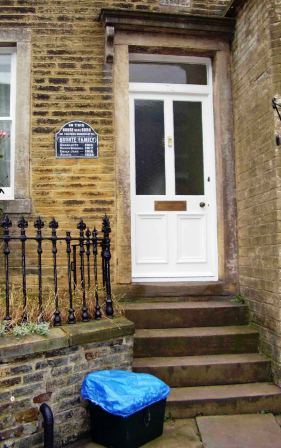
Bronte Birthplace
How They Do It in Yorkshire — Birthplace of the Brontes

At the conference I met writers from places like Durham, Lincoln, Doncaster, Nottingham and quite a contingent few from York itself – all places where it doesn’t take an Olympic Games for people to be friendly to strangers. Obviously, writers can work virtually anywhere but being in central London most days means it’s easy to believe the outer limits of the publishing world coincide with the Zone Two and Three boundary. So credit to the Writers’ Workshop for travelling up to York, reinforcing that there are thriving writing communities all over the country.

As an aside, the inspiration provided by the British landscape to writers over the last thousand years is the subject of an engrossing exhibition at the British Library. I’m aiming to blog, eventually, about visiting Writing Britain: Wastelands to Wonderland but, in the meantime, I’d recommend anyone to visit in its final week and be as awestruck as I was in seeing original manuscripts by Hardy, George Eliot, James Joyce, Charlotte Brontë and countless others. And, speaking of the wily, windy moors, there’s a series of photographs of the Pennine area where I grew up, which gave inspiration Ted Hughes and Sylvia Plath.

Back to the less gritty setting of the Vale of York and, having made the generalisation that writers might be quiet sorts, it certainly doesn’t mean they’re not sociable creatures. In my own case, one of the reasons why my novel prominently features the fortunes of a pub is because I like to spend so much time there – another reason why my manuscript still isn’t quite ready to set before an agent. The speed with which the (sadly limited) complimentary wine was downed and replacement bottles ordered at the dinner tables, the York festival showed many writers are similarly sociably minded.

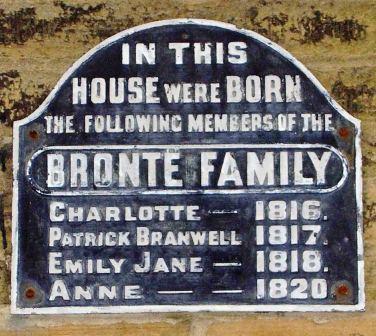
Bronte Birthplace Plaque
Bronte Birthplace Plaque, Thornton, West Yorkshire

And, because writers are normally scattered working in solitude all over the country this sociability has found an enthusiastic, virtual outlet in blogging and Twitter. It was probably via Twitter that I learned about the conference in the first place. I’d certainly come across some of the agents attending and some very helpful blogging book doctors via Twitter – and one of my objectives was to hunt these down, in the nicest possible way, so I could say ‘hello’ in person rather than online.

My Big Two, in terms of tweeters I wanted to track down, were Debi Alper and Emma Darwin. I managed to buttonhole Debi after dinner and she introduced to me to Emma. They’re both successful authors and had a long day book–doctoring (as well as running workshops, about which other delegates were very complimentary) but they were both very friendly and approachable. Emma’s blog, This Itch of Writing (see sidebar) is an antidote to all the ‘Follow My Ten Rules and Write a Bestseller’ sites and,  now having met Emma in person, I can understand why it’s one of the most intelligent and practical resources on writing that I’ve found on the web.

The role of literary agents in the traditional publishing process is often described as that of gatekeepers – it’s said that finding representation by an agent is frequently the biggest obstacle a writer has to overcome on the road to publication. So when they emerge out of hiding behind website submission guidelines and laconic Writers and Artists’ Yearbook entries, one might imagine agents to seem as unyielding as doctors’ receptionists from hell.

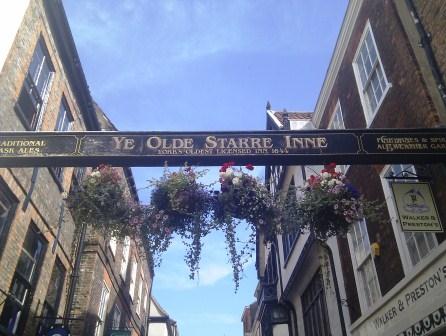
York -- Old Star Inn 090912
A Lovely Pub in York I Didn’t Get to Visit This Time — The Old Starre Inn Sign — Stonegate

The great benefit of a conference like the Festival of Writing is to allow writers to discover that they’re not. At least the many that decamped out of their normal habitat to spend the weekend in York, make strenuous efforts to seek out new talent (seeing half–a–dozen writers back–to–back for the intensive ten minute one–to–one sessions must be exhausting work – like speed-dating with reams of A4). Beyond the scheduled one–to–one sessions most agents seemed perfectly approachable although the Festival Handbook reminds over–zealous delegates of protocol – don’t try to subject your selected agent/victim to your carefully honed three–hour elevator pitch over dinner or try and open (and close) a deal in the queue for the toilets.

Given the unagented, aspiring writer’s curiosity about agents and how best to make an approach, it doesn’t take much of a leap of imagination to imagine a David Attenborough–style whispered commentary: ‘Here we see the literary agent species drawn out of its usual habitat of secluded offices in Camden, Bloomsbury and Notting Hill to gather around this alluring watering hole. And contrary to the species’ forbidding reputation, they can be observed to be a remarkably sociable group.’

If anything, the experience of meeting agents, listening to their views on panel discussions and the like, shows they are remarkably diverse bunch: talkative extroverts, intense bibliophiles (not a reference to the festival bar), laid–back ‘regular guy’ types and one who, oddly, reminded me of Malcolm Tucker from The Thick of It.

Writers who desperately want to get ‘an agent’ are sometimes advised that it’s not ‘an agent’ they need but the right agent and, having seen more agents together in one place at the Festival than I ever have before, this would appear to be sound advice (see this guest blog post I found via Twitter from A.P.Watt agent Juliet Pickering). Accordingly, they’re all so different that not all are going to like your book – but you hope that, with so many different personalities, eventually one will. That is unless you happen to have self–published and have sold tens of thousands of e–books already, in which case, it’s likely most agents will want to shove a contract in your direction.

That last point was made in one of the panel discussions on the future of publishing – a topic no–one seems to be able to agree on. Attitudes do seem to have recently changed to suggest that it does an author no harm to self–publish, if it’s done properly. David Gaughran, a self–published writer who’s also written about the subject, stressed in response to a concern about the overall quality of self–published books, that he has access to the same freelance copy editors as used by large publishing houses.  Similarly, self–published authors can also pay for the services of other professionals in the publishing process, such as PR agents. While this breaks the maxim of ‘money flows to the writer’ it’s argued that the much higher royalty rate on self–published e–books can be more financially rewarding overall, even on lower net sales, for an author even when such expenditure is incurred upfront.

At its most basic, an author’s journey for publication is a search for people prepared to invest money and time (and a professional’s time means money) in editing, printing, distributing and publicising your work. Each link in the chain is like a pitch from Dragon’s Den to persuade someone to commit resources: author to agent; agent to commissioning editor; publisher to bookseller and so on.

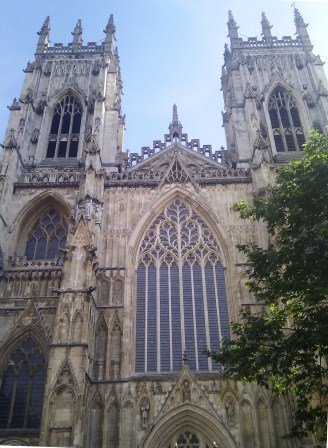
York Minster
York Minster

That’s why I found one of the most informative workshops at the Festival was The Acquisitions Meeting with Gillian Green and Michael Rowley, both editors at Random House, who are currently building a fiction list for Ebury Press.

They gave an intriguing insight into the business side of publishing a novel. They explained how non–editorial staff, like the production director, who counts the cost of shiny covers and different grades of paper, have a vital say in whether a title will be acquired or not. It’s the antithesis of the literary agent’s unquantifiable ‘I just loved it’ reaction to a text – where calculations about break–even print runs in a spreadsheet determine the final publication decision.

Forecasts of sales are much more rigorous than finger–in–the–air. For debut authors, analysis will be made of the sales of comparable writers’ titles and existing authors will have their Nielsen Bookscan figures scrutinised. If an author’s sales have been on a declining trend then this can be a deal breaker, no matter how great their new book. A debut author’s lack of a track-record can paradoxically work in their favour.

I’ve dwelt on those elements of the conference that were particularly relevant to where I am now with my writing but, as well as content on the process of publishing, there were plenty of sessions and workshops on writing technique (voice, character, editing and so on). And probably having already written my longest post on the festival (ridiculously long for a blog) I guess I’ve proved I found plenty to interest me in York.

Oh, and how did I get on in my one-to-ones with literary agents, bearing in mind my initial frustration that with no finished manuscript to offer, I worried they’d be wasted opportunities? (You submit the first chapter and an ‘introduction’ in advance so the agent can arrive prepared.) Well, I got some very useful feedback on how to describe the novel in a covering letter and comments on extra angles I might consider in the first chapter.  (It’s always really valuable to get a reader’s initial reaction to the novel – bearing in mind that most people who are kind enough to give me feedback have seen it develop as a work-in-progress.)

The agents seemed to like the writing and thought it fitted the type of genre that I was aiming at (note that both asked me which writers’ novels I thought might be similar to my own). I was given positive comments on the structure of the novel, the dialogue and the writing about food (the first chapter is very culinary – it would be interesting to find out what they’d think about themes in later chapters).

I’m told that agents, while being polite people, don’t want to waste their own future time by giving false encouragement which would leading writers to inundate their inboxes with further material the agent knows from the initial reading that that they’d never represent anyway. So I guess it must be encouraging that both agents said they’d like to read more of my novel when it’s all ready.

The agents also, perhaps most importantly, seemed to have thought carefully about whether there was a market for the novel – and they both thought that there was, although admittedly from reading only that rather foodie first chapter.  I was also asked by one agent if I’d had direct experience of the dramatic predicament that opens the novel. Apparently she’d had approaches from a couple of people who’d been in that situation in real life and she found my description (which I’d largely imagined) very realistic and compelling, which can only be good.

So no being signed up on the strength of the opening 2,700 words but I think their collective reaction was quietly encouraging.

But, to underline the points about informality and networking, I stayed behind after an agent panel debate with the intention of saying hello to an agent who’d read some of my novel’s very early material at another conference a couple of years ago. I’d talked to her once since at an event at the start of the year (when I’d said the novel wasn’t too far off). I was pleasantly surprised that she recognised me at York and was the first to strike up a short conversation. She might have been being terribly polite but it’s still a good piece of motivation to have a literary agent say goodbye to you with the words ‘I’ll look forward to getting the book’.

Now that might go a long way to towards explaining my uplifted mood as I drove back down the motorway.