
The Accidental Street Art Photographer

This weekend is one of the biggest in the London art world with the huge Frieze exhibitions in Regent’s Park and many associated events. In 2010 Village Underground started to host the Moniker art fair, which is a showcase for leading urban, street and contemporary artists timed to coincide with the Frieze festivities.

The Moniker fair attracts a number of well-known artists from all over the world and one of the highlights of this year’s schedule is a new work by Ben Eine (see post about his other work in Shoreditch), who has a long association with Village Underground (he painted the ‘Let’s Adore and Endure Each Other’ message high up on the Great Eastern Street wall.

In The Angel Kim has her studio in one of the tube carriages on the roof of Village Underground in Shoreditch. I’ve been there quite a few times (up in the carriages and in the venue space below). I paid a flying visit to the fair (which unlike Frieze at £20+ is free to enter) yesterday evening and on my way up towards Old Street (where I also paid a flying visit to the National Academy of Writing fair) I noticed the lower part of the wall on Great Eastern Street was being painted.
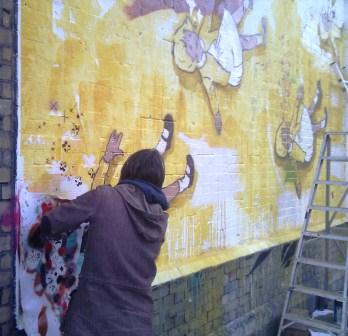
The Gravity Garden -- Amanda Marie at Work
The Gravity Garden — Amanda Marie at Work

Unusually, it was a female artist at work and her style was distinctly different to much of the street art that normally covers the walls around Shoreditch — lots of yellow and pink —  not monochromatic blacks and greys or electrifying primary colours. She also used some intricate stencilling work to apply small coloured stars, crosses and lines to the mural.  And featuring figures of children in the work is fairly radical for street art.

I’d not seen a street artist at work and I was intrigued by the stencilling before so I asked if I could take a few pictures and we had a short chat. She told me that she was Amanda Marie from Colorado (website here), who’d come over from the US for the fair, and she had work on show inside the exhibition. The Moniker website describes it as ‘storybook imagery [that] can feel edgy cute, but it is washed with mischief, and can be a bit spooky.   Her work is Child-Like, but not Childish.  The paintings are allegorical and proverbial.’ The project on the Village Underground walls is called ‘Gravity Garden’ (sponsored by a gallery in Amsterdam) and it’s of ‘children gently falling through wonderfully endless skies painted directly on the walls.  It will be a spooky oasis.’
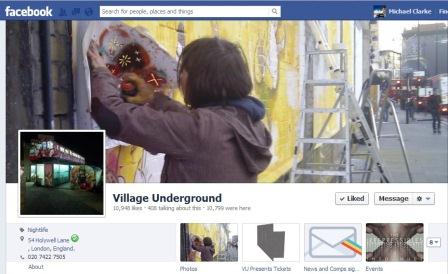
My Street Art Photos on Village Underground's Facebook Cover
My Street Art Photos on Village Underground’s Facebook Cover

When I got home I thought the photos looked quite interesting so I posted one on Village Underground’s Facebook page and said I had a few more if they were interested. They were and I e-mailed the photos over and they appear to have liked them so much that they’ve not only put all of them on their Facebook and Flickr pages (and giving me the credit) but one is currently Village Underground’s cover page (see photos) — as liked by over 10,000 people. The photos themselves have got nearly 100 ‘likes’ in a few hours. I’m feeling quite impressed that I’ve promoted the London street art scene, even if only in a small, accidental way.
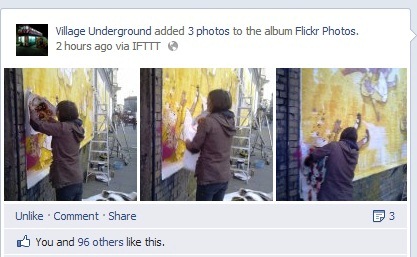
Liked by Me and 96 Other People!

As a quick aside, the most interesting thing that came out of the panel discussion I went on to see at the National Academy of Writing creative fair was the comment by Andrew Cowan (who runs the famous UEA MA programme) that most of their alumni who achieved distinctions did not go on to become published writers. It was those whose writing was less lauded by the academics who tended to make up their impressive list of students who went on to later success when the course ended. I was quite encouraged by that.

Update on the photo on Sunday 14th Oct: the artist herself has shared my photo on her Facebook page with my credit (see below).
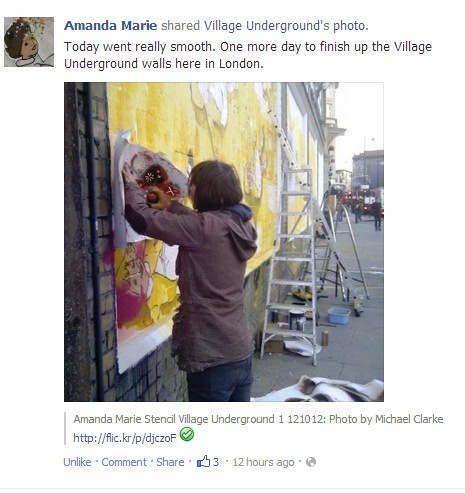
My Photo on the Artist's Page (with credit)
My Photo on the Artist’s Page (with credit)

(If I get so excited about having a photo of mine shared around the web, I can’t imagine what I’d be like if the novel was to be published.)

Is It True What They Say, the Better the Devil You Know?

I had one of those metaphorical comic-book light bulb moments the other day while walking to the station. I realised what my novel, The Angel, is really about. That might seem odd as I’ve been working on it for so long but, perhaps, it’s because I’ve stood a back a little recently from the novel and possibly the Transmission project made me think more objectively about its structure (see lots about structure in the post below).

It won’t be a spoiler to discuss the basic plot premise of the novel to any of the growing band of readers who’ve become familiar with the draft in some shape or form or, in fact, to any reasonably long-standing readers of the blog  (I love all of you!). However, if you do really harbour aspirations that, come the hopefully glorious day, you’d like to approach the novel completely fresh then stop reading here.

The engine of The Angel’s plot is a triangular relationship. James and Emma are married and, outwardly, are a successful, attractive, high-achieving couple who ‘have it all’. Then James meets Kim, a German artist. Superficially, Kim is as alternative as James is conventional.

The dilemma that James faces in the novel is choosing between the two. He’s already embarked on a safe, traditional, reasonably satisfying but ultimately stultifying relationship with Emma, largely based around materialism and consumerism that reflects their professional status. Kim is a catalyst who makes James confront his latent dissatisfaction with his existing relationship.

James has to consider whether he opts to make a risky choice and pursue Kim. While he loves her unconventionality, he’s aware of some difficult baggage from her past. He thinks he feels instinctively  closer to Kim but doesn’t know if that’s a case of the grass being greener. And, of course, there are no guarantees. Even if he was to hedge his bets and try and engineer an affair with Kim (and that makes the huge assumption she’d be willing to) he runs the danger that he’d destroy his reasonably tolerable marriage for something that might only turn out to be a brief fling. This dilemma may be more complicated if James isn’t aware of the full picture — can he be so sure about Emma’s commitment and the enduring stability of his marriage?

Perhaps this situation reflects the sort of universal dilemma about risk and reward that most people have faced at some time — why Mephistopheles is required to broker a Faustian pact on one hand or as Kylie Minogue sang Better the Devil You Know on the other? Also, this kind of choice is certainly not exclusive to relationships — one might argue the current economic crisis is because the entire worldwide financial sector chose reckless thrill-seeking over stolid domesticity. However, when these choices involve human relationships, emotional responses are heightened. I deliberately chose adultery as a subject because it’s one of the few remaining conflicts within established relationships that triggers strong feelings.

The appeal of the story notwithstanding, it’s been something of a puzzle to me how I’ve come to write a novel and sustain my interest in it so long that has, in this respect, no direct parallel experience in my own personal life (the triangle dynamic is definitely not a case of ‘write what you know’). Ironically,if I’d been consumed by the emotional stress of prevaricating between two romantic partners then I doubt I’d have had the time to write a novel about it.  Yet the novel has felt very personal and it’s finally dawned on me that James’s situation and much else in the novel directly relates to the situation I’ve found myself in while writing it with the difference that James’s dilemma is a metaphor.

For me, the dilemma is between the ‘day job’ (Emma) — a career that probably looks quite planned and reasonably successful from the outside, not badly rewarded, fits my (technical) skills but is something that maybe I’ve fallen into doing. Kim is the writing — risky, economically a basket case, but a choice that I appear to be irresistibly and instinctively drawn towards. And at this stage it’s only a flirtation — a few encouraging responses but nothing approaching any substantial relationship and definitely no guarantee of commitment in return.

I suspect that the same is true for many writers in a similar position to me — striving to establish ourselves on the path towards Maslow’s self-actualisation while having to service the bills. In common with the fictional adulterer we’re almost illicitly wining and dining the seductive new partner and experiencing all the uncertainty, guilt, anxiety about being found out but also, perhaps, the thrill involved in juggling the two contrasting partners. Ultimately, like my character James, I don’t want to be a cheat.