Alexis Cole — Transcendence

One of the questions that recurs in my novel is the importance of  location — especially for artists.In my novel Kim is a German artist who has arrived to London from Berlin in the expectation that it’s the place to be to make her name in the world of modern art. During the novel she also experiences the bucolic joys of the rural England that can still can be found, surprisingly, less than forty miles from grungy Shoreditch.

While it could be argued that Dalston, Stoke Newington, Hackney Wick or further flung places are where the artistic action is now happening, the spiritual homeland of contemporary urban art in London (if not the world) is still the Shoreditch/Hoxton/Brick Lane area. It’s been deserted by the Young British Artists (YBAs) of the late 90s (the group that included Tracey Emin and Damien Hirst and the subject of the interestingly titled Lucky Kunsts by Gregor Muir (although there’s a big Hirst formaldehyde thing apparently in the new Tramshed restaurant on Rivington Street). However, the place is becoming more corporatised with the arrival of the likes of Google in ‘Tech City’ at Old Street Roundabout — and endorsements by the likes of Boris Johnson and David Cameron.

As an aside, I met Mat Collishaw (apparently Emin’s ex) in person at a Love Art London event a few weeks ago at Blaine Southern in Hanover Square at his most recent exhibition — where his painting were going for £110,000 a piece.

Nevertheless, the locality still attracts the most infamous graffiti artists and is stuffed with galleries. I recently followed a walk from Hoxton Overground station via Shoreditch to Old Street in Stephen Millar’s London’s Hidden Walks 2 and found plenty of urban grittiness only a street or two away from where the hipsters hang out — at the top of Hoxton Street, for example.

The association of artists with the Shoreditch area suggests that location is an important factor for artists to attract attention from dealers, critics and buyers. It has a long historical precedent: some of the best known painters often made long journeys to their best markets. In Beak Street in Soho a plaque marks the location where Canaletto stayed for two years in the eighteenth century. He came to London to sell his pictures to patrons who liked reminders of the Grand Tour. Appropriately enough, the building now houses the Venetian-inspired restaurant, Polpo.

So having written about an artist who comes from Shoreditch and spends time in the Chilterns, I was fascinated to read a story on my local newspaper’s website about an artist who was was, in a way, doing the opposite.

Alexis Cole is an artist who works from home in Thame (which is a picturesque Oxfordshire market town with a huge main street with many good pubs about 45 miles out of London). Co-incidentally, like Kim, she comes from Europe — Croatia in Alexis’s case, although, when you meet her, it’s obvious she’s lived in this country for a while (she went to university here).

Alexis Cole in Brick Lane Gallery Annexe

This was the first time Alexis  had exhibited her work at a gallery and she chose to do so not in rural Thame but in the heart of the London contemporary art scene — at the  Brick Lane Gallery Annexe (on Sclater Street, which connects Brick Lane with Shoreditch High Street Overground station). It’s a location that’s bang in the middle of the arty fringes of the City — close to Redchurch Street.

Alexis exhibited work in three broad genres: papier mache flowers (which were very popular); pastel pictures, generally of animals or geographical destinations; and abstract acrylic paintings that often had objects embedded in the surface. The last style reminded me of a cross between the abstract squares of colour of Mark Rothko and the collages of Kurt Schwitters — the German artist  whose work can currently be seen in an an exhibition at Tate Britain (and mentioned previously in this blog post).

Surf and Microshines

I got in touch with Alexis, explaining my interest, and visited her show, Transcendence, at the gallery the day after it opened in March. (It’s probably not giving away any spoilers about the novel to say that it wouldn’t be much of a story involving an artist if she didn’t put on any exhibitions.)

And I was impressed by Alexis’s artwork — as were other visitors. I’ve included a few photos of my favourite examples of Alexis’s artwork with this blog post, along with a photo of the artist herself, although as they were taken with a phone camera, they don’t do justice to the exhibition.

Alexis’s website (click here for the link) has much better photographs of the paintings and I’d recommend visiting it, although the three-dimensional works, like the collages and flowers need to be seen properly in person.

As this blog shows, I’ve tried to learn over the past couple of year more about how book publishing  operates and I’m also interested how it compares with the market for art — an issue that’s close to the heart of my character, Kim.

Three Pictures by Alexis Cole

As far as I can tell, the art market appears to work in a less structured way because artworks are individual entities (or scarce copies in the case of numbered prints). This means they’re far more expensive to buy than books. For example the Battersea Affordable Art Fair which I attended recently with Love Art London defines ‘affordable’ as anything under £4,000.

By contrast, the written word is, in essence, intangible: like recorded music, once the work has been created it can be copied an infinite number of times. However, in the physical world, the fixed costs of printing a book are high. Aside from editing and marketing a book, publishers provide the large amounts of capital that funds book printing and distribution — a formidable barrier to entry for new writers.

On the other hand, an artist has to spend money on materials, whereas all a novelist needs is, arguably, paper and ink. (A Windows 95 spec computer with a prehistoric version of Word is good enough to write a manuscript — and, as for a fast internet connection, the likes of Twitter probably erodes any of potential productivity gain.)

Yet the artist creates an object that can immediately be sold (unless it’s performance or conceptual art) whereas the writer’s work results in a file on the computer or, without efficient printing technology, a heavy wad of A4 paper wrapped with an elastic band.

Darkshines
Darkshines

Given that, in all but the most extreme cases, a book takes longer to create than a piece of art, the writer needs to sell a substantial number of copies of a work just to cover the cost of its production (let alone make any income from the time spent writing it). Conversely an artist will sell a lesser number of works but they’ll usually be individually created (hence the controversy over the value of works that are very similar, like Damien Hirst’s spot paintings).

To market their work, an artist needs an exhibition space and then a means of attracting potential customers to it. Commercial galleries will often provide these functions in exchange for a substantial cut of the selling price of an artwork (many represent artists exclusively).

However, there are many other ways for artists to engage directly with their customers — it could be as simple as hiring a gallery space, hanging the art on the wall with a price tag and creating as much publicity as possible or maybe just hope for word of mouth to take off.  There are also plenty of routes to market outside the traditional gallery channels for artists — for example, I know of a number of pubs that have dedicated art gallery spaces or are keen to showcase local artists’ work for sale.

No one opens a pop-up bookshop to sell their self-published novel — books have tended to be sold through a relatively limited number of outlets. Because of the small absolute profit made on books, they need to be sold in quantity — and in a place where they’re in competition with many other alternative titles.

Amazon is arguably even more dominant of the ebook market than Waterstones or the supermarkets are over the printed book. However, the marginal cost of reproducing ebooks is tiny and it is easy to list an ebook for sale on their site (albeit along with millions of anonymous titles) — and these factors may start to make the book market start to take on more similarities with the art market. For example, intermediaries (publishers, agents, booksellers) might be circumvented by those who can raise their visibility in the market by other means.

How artists measure their own success?

Certainly, as with writers, one substantial achievement would be to make a living from their artwork. Surprisingly few writers are able to survive on income from book royalties alone but there is a fairly well-defined progression of levels through which writers progress — a bit like a computer game. For example, being represented by an agent, getting a publishing deal are daunting hurdles to clear. And once published there are many stark metrics by which publishing is analysed — Nielsen Bookscan figures, Amazon ratings, etc.

It’s true that the art world has many prizes that are keenly contested, as does the literary world. However, there’s no equivalent of the Sunday Times Top Bestseller list for artists — which raises fundamental issues about how much of a commodity books are, as opposed to examples of creative art that can’t be ranked by sales figures.

Alexis was very happy with the exhibition — e-mailing me afterwards to say she was thrilled about how it had gone. She received some useful feedback from viewers of her work, sold several paintings and received some commissions. With a steady stream of inquisitive visitors to the gallery, the Brick Lane location seems to have worked well for Alexis.
 

Subscribe to MacNovel

Look to the sidebar on the right and see an exciting development — something that this blog’s been missing that I’ve now hopefully remedied. It’s a ‘follow this blog’ mailing list.

To be alerted whenever a new post is added to this blog (and that’s not something that happens with a frequency that’s ever going to threaten to clog up your inbox) then type your chosen e-mail address into the box and press the button.

You’ll be redirected to a service called Feedburner (which is apparently owned by Google) that will do one of those annoying Capcha things to defeat the spammers and then, if all goes well, you should be sent an e-mail on the infrequent occasions when I have something new to say on here. If it works as it should, you’ll also only get a maximum of one mail per day and only when a new post is added (which has sadly been about once a fortnight over the last few months.)

It’s been a fiddle to get to work properly (I do all this web admin stuff myself) but I’ve managed to test it out with some success.

Feedburner Update E-Mail

When you receive an update e-mail (see example above) it has a link to the new post. It also has the normal options to unsubscribe so you can always opt out. Feedburner also promises not to send spam.

Go on, sign up, you know it makes sense!

Agent Hunter

Sounds like some kind of Skyfall clone doesn’t it, but Agent Hunter is a new source of information that might be almost as valuable to aspiring authors as state secrets to 007. It’s a new website that has collated a huge amount of information on literary agents, agencies and publishers together in an online database. It also comes with a search facility that’s ingeniously configurable.

Agent Hunter is from the Writers’ Workshop — the people behind the very enjoyable York Festival of Writing that I attended last September. (I posted about the Festival here –and an edited version of the post has been included by Debi Alper in the book of the festival along with many entertaining accounts by other delegates — available for purchase for Kindle on Amazon.)

I ought to declare an interest in Agent Hunter before going on to review it. Harry Bingham, of the Writers’ Workshop, has given me (and other bloggers) a free year’s subscription to the site, in return for a review on the blog but there are no conditions attached on what I write — the comments below are entirely my honest opinion.

Now I’ve mentioned that it’s a subscription site, I’d better mention the cost upfront — £12 per year. You can get on the site to have a look around for free (accessing the database is what you need the subscription for) and also get a try-before-you-buy 7 day period before you get charged.

So, is it worth it?

To answer this question, you need to consider both the quality and organisation of information on the site compared to that available elsewhere on the web — and the value you place on being able to easily access it.

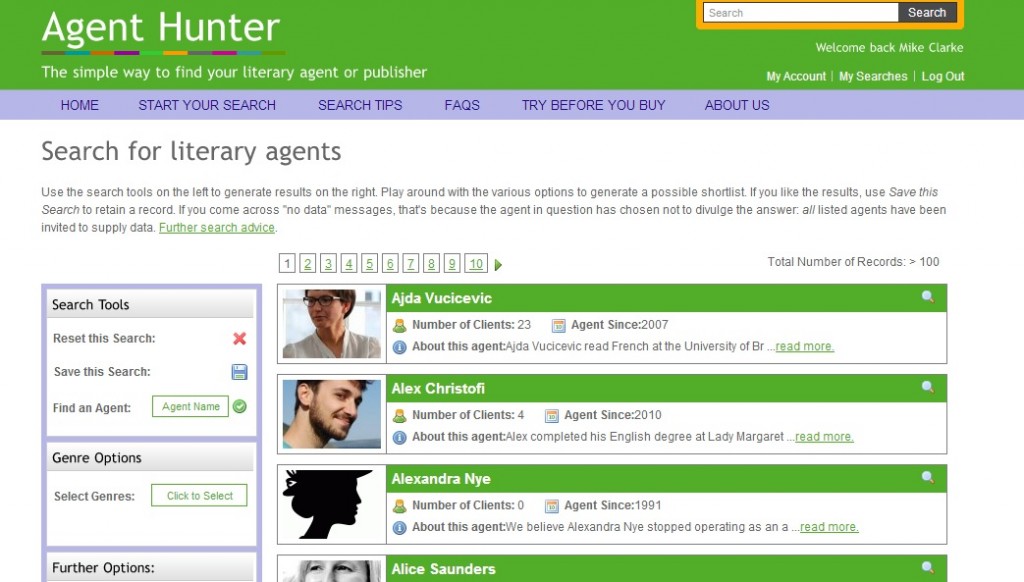
A List of Agents Generated by Agent Hunter

The traditional (pre-internet) method of finding agents’ and publishers’ details was to use a directory like The Writers and Artists’ Yearbook. Harry Bingham hasn’t set up Agent Hunter in competition to the W&A YB as he’s the author of two branded companion volumes — The W&A YB Guide to Getting Published  and their How to Write guide. Also, the W&A YB takes a broader and shallower sweep across many creative industries (including journalism, photography and artists’ markets – as the name suggests).

Most crucially, the book is an annual publication (coming out in the summer before the year in its title) and, for prospective authors, only deals with agencies rather than individual agents. As hard-copy submissions (including that infamous SAE requirement) appear to be almost universally being replaced by online alternatives of some form, most writers now probably use the yearbook as a starting point to research agencies’ websites.

The Agent Hunter Search Box

Largely being small enterprises (with a few big exceptions), agencies don’t tend to operate whizzy interactive websites full of bells and whistles (and some do have pretty basic sites) but most will at least list their submission guidelines — occasionally with automated ‘click here to attach’ links to make it easy for authors to submit to a central submission clearing system.

As well as lists of their clients, most agencies will also usually provide details of individual agents, maybe with a bit of a bio, along with the genres they’re interested in representing. When speaking to writers at events like conferences or talks to students, agents tend to stress how doing a bit of research on individual agents’ preferences is usually time well spent.

Often agencies are staffed by a mixture of senior agents with relatively full client lists and more junior associate agents who are much keener to trawl through the slush pile to find the Next Big Thing. If the agency’s guidelines allow it, these hungry agents appreciate being treated as individuals and contacted directly.

Conversely, a staggering proportion of agents’ rejections are for material sent to the wrong place — short stories, scripts, poetry, memoirs, sci-fi and fantasy (to a large extent) and so on tend to be handled by specialists and won’t be read by an agent who’s advertised a preference for, say, general fiction or romance.

So with all this information available on agency websites, what’s the advantage of using Agent Hunter? It largely depends on how much you value what else you could be doing with your time. Would you rather be writing your book than compiling a list of agencies and then trawling through the uneven content on agency websites? In monetary terms, the annual subscription, comes to just under two hours work at national minimum wage rates (sadly that’s quite a lot higher than the return on their time many writers achieve).

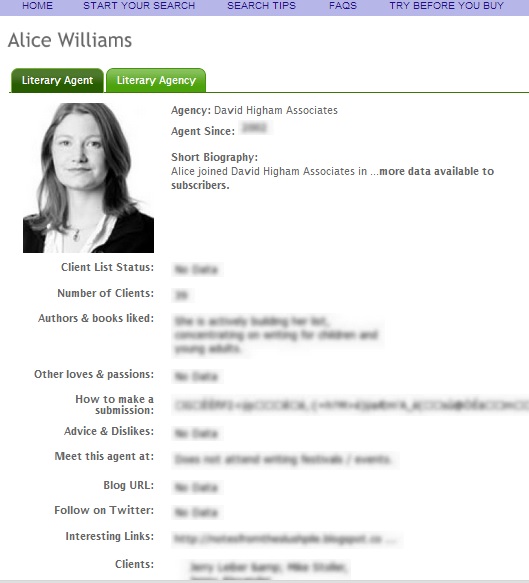
Agent Hunter also has an advantage that its information is potentially much more up-to-date than traditionally published sources. The database can also be more extensive and personal than the brief corporate CVs that often appear on agency websites. For example, extra biographical information can be added, Twitter names may be included, preferences such as whether agents appear at conferences and so on — see screenshots accompanying this post. (I think this line has convinced me that this particular agent might like my novel: ‘She likes the store Liberty, taxidermy and skulls’!)

Some advice on what an agent would like to see submitted (or not submitted) is also included on some entries, although it can be rather terrifyingly blunt. ‘Whilst we welcome genre fiction…we aren’t fond of writers who do nothing new with the established tropes of their chosen [genre]…We certainly don’t want to see books that we could have, essentially, read already.’

Or ‘Enjoys…stories with an emphasis on plot instead of endless pages of metaphor’. Damn, there I was, ready to submit my manuscript with its endless pages of metaphor until I read that!

There’s also some useful practical tips: ‘Slush Tip: Don’t send fresh produce with your submission. Currently reading a teen fiction manuscript splattered with exploded passion fruit.’

When You Sign Up You Get to Read the Blurry Bits

Another bonus is the uniformity of the data — making information from different agents much more easily comparable than with an online search. The database search is  handy, for example, if you want to filter out agents who aren’t currently building their list or aren’t interested in your genre. There are many different ways the search can be configured — it’s almost like online dating for writers!

And, perhaps like online dating, the amount of material fluctuates wildly that’s supplied by agents into the public domain to interest possible suitors . Some may as well have written ‘bugger off’ and be done with it, while others have offered information that’s actually quite helpful.

On the other hand, social media may lead to knowing rather too much about an individual.  In the few years since large parts of the writing community became some of the most enthusiastic Twitter users, it’s been possible to find out more than it’s probably advisable to know about some agents’ personal likes and dislikes. While it’s often very entertaining, and certainly diverting, to read about what meal an agent is eating, how their football team is doing, what outfit they’re wearing that day or to follow a Twitter gallery of photos of sleeping kittens, this information is likely to be filtered out in the Agent Hunter database.

Agents hate being pitched to on Twitter and some no doubt enjoy a bit of online interaction with potential clients. However, others are probably rightly cynical about the intentions of those who try to build up relationships via Twitter in the hope it might sway representation. At a talk I was at last month, one agent baldly stated that trying to cultivate any sort of relationship with a prospective agent was a waste of time — all they’d be interested in was the quality of a client’s writing, not the quality of their Twitter banter.

Interrogating the database to find an agent who’s right for you (at least theoretically) as an individual writer is a little empowering in a modest way — a welcome change from the ‘I absolutely, really, really must get an agent but how on earth will even one agent possibly read let alone like my writing out of the millions of others on the slush pile’ anxiety of the un-agented author.

As discussed in my MMU Text assignment, agents are now regarded, albeit at times unfairly, as gatekeepers to the traditional publishing word and, while I’ve met plenty of writers with agents who’ve yet to be published, for most types of book,  having the representation of an agent is normally a prerequisite to getting a publication deal.

As part of an MBA several years ago, I studied corporate strategy for much less interesting industries than publishing. But publishing isn’t a normal industry. I sometimes try to reconcile the way publishing works with classic models of business theory — like Porter’s Value Chain where the raw material gets shoved in at the start and then everyone involved adds a bit of value and gets a cut of the profit. But at least the acquisition part of publishing (the research and development bit) works so counter to this that I risk getting bewildered into a brain meltdown — and need to remind myself (in the words of Mel and Kim ‘that’s the way it is, that’s just the way it is’).

But it’s interesting theoretically to compare different industry sectors’ attitude to research and development. A pharmaceutical company or IT software company might spend 15-20% of its turnover on research and development (R&D) — on the intellectual property to keep new and innovative products appearing in the future.

The publishing industry arguably has a negative spend on R&D if one includes the market for ‘how-to’ books, literary events, self-publishing fees, courses run by publishers and agencies (and more in the educational institutions that also run courses and the like). The industry (in a broad sense) makes money from people wanting to do its R&D for it, as well as inundating agents and publishers with so much unsolicited material that it’s referred to by terms like ‘the slush pile’.

Publishers and agents may well counter argue that the majority of published books, as well as investment in new authors, should be regarded as R&D or speculative marketing costs because so few sell enough to make a decent return — with the industry kept solvent by bankable blockbuster authors and the rare unknown titles that suddenly take off (either out of the blue or with the support of a prize or similar publicity).

This is probably the case for most of the creative industries — there are legions of musicians, actors, artists, dancers (even chefs, bakers and the like these days) who, like writers, are toiling away for the love of it but also hoping that their talent is validated and recognised (and necessarily risking the investment  of that very fragile part of their ego in the judgement of others which is bound up in the endeavour of publicly exposing a creative project).

Even so, those lucky enough to get a lucky break also realistically know that even landing a good part or a recording deal won’t, on the balance of probability,  lead to fame and fortune and giving up the day job. As with writers and literary agents, most equivalent creative types are represented by managers or agents who take a percentage of their income as payment.

However, it’s arguably unusual that in publishing the intermediaries that are funded by a cut of the artists’ income also perform the function as gatekeepers for those who risk capital in the enterprise (i.e. the publishers). In other aspects of their job, agents will have a potentially adversarial relationship with a publisher (negotiating a good deal) but, in sifting new talent, they perform a function on the publisher’s behalf.

Actors will audition for directors, musicians will be send in demos to A&R departments or be spotted at concerts or online by record companies — the representation by the agent or manager tends (at least to my incomplete knowledge) to come at the point where the artist has already been offered a commercial deal. Maybe there’s something particularly time consuming about the assessment of a manuscript compared with walking into a bar and hearing next year’s headliners at Glastonbury. (However, agents and publishers often say they can make a decision on the vast majority of submissions by the end of the first paragraph.)

Are actors turned down for audition because they don’t have agents or bands not signed because they don’t have managers (real bands, not ones put together by the likes of Simon Cowell and Louis Walsh)?

Bearing this model in mind, and knowing how most agents, even those who work closely editing their clients’ work, thrive on the deal-making side of their business, it’s perhaps not surprising that some agents are a little ambivalent about the talent-spotting role that publishers seem to have thrust upon them. This may be why agents are now quite enthusiastic about taking on authors who have a decent self-publishing track record — they’ve proved there’s a demand for their work and the agent can maximise the commercials.  There’s a growing body of opinion that argues that a track record of self-publishing may replace the slush pile as a means of identifying new authors.

Certainly online communities that feature new writing (such as Novelicious) are attracting a lot of agent attention. I met a writer recently who was signed up by an agent on the basis of a serialised novel that she’d published for free on her blog (Emily Benet Spray Painted Bananas). And agents also keep a close an eye on other, more traditional, avenues, such as short story competitions.

But will I use Agent Hunter? Certainly. Although I have a good idea of the first few I’ll approach alreadyIt will be one of the resources I’ll use to draw up a list of likely targets once I’m finally there with a decent draft of the novel — and I’m not too far off — today I got some encouraging feedback from my MA supervisor on one of the last sections I decided to completely rewrite.  Watch this space for details.