Looking At The View

Sunrise Over Beacon Hill

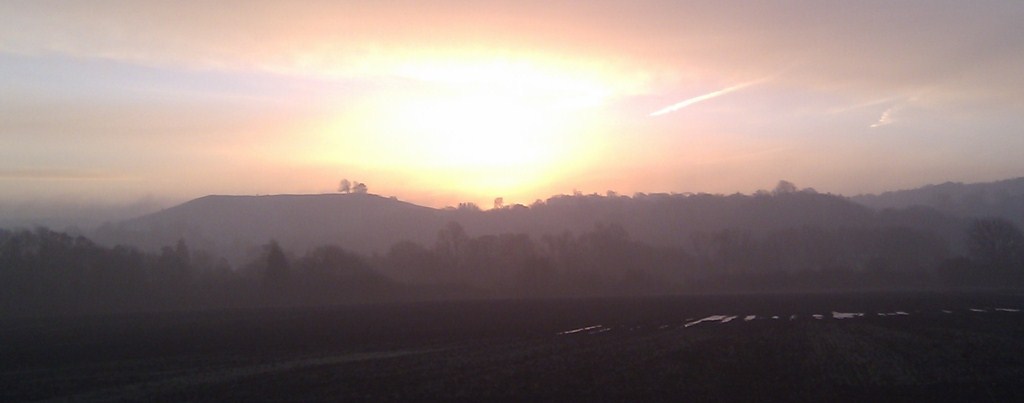
I was walking to the station a few days ago — the long way round because the footpath over the fields is too muddy (see the melting snow in the photo) and noticed a wonderful sunrise emerging over the tops of the Chiltern Hills, specifically Beacon Hill and Pulpit Hill (to the left and right respectively). I took a quick couple of photos with my phone and thought no more about them until I came to download some other photos to my laptop — and then was blown away by the way the camera had captured the moment. (The photo above hasn’t been altered in colour by any photo-editing software).

The beaming, beacon-like sun means I like this photo in a slightly superstitious, borderline-karmic way too because in my mind, the imaginary village where much of the novel is located approximately under where the sun is breaking through the clouds — just on over the scarp of Chilterns. In reality, there is already a steaming hot-bed of scandal and highly-secret political intrigue nestling on the other side of those hills. It’s called Chequers — and while what goes on in there is no doubt stranger than fiction, its stories are subject to the hundred years rule.

There’s something also a little Turner-like about the yellow blast of light spilling over so much of the sky between the hills, which also ties in with the novel. One of the reasons Kim considers leaving London for the countryside is that she wants to paint landscapes — something there’s limited scope to do in Shoreditch and Hackney. A German artist coming to Britain also draws on a strong tradition for landscape painting common to both countries — and a subject I’ve been learning about as I’ve been writing the novel.

Caspar David Friedrich is a dominant figure in early nineteenth century German art and his  landscape paintings depict a romantic melancholy that, it could be argued, reflects a strand of the German character – certainly a phlegmatic love of the open-air. I recently went to a lunchtime lecture at the National Gallery titled Caspar David Friedrich and the Tragedy of the Landscapewhich rattled through slides of dozens of his paintings, accompanied by an illuminating commentary. Kim will know Friedrich inside out.

Friedrich was a contemporary of the great British Romantic landscape artists, notably Constable and Turner, whose most famous paintings, such as The Hay Wain or The Fighting Temeraire, hang in the likes of the National Gallery. I went to the last weekend of the current Constable, Gainsborough, Turner and the Making of Landscape exhibition at the Royal Academy yesterday and saw a few of the lesser known paintings by the famous three in the exhibition’s title, as well as examples by many of their lesser known predecessors. Turner’s fishing rod was also exhibited!

However, the National Gallery’s Room 34, in which those two painting hang either side of the entrance door, always awes me. Unlike writers, whose physical works are interesting curiosities but lose nothing in reproduction, painters’ original works are fascinating in person because of their physicality. It’s fascinating to stand close to the Turners, in particular, and see the brush strokes and the varying thicknesses of paint on the canvas — there’s a direct connection between artist and viewer that’s unique in painting.

I had the chance at the Tate Britain’s new Looking at the View landscape exhibition to see the original of a print that hangs on the wall above my computer at home — John Nash’s wonderful The Cornfield (sadly the Tate’s website doesn’t show an image of the painting but instead suggests his The Moat, Grange Farm, Kimblewhich is of a landscape less half a mile away from where I’m currently typing).

I’d looked before for The Cornfield in the Tate and found it not on display so was very pleased to see it hung in the exhibition. I spent several minutes looking carefully at the way Nash had created the authentic, yet modernist,  representation of wheatsheaves and summer foliage in the original. It was also fascinating to stand back from the painting in the gallery and observe the way Nash had cast the low sunlight and lengthening shadows across the painting. Painted in the last summer of the First World War in 1918 in the Chilterns near Chalfont St. Giles, it’s such a beautifully understated painting that both nods back to the Romantic tradition and anticipates the disruptions of the early twentieth century that it features on the cover of the book of the David Dimbleby A Picture of Britain series of a few years ago.

The Looking at the View exhibition displays many classic works but chooses to display these alongside more modern works — often photographic — and so seeks to show that landscape painting is a vibrant part of the contemporary art scene — and not just about haystacks and water mills. For example, there’s a series of 56 photos called Concorde Grid by Wolfgang Tillman. They’re all taken around Heathrow Airport’s perimeter, in Hatton Cross, Cranford and Hounslow West in 1997 and, in addition to Concorde passing over , they feature things like the BA maintenance base (inside which I worked for four years and close by for an additional eight), the road sign on the A30 and what seems like a scrapyard on Hatton Road.

As the Tate exhibition shows (it runs until June), landscape is something that still holds a fascination for both artist and viewer and there’s plenty of scope for Kim to move to the landscape of the photo above and start to paint her own unique synthesis of Germanic melancholy, English pastoral, Berlin reinvention and Shoreditch cool.

And, in doing so, she’s almost retracing the journey of another famous (real) German artist — Kurt Schwitters — co-incidentally also the subject of a major current exhibition at Tate Britain,  Schwitters in Britainwhich I’ve also seen. Schwitters is most known for his collages, the lasting effect of which can be seen even now in most graphic art (e.g. magazines), inspired by his concept of Merz.

Like Kim, Schwitters came from Hanover, where much of his work is now curated in the Sprengel Museum. I used to go to Hanover at least a dozen times a year over a period of eight or nine years so I may have picked up Schwitters’s story without realising it. (I certainly remember the Sprengel Museum itself — it was near the Machsee, location for a wonderful beer and bratwurst festival in the summer.) But Schwitters being an entartete Kunst,  he sensibly fled to Norway and then to Britain.  He was interned for a while in the Isle of Man and the Tate exhibition has his original application, made whilst interned, to remain in the UK. It is typed in faltering English, describing himself being ‘called by the Nazis’ for being ‘a degenerated artist’.

The form is humbling and heartbreaking to read but also hugely uplifting, because the application was eventually successful and Schwitters was released to live freely in London. He subsequently moved to Ambleside in the Lake District, where he made a living by painting portraits and also made many paintings of the dramatic local landscapes. In 1948 Schwitters learned he’d been granted British citizenship — on the day before he died .

Sunset Across The Chilterns 20th February 2013

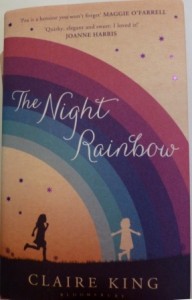
The Night Rainbow

Last night I went to my first book launch — Claire King, author of The Night Rainbow (published today by Bloomsbury) was kind enough to invite me to Daunt Books on Marylebone High Street for the event.

The Night Rainbow -- Claire King
My Copy of The Night Rainbow — Claire King

Unlike many of the people at the launch who’d read preview copies, I bought my copy of The Night Rainbow (plus a gift copy) at Daunt’s on the night (see photos) so I can’t yet give my verdict on Claire’s novel. However, as can be seen on the cover, the book is endorsed by quotations from some very well known authors and every review I’ve read of the novel has been very complimentary, as were people I spoke to last night who’d read The Night Rainbow in advance.

The novel is set where Claire lives, in the south-west of France and tells the story of five year old Pea and her sister Margot. Bloomsbury have produced a charming trailer that also builds on the cover’s distinctive artwork, which can be found here.

I’m very much looking forward to reading my copy.

There was a healthy turnout at Daunt’s for the launch and all evening Claire herself was surrounded by a scrum of people waiting patiently for her to sign their copies. But what was fascinating about many of the guests was that it was the first time that they’d met Claire in person (me included), as the event was a huge literary tweet-up.

I’ve exchanged tweets and comments on Claire’s excellent blog (I can’t remember which came first now) for quite a while now and have gradually come to know many people online who were also invited to the launch. Even though I’d come to know several guests’ virtual selves very well, I’d only actually met one other guest in person before last night —  Debi Alper, whom I’d had a chat with at the York Festival of Writing gala dinner.

By the end of the evening, I’d managed to say hello to a number of my most regular Twitter friends — who, in turn, introduced me to several fascinating new people I’m now following. I had a very enjoyable conversation with Isabel Costello, writer of the wonderfully titled Literary Sofa blog. And all evening I’d been hoping to bump into Pete Domican, a fellow Lancastrian, football fan and writer, whom I eventually met when we were both getting our books signed by Claire at the same time.

So thanks again to Claire for inviting me and giving me the opportunity not only to eventually meet her in person but also so many other Twitter friends — and, as we all said to each other, we all seemed to get on just as well in person as online. And it was a pleasure to share in Claire’s obvious pride and pleasure about the book’s publication — clearly the culmination of much perseverance and hard work —  and a great example to those of us currently toiling away ourselves.

Point of View


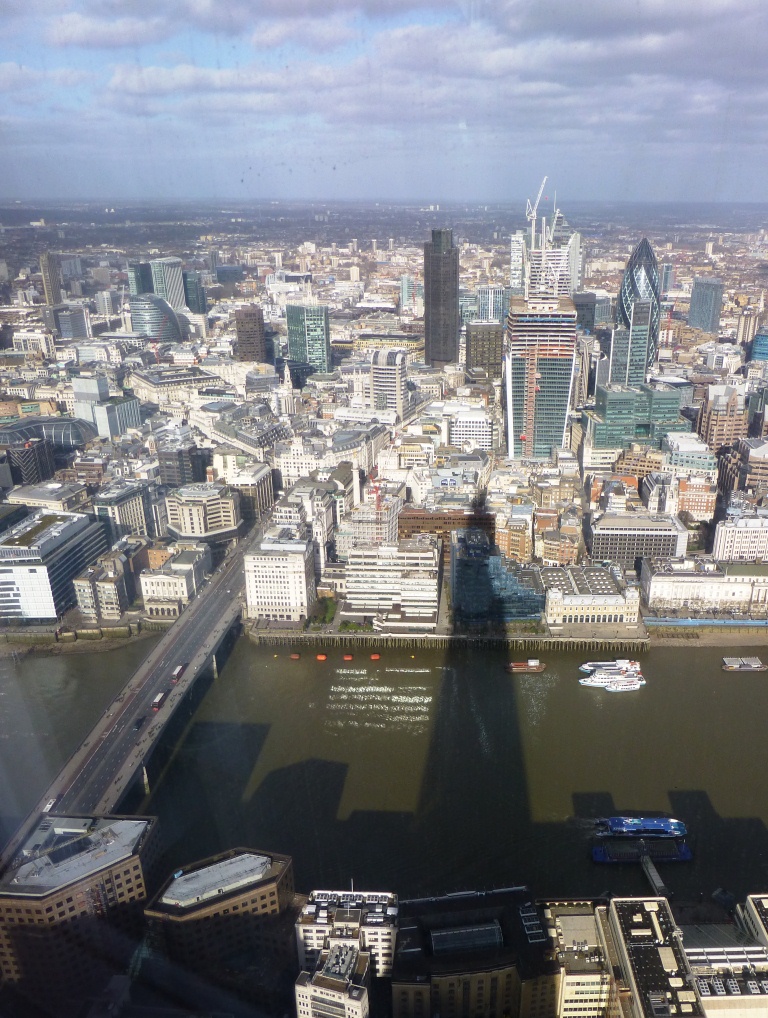
The Shadow of Shadows
A Shadow Amongst Shadows

The point from which this view can be seen is unique — with that tremendous triangular shadow — and it’s only been open a week. I must have been very lucky to have caught a moment where the sun was almost directly to the south of the Shard and low enough in the winter sky to have thrown that needle-like shadow long enough to cross the Thames and into the heart of the City itself. While I’ve reduced the resolution of the photos for quicker downloading, it can be seen that the tip of darkness points about a hundred yards directly east of The Monument — perhaps rather symbolic from the new structure in Southwark.

So — I couldn’t resist it. I splashed out my £25 and went up the Shard on Monday this week — only the fourth day the viewing platform, The View From the Shard, had been open.  Well, I had to really, after all, I’ve been following its progress while it’s been under construction and charted much of its development on this blog.

This post isn’t entirely unrelated to the novel. A significant part of The Angel’s plot happens in places photographed below, which I’ll mention, and I suspect there’s something quite writerly about enjoying a view like this from high above.

But principally, this post is an unashamed Shard-splurge and, rather appropriately, takes up a lot of vertical screen space — but, if you’re on the home page and looking for other posts, keep on scrolling as it’s all still there — just a long way down (like the River Thames above).

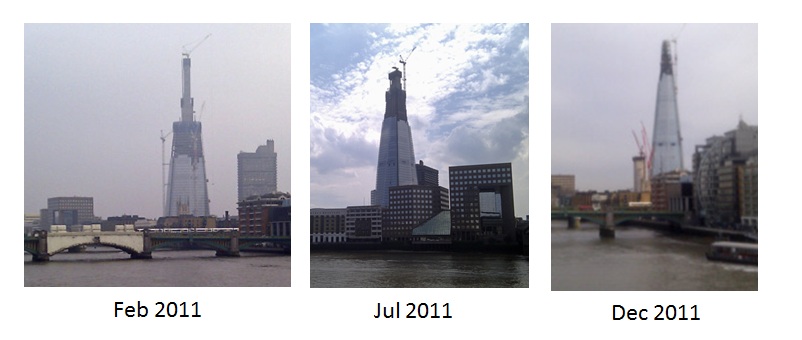
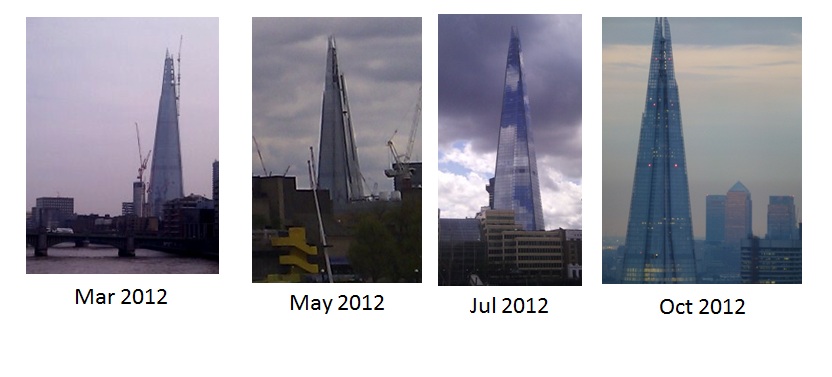
I’ve thumbnailed seven photographs below from in 2011 and 2012, most  of which have appeared on the blog. Taken from various viewpoints (anyone want to guess where?), the photos show the rapid pace of construction.

Here’s the Shard rising in 2011.

Shard's Construction in 2011
Shard’s Construction in 2011

The viewing platform is lower than might be imagined. It’s on the   highest of the steel floors that were slotted around the concrete core as it rose upwards. However, The pinnacle of the building (a considerable height as can be seen from one of the photos below) was prefabricated like a 3D jigsaw and assembled in Yorkshire before being disassembled and lifted into place on the top of the building.

Here are four shots from 2012. The crane has disappeared in the May photo but the lift along the outside remains attached. I was baffled at the time about how the crane at the top would be removed but the builders ingeniously erected a temporary crane on the side of the Shard close enough to the top to be able to reach up to remove the tall crane but accessible enough from within the building to be disassembled. Cranes fascinate me.

Sp the viewing gallery is around the point where the track for the exterior lift stops in the May 2012 photo. Even so, it’s very high, as can be seen by some of the pictures below, and it’s odd to think that slightly over a year ago the viewing platform was just empty sky.

Completion of the Shard in 2012

The dreadful weather in London over the last couple of years is noticeable in the series of photos — there’s barely any blue sky in any of the photos — even those taken in the summer.

By contrast, I was lucky with the weather when I was actually on top of the Shard. Monday was a bright and breezy day. Imagine pre-booking several tickets at £25 to find that the top of the Shard was shrouded in low cloud — something that will happen. Looking at the website’s terms and conditions, it appears that the management has discretion to provide a voucher in lieu of future use in these circumstances.

Although the top floor of the observation area is open to the elements, there’s still a safe wall of glass extending well above head height. The combination of glass and light entering from all directions means the viewing area, particularly the higher level, is tricky for photography (at least when it’s bright — next time I won’t wear a light-coloured coat). Half the photos that I took aren’t publishable on this blog due to smeary reflections.

As its marketing suggests, the View From The Shard is a well-organised and a friendly experience, if the chatty lift attendants are anything to go by. Unlike the London Eye, where by definition your viewing time is limited, visitors can stay all day at the top of the Shard (although entry is by timed-slot). Much attention has been paid to the detail, with an interactive map of where the four viewing platform lifts are positioned and even specially woven London sight-themed carpets. There’s also a little gift shop seventy storeys up. But as I queued in front of a large video screen for the airport style security scanners, I didn’t expect to see the scene below:

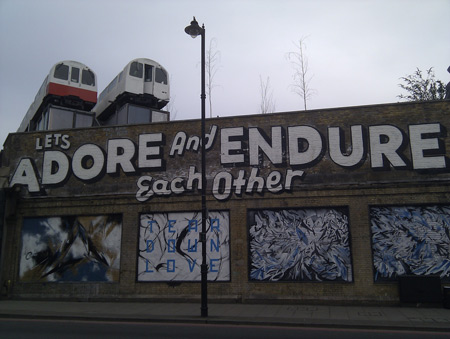
Village Underground -- Let's Adore and Endure
Village Underground — Let’s Adore and Endure

Yes — Village Underground’s facade on Great Eastern Street was entertaining the waiting tourists. (This is where Kim has her studio at the start of the novel.) It was part of a montage including Brick Lane and other ‘edgy’ urban attractions that shows how the urban street-art scene is now an established part of the London tourist experience. I asked Village Underground via Facebook if they knew their wall was being used as part of the Shard’s tribute to the capital’s culture — they didn’t but thought it was quite cool.

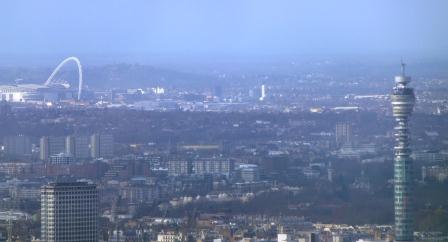
So, how far can you see? As this picture shows, I was able to get a  hazy view as far out as Wembley, with a fuzzy glimpse of Harrow-on-the-Hill and the Chilterns beyond. The hills of Essex and the North Downs are also visible from other directions but I’d love to go up on an exceptionally clear day with a pair of binoculars and find out how far I can see.

Wembley Arch and the BT Tower

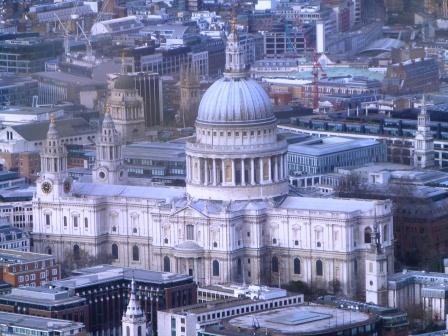
One paradox of the view from the Shard is that it’s a high enough perspective to avoid all the buildings that normally clutter London’s sightlines. Take St. Paul’s Cathedral. Although it’s a little distant and the view is necessarily from above, in this picture it’s possible to imagine how St. Paul’s used to dominate the London skyline until the second half of the last century.

St. Paul's From the Shard
St. Paul’s From the Shard

The St. Paul’s photo shows something of a parallel with narrative point-of-view. The height of the Shard gives an almost omniscient, third-person perspective — with enough information to see the big picture — how the components of the view or narrative relate to each other. And (with a camera or change in what Emma Darwin calls psychic distance) you can zoom in closer to the subject. But the trade-off of omniscience is distance and remoteness. Only by standing close to St. Paul’s can you appreciate its scale or touch the fabric of the building and feel its solidity. And to stretch the metaphor further, go inside the building and explore within.

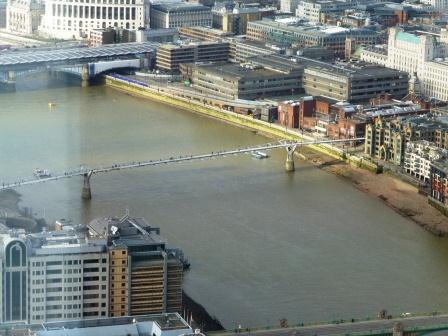
A significant part of the plot in the London section of my novel occurs around St. Paul’s and the Millennium Bridge also features.This photograph shows the elegance and economy of its design — leaving very little impact apart from a silvery filament connecting both banks of the river.

And it serves as a great metaphor — linking the commercial Square Mile with the two cultural icons of the Tate Modern and Shakespeare’s Globe on the South Bank. The top of the photo also shows part of the new, incredibly long, Blackfriars station which extends right across the river. Note the solar panels that provide half the electricity for the station.

Millennium Bridge from the Shard

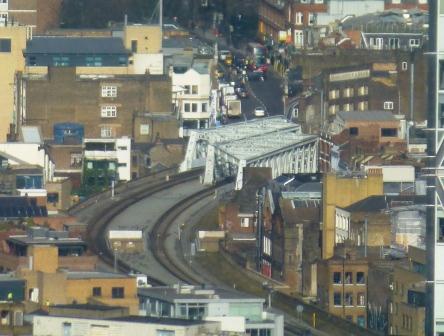
Having a camera with a (modest) zoom lens is obviously useful when you’re 300m up. Also, going back to locations in the novel, the below is a telephoto view of the bridge that takes the new Overground line across the top of Shoreditch High Street. The bus is at the end of Kingsland Road near the Geffrye Museum by a line of shops that features in a section of the novel connected with street art, although this piece might be one of the casualties of revision. I tried to spot Village Underground, with its tube trains on the roof but it appears to be hidden from the top of the Shard by the Broadgate Tower — which is at the extreme right edge of the photo.

This is a telephoto view of what I'm fairly sure is the bridge that takes the new Overground line across the top of Shoreditch High Street. The buses are on the end of Kingsland Road near the Geffrye Museum. The line of shops features in a section of the novel connected with street art, although this piece might be one of the casualties of revision. I was trying to spot Village Underground, with its tube trains on the roof. It appears to be hidden from the top of the Shard by the Broadgate Tower -- see the extreme right edge of the photo.
London Overground Through Shoreditch

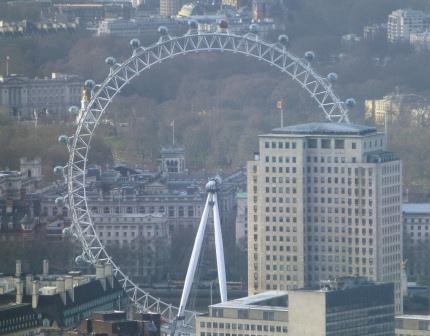
Here’s the London Eye with St.James’s Park behind. Buckingham Palace is around ten o’clock — it’s quite a difficult place to pick out — I had to describe the location it to a family who were particularly looking for it. This shows that the London Eye is in a far better location for sightseeing, being much closer to the main tourist sites. Unfortunately for tourists, most of the view from the east and south sides of the Shard is devoid of landmarks, although I’m quite interested in looking at ‘ordinary’ London from the Shard. Even though I like the Shard, I’m glad it’s not been constructed slap bang in the centre of London — imagine how out of scale it would look next to Nelson’s Column or Big Ben.

London Eye from the Shard with St. James's Park and Buckingham Palace
London Eye from the Shard with St. James’s Park and Buckingham Palace

It’s a shame the big beach volleyball stadium at Horse Guard’s Parade has gone. It would have been slap right in the middle of the photo.

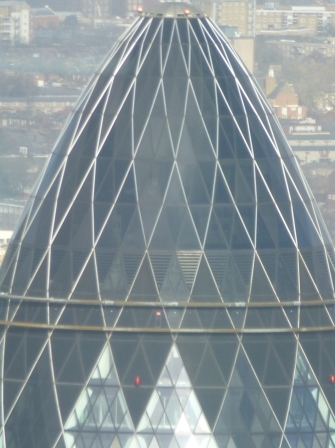
The height allows you to get up close for unusually personal views of better known landmarks from a unique perspective.

The Gherkin from The Shard

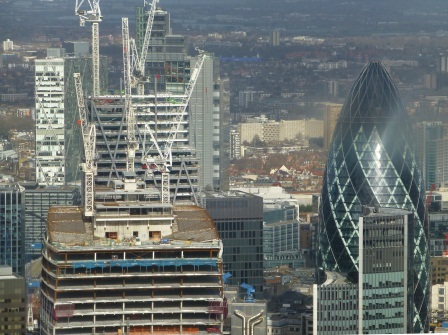
Sadly the well-loved Gherkin seems to be in danger of being obscured, especially from the west, by its new neighbours under construction — the Walkie Talkie and the Cheesegrater. Both are seen in the photo below, although I’m not yet sure which is which.

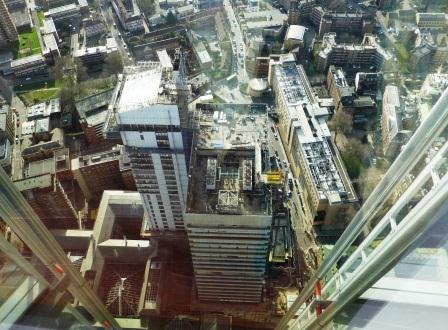
Cheesegrater and Walkie Talkie
Cheesegrater and Walkie Talkie Under Construction

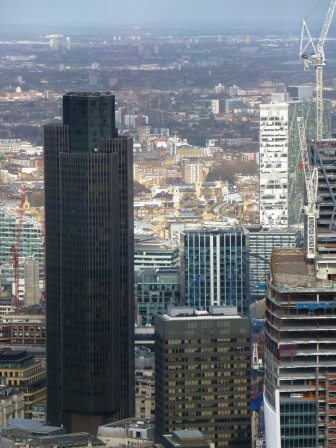
Slightly to the west (the other side of Bishopsgate) is the building that was the tallest in the country for many years — Tower 42 (previously the NatWest Tower). The perspective from the Shard shows how much the new record holder looms so much taller.

Tower 42
Tower 42

(Tower 42’s story partly explains why the opening of the Shard gallery is such an event. When it was the Nat West building, it was  severely damaged by a terrorist bomb. Terrorism was one of the reasons why other high buildings either closed to the public or never opened public observation areas at all — such as the BT Tower and Canary Wharf tower. Unlike many other cities, London had no public high level viewpoints, excepting restaurants and bars, until the Eye opened in 2000 — the Shard really is an innovation.)

The below picture also gives an idea of the Shard’s height — it looks down on the roof of Guy’s Hospital tower — which was one of the tallest buildings south of the river pre-Shard.

Guy's Hospital from the Shard
Guy’s Hospital from the Shard

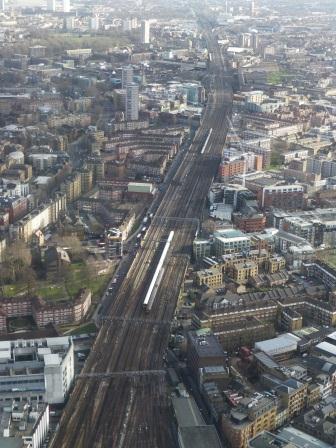
A sense of height is also given by the way the railway lines from London Bridge stretch out into the distance.

London Bridge Railway Lines

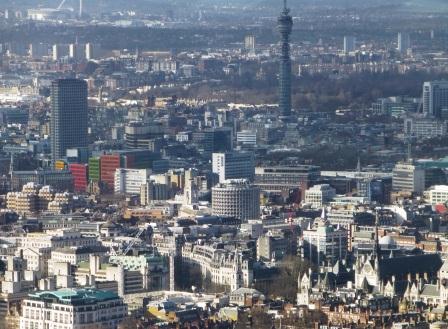
This view towards the north west shows how the BT Tower also stands high over Fitzrovia and Marylebone. In the bottom right there’s a good view of the Royal Courts of Justice and to the upper left the colourful, new St. Giles’s development stands out. (Maybe I should get a job as a London tour guide?)

Covent Garden and West End from the Shard

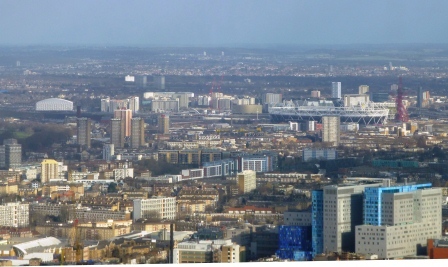
From this high up, the Olympic Park seems relatively close to the centre of London — much nearer than Wembley, although the Shard’s position itself is skewed to the south-east of central London.

East End and Olympic Park

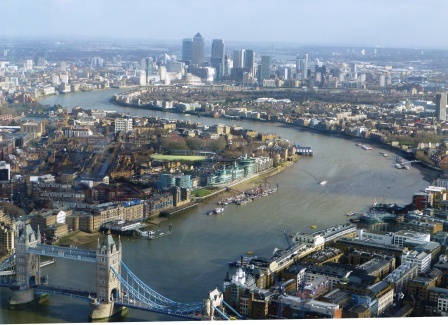
One of London’s most distinguishing characteristics is the meandering Thames — and the twists and turns of the river can be appreciating from the Shard as from no other perspective.

Thames Looking East and  Tower Bridge
Thames Looking East and Tower Bridge

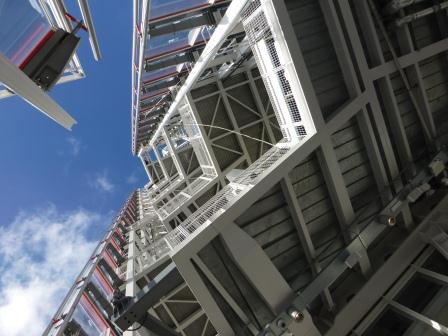
And yet the Shard’s summit is substantially higher than the public deck, although you’d have to have a hard hat and a remarkable head for heights to climb the pinnacle below to reach the very summit.

Shard -- Looking Up
Shard — Looking Up

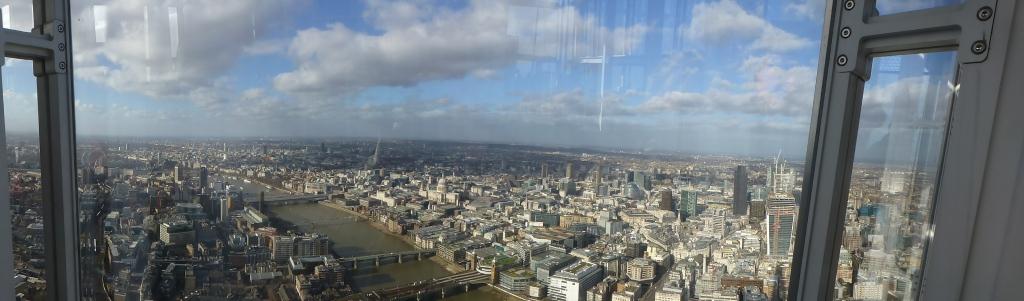
So, is it worth it? If you’ve got a morning or afternoon to spend and you’re interested with London’s geography already then you’ll be fascinated — but also if you just want to indulge a child-like sense of wonder of being so high above the rest of the city then it’s a unique experience. There’s something inescapably human about wanting to stand and look at a city in this sort of panorama. And, to bring it back to novel writing, think of all the many stories that are playing out down below.

Panaroma from the Shard

Panorama from the Shard

Parallel Lines

A Rana Begum Work in Her Studio

Last week I ventured into deepest Stoke Newington for another fascinating Love Art London event. I wasn’t sure what to expect in advance of visit to Rana Begum‘s studio.

The Love Art London website promised that ‘tightly controlled compositions, hard-edge lines coated in thick glossy resin, impeccably applied colour and seductively tactile reflective surfaces are all very powerful features of this extraordinary artist’s work. Rana’s paintings are each an exercise in rhythm, symmetry & repetition which satisfy the eye’s appreciation of order and beauty in its simplest form.’

Indeed. And this is an accurate description of the finished works — but we discovered that behind the discipline and order of Rana’s art there were also some fascinating stories, involving some chance and almost haphazard events, which are as fascinating as the geometry of the work.

Rana’s studio is hidden down the end of a mews just off Stoke Newington Church Street. On entering, it seems more like an engineering workshop than anywhere an artist might be at work, as you walk past metal cutting and sanding machines, propane bottles and stockpiles of aluminium. It’s a paradox when you meet Rana, who’s physically quite petite, that these industrial tools and materials are those with which she (and her team) create her artworks.

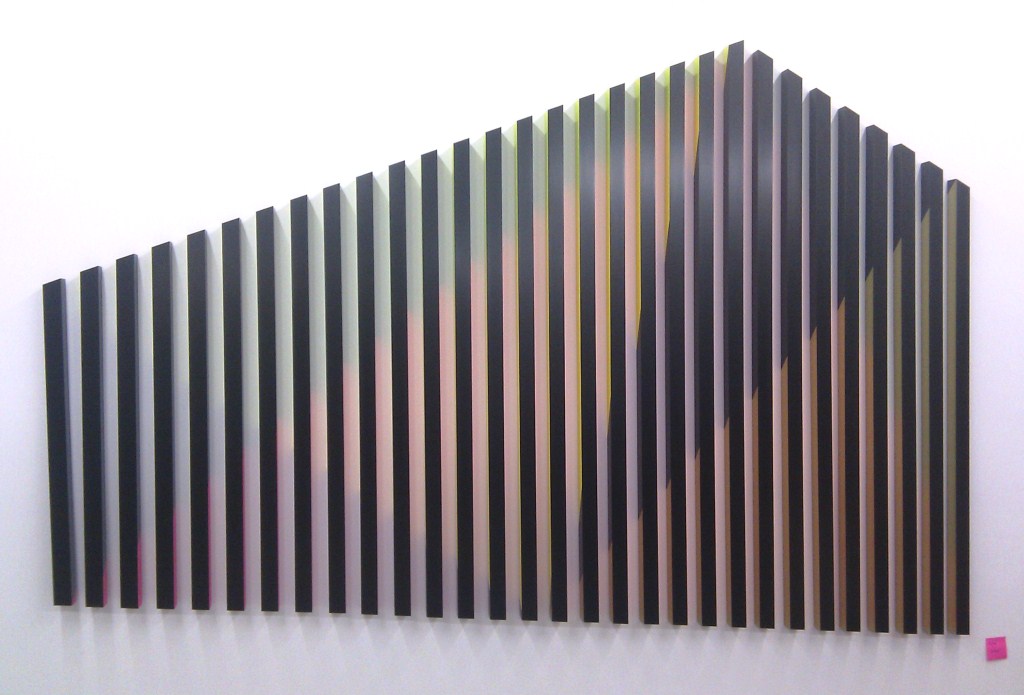
Although she is known to her team, uncompromisingly, as ‘the boss’, Rana was an informative, generous and charming host. As the Love Art London party trooped around her studio, she took us through the lifecycle of a typical piece of her work, a good example of which is in the photo above, taken in the studio.

For one of these pieces, using parallel metal bars, square sectioned pieces of aluminium are inspected and then cleaned, cut and sanded and prepared for powder-coating at a specialist supplier — usually in black or a neutral colour. Rana then carefully paints the surface of the material of the component parts as part of an overall pattern. These pieces of metal are precision engineered — to thousands of a millimetre — to ensure that they hang exactly in place.

As can be seen in the photograph above, the colour works in its own right, visibly applied to the metal surface. However, given a blank background and enough light, the colour casts a diffuse reflection on to the space in between the bars. If two facing bars are finished in different colours opposing each other, the reflection of  each interferes with its opposite to form a third colour, which often subtly changes in proportion to the quantity of its ‘parent’ colours (often the patterns taper along the inside metal surfaces).

When the piece is viewed as a whole, these interactions form a fascinating overall pattern within the bars. The photograph above is an example of this effect. It’s very clever – almost as if these industrial, inanimate objects have created their own artwork independently. Add the changing quality of natural light and these inanimate sculptures constantly evolve.

Rana has produced these large scale works for public spaces — one is on Regent Street — and other can be found in places such as health centres, probably a good choice as the pieces can be contemplated for a long time.

She also produces similarly geometrically orientated artworks in other materials — folding sheets of metal like origami and some amazing folding wood benches.

But Rana’s own story is also enthralling — and echoes some of the themes in the last blog post. She was born in rural Bangladesh but moved with her family to this country when she was eight, not being able to speak a word of English. She described how she may have expressed herself primarily through art in the period where she tried to catch up with the language — a skill she extremely modestly said she hadn’t yet fully mastered — don’t believe her, she has — I had a lovely, long conversation with her in the pub after the visit (which was so unpretentious that it ended with Rana pointing me in the right direction for the number 73 bus).

While Rana’s patterns are stark and geometrical, her studio had much human warmth, even eccentricity. There’s the evidence of her two young children’s about the place but it’s additionally home to two team members. One is Pierre, her French (I think) assistant who shares much of the donkey work of sanding and cutting metal. The other is Bob — a thoroughly down-to-earth, somewhat grizzled, East End bloke who, amongst other things, drills the keyholes in the metal so the works can be hung precisely.

It turned out Bob played another role in the Rana’s story – she’d actually bought the studio from him. They’d become acquainted while Rana was working in an artists’ co-operative studio in the building next door. Bob was looking to retire from his engineering business when, serendipitously, Rana was also looking for her own premises.

In a mutually beneficial arrangement, Bob sold his workshop to Rana but, realising that her artwork employed the use of some of his skills, he began to help out with the preparation. Some of Bob’s metal-working machines remain in the studio and he still pops in to help out a few days a week.  He told me he has no idea about the artistic side of Rana’s work but perhaps a trace of his non-nonsense stoicism comes through in the minimalist designs, regardless?

As a result, the studio is an idiosyncratic combination of corners full of Bob’s tools, with the accretion of the detritus of years of use, and Rana’s bright, clean minimalist office and exhibition space.  There are also areas of the studio where Rana gets thoroughly messy – I looked in the spraying room where the painting is done and I noticed shelves full of the Montana Gold spraycans I used in my own street art experiment.

Rana is a now a very successful artist, exhibiting at Bischoff/Weiss plus a gallery in Germany and in India, as well as the major art fairs, such as Frieze and the London Art Fair. I can’t help thinking her story, especially that of her studio, is something of a metaphor for how London has changed – and is changing – with artists moving into previously industrial areas of the capital. But in the case of Rana, she’s not displaced what existed before, but adapted it and worked with such an unlikely artist’s assistant as Bob, to create art that’s both new and inventive and also very reflective of its time.