As anyone who’d watched TV or picked up a newspaper since Christmas will know, 2012 is the bicentennial anniversary of the birth of arguably Britain’s greatest novelist. If you’re a person with more modern tastes in literature you may believe that the quality of his actual writing is less laudable (he uses plenty of adverbs and adjectives, omniscient narrators and other contemporary sins), you’d still have to concede the lasting influence of Dickens on British society and culture.
I would be interesting to see how a modern-day Dickens fared in a creative writing workshop. As Armando Ianucci argued in his recent BBC programme celebrating Dickens, it’s the writer’s gift for creating memorable characters, evoking setting, raging against social injustice and, above all, as a humorist that make his works so memorable — and so widely adapted into other media. Character, setting, theme and the ability to give a reader the sheer enjoyment of reading are vital ingredients of a successful novel but are very difficult to teach on creative writing courses that necessarily focus on analysing shorter passages.
I bought Vladimir Nabokov’s Lectures on Literature for my recent MA essay on The Rules of Creative Writing and Nabokov uses a lecture on Bleak House to examine Dickens’s techniques in detail. Nabokov identifies thirteen different different attributes of the style of Dickens’s language — including repetition, evocative names, plays on words, oblique description of speech, epithets and something called the Carlylean Apostrophic Manner.
Nabokov criticises Dickens’s storytelling ability but still rates his as a great writer, as well as a particularly enjoyable one to read. Bearing in mind the extended form of the novel Nabokov says ‘Control over a constellation of characters and themes, the technique of holding people and events bunched together, or of evoking absent characters through dialogue — in other words, the art of not only creating people but keeping created people alive within the reader’s mind throughout a long novel — this, of course, is the obvious sign of greatness.’
This last point is so obvious it often seems to be omitted from a list of techniques required by novel writers — ‘the art…of creating people [and] keeping [them] alive’ — all other novelists techniques are really subordinate this aim.
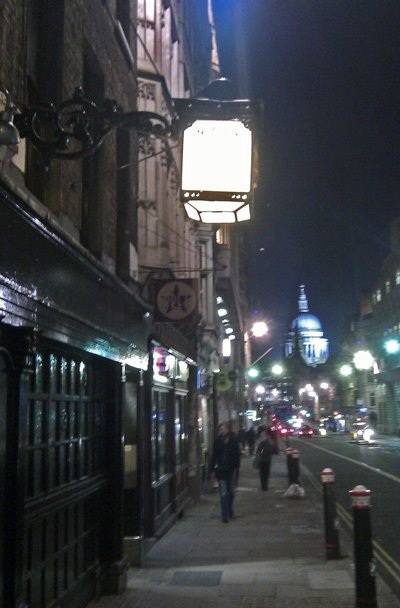
Dickens’s actual birth date is the 7th February, next Tuesday, but I’m paying tribute to the great man in a way that he would surely approve of — by organising a pub crawl around some of the drinking establishments that he visited himself and featured in his novels. So tomorrow (as I write it — Friday 3rd February for clarification) I will be leading a party in literary homage visiting the following places at approximately the following times:
6pm Cittie of York, 22 High Holborn, WC1V 6BS (Chancery Lane Tube) – The Cittie of York is on the site of Gray’s Inn Coffee House, mentioned in both David Copperfield and Barnaby Rudge.
6.45pm Knight’s Templar, 95 Chancery Lane, WC1A 2DT — not much of a Dickens association apart from being in the middle of Chancery Lane — so bang in legal London — it’s a Wetherspoon conversion of what was apparently the Union Bank.
7.30pm Ye Old Cheshire Cheese, 145 Fleet Street, EC4A 2BU — the current building dating to a rebuild in 1667, Ye Old Cheshire Cheese was one of Charles Dickens’s favourite pubs, along with many other famous authors. It is likely the inspiration for a pub on Fleet Street mentioned in The Tale of Two Cities.
8.15pm Ye Old Mitre, 1 Ely Court, Ely Place, EC1N 6SJ — Dickens was known to drink in the historic and secluded Old Mitre — a pub that has so much bizarre history (its licence used to be granted in Cambridgeshire until the 1950s) it could fill its own guidebook.
9pm Craft Beer Company, 82 Leather Lane, EC1N 7TR — close to Bleeding Heart Yard (in Little Dorrit*) but it’s the best new beer pub in London (*anyone know which flower’s most well-know variety is named after this novel?)
9.45pm The One Tun, 125-6 Saffron Hill, EC1N 8QS –Â The One Tun is believed to have inspired Oliver Twist. The Three Cripples fictional public house was located next door to the One Tun and a real-life Fagin lived nearby. Dickens drank in the pub from 1833-1838.
If you’re in any of those pubs on Friday 3rd February then come and say hello — although it might need to be a virtual one via the blog. If I say you’ll be able to spot me as I’ll be semi half-cut (a tautology I used in work submitted on my MA course) with a group of around half-a-dozen males looking desperate for the next ale then it won’t be much use as half the pub will answer that description.
Some of the historical information was gathered from Time Out’s recent Dickens edition and some from the interesting Digital Dickens site.
Anyone familiar with London will notice that this subset of pubs with Dickens associations is in the Holborn-Fleet Street- Farringdon-Clerkenwell area — not a particularly touristy part of the city even now — and one that changed a greatly in the nineteenth century with, among other developments, the culverting of the River Fleet in the Farringdon area in conjunction with the construction of the Metropolitan Railway — the world’s first underground. Â (Crossrail now means the Farringdon area is being dug up all over again.)
Even so, the area north of Hatton Garden around Gray’s Inn Road and Mount Pleasant and stretching towards King’s Cross retains a more raffish atmosphere than most parts of London — this was the territory of Bill Sykes and his presence still seems to permeate the area. Perhaps it’s the geography of the area — much more vertical separation than most of London with a roads on different levels and a few steep streets?
I’m attracted to exploring these lesser known parts of London and the characters in my novel will make a journey on the other side of the Fleet valley (the contours of a river valley are very noticeable, particularly where Clerkenwell Road crosses the Metropolitan Line near Farringdon station) from Shoreditch to Bankside via Hoxton, Finsbury, Clerkenwell, St.Paul’s and Blackfriars — not the areas you normally find on the open-topped bus routes.