Something Else That’s Nearly There

Shard 220312
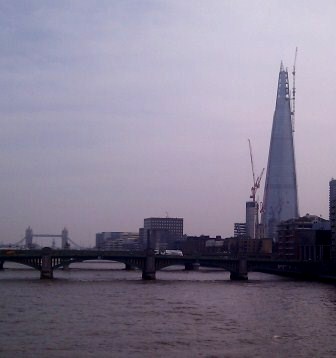
The Shard from the Millennium Bridge 22nd March 2012

The post below said that I’d been given good advice that one final push should see completion of a decent draft of the novel. Co-incidentally, that’s similar to the progress of something else that’s been featured in this blog occasionally (and pictures of which seem to get a fair number of hits).

The Shard is due to be finished by May this year. However, it’s still got a small way to go. I can see its progress most days from the office where I’ve been working (although, by definition, it can probably be seen from more offices than any other building now). The spire at the top is apparently complete but the uppermost floors aren’t yet finished.

I’ll be fascinated to see how the crane is removed. There’s a similar type of crane right next to where I usually work and I was really interested to see how that was erected. But that’s not 72 storeys up in the air.

So here’s a photo I took on a run last Thursday — there won’t be many more opportunities to photograph the building’s construction. Seeing as my novel features a lot of London, although its timescales predate the rapid rising of the Shard on the skyline, it would be a nice bit of karma (as a couple of my characters like to talk about) for both to be completed at the same time.

UPDATE: On the same day I posted this, the BBC website reported that the last pieces of the steel spire on top of the Shard had been lifted into place. They say the construction will be finished in June (does that I mean I give myself an extra month with the novel?)

A Most Critical Two Weeks?

Anyone who read the post from a couple of weeks ago ‘Out of the Chaos — A Manuscript’ might be wondering, in the style of a minor cliffhanger, what was the verdict on the 174,000 words that I believed I’d pieced together in a somewhat desperate and incoherent dash to meet my reader’s deadline.

The verdict has now been delivered and, to my surprise, it appears I’ve been overdoing the  mental self-flagellation. I received a report on the manuscript, followed up with a face-to-face meeting, that was, overall, very encouraging.

In fact, it was my professional reader’s opinion that with about two weeks of solid work I could craft the whole novel into a shape that would be of a standard to send out to agents – which is fantastic. This ought to certainly silence my inner-critic — the one that must have been responsible for the post dwelling on the manuscript’s shortcomings.

Of course, those two weeks are full-time writing work. This doesn’t include my current day-job, nor the hours sitting on a train I use to travel to it (as I’m doing now) – or family or social life. But, then again, I suppose it’s only seven solid weekends.

Before going into a little more detail I should reveal (now she’s said fairly nice things about it) that it was Emma Sweeney, who ploughed through the huge Word file and reported her findings.

Emma taught us at the very end of the City University Certificate in Novel Writing when Emily had left a few weeks before the end of term on maternity leave.

(As an aside, the Certificate in Novel Writing has now been revised and relaunched as ‘The Novel Studio’ with its first incarnation in this form starting in the autumn — Emily, who’s now Course Director is taking applications now and I know she’s made changes partly based on feedback from alumni so promises to be a great experience. Emma Sweeney is part of the teaching team on the new course.)

Emma also works individually with writers (see link to Emma’s blog). I know a couple of course-mates from City University have used her services as a mentor since the end of the course — Bren Gosling has mentioned this in his blog (see link on sidebar) and his first novel, ‘Sweeping Up The Village’, was recently short-listed for a literary award, the Harry Bowling Prize.

Emma’s blog also mentions that she performs manuscript appraisals.  For me, an unavoidable side-effect of having workshopped the novel in and out of various courses over the past two years meant that most people I knew who might cast an eye over the coalescing manuscript (course-mates, tutors and other very helpful readers) would already have more knowledge of it than they might ever have wanted — and would remember the history of its development.

What I needed was someone to read it with a fresh eye — which Emma was able to do but also with some prior knowledge of my writing (see Onwards and Upwards).

So, after a few delays and postponements, I finally sent Emma the novel as it stood, with all its imperfections. She turned it round very quickly — in just over 6 working days — which is impressive for a manuscript of that length.

Moreover, it was clear, both from her report and from our subsequent discussion, that Emma had read the novel carefully — which isn’t always the case with creative writing classes and tutors. Of course, this reading was a professional arrangement, which has a not insignificant cost to the writer, although this isn’t surprising if one considers the time taken to attentively reading that many pages. It’s very unusual to get more than 5,000 words read at one time by a tutor, even on advertised novel-writing courses.

As mentioned, I was amazed that Emma thought the manuscript itself was in much better shape than my doom-laden forewarnings had suggested. While some of the material was  hastily cut and pasted as rough drafts were re-arranged and intercut and sections that had heretofore only existed in my head were written down in skeletal, first-draft form, the combined whole was adequate (in conjunction with the more polished bulk of the novel) to give a decent account of the plot and characters at least.

But — did Emma think it was any good? Well, yes she did — and said some very positive things which I won’t dwell on here — but she added some significant caveats about issues that have to be addressed in those two weeks of revision. Issues like:

  • Some work making a character a lot more sympathetic (any ideas gratefully received — what about bringing in a 3-legged dog or something?)
  • Aspects of the plot need revising and some sub-plots need killing or fleshing out
  • Characters’ motivations require better development in places
  • Evidence of my tendency (as blog readers will no doubt recognise) to slip into rambling, abstract, academic style prose needs ruthlessly cutting out — this is good because the word count is too high and if this can be lost without abandoning the reader then it’s good news for me
  • Various amounts of copy editing to do in the sections I haven’t buffed up for workshops, etc.

But all the above are within the realms of the fixable and the Emma said she enjoyed the few days that she spent with my characters in the novel’s world. In fact, when we met face-to-face, Emma said she was automatically discussing the characters’ options and decisions with me as if they were real people — which was a very good sign.

Emma also said she enjoyed the humour and the psychological side to the characters and plot — sometimes I’ve mulled over the characters’ dilemmas for hours myself and still not resolved them. She also found some of the sensuous writing to be one of the novel’s strengths, which is very re-assuring. Emma is the first person to have read a lot of the sex scenes. I was in too much of a hurry while editing to think about losing my nerve and coyly dilute them. (There’s a particular scene she thought must have been very hard to write but that she thought I got right. If, dear reader, you ever have a copy of the finished novel in your hand, you’ll probably be able to identify it.)

One of the most encouraging observations was that she thought the nature of the writing — a fair amount of dialogue plus the way the story is told from the perspective of the characters — doesn’t make the novel seem as long as it actually is. She thought it read like a novel about two-thirds of its actual length. This is particularly comforting as I erred on the side of caution and put in the manuscript several sections that I’m probably 80% certain to cut – I wanted a second opinion.

I realise that because someone with a respected reputation has said she lies the novel (pending fixes) that there’s no guarantee that anybody else will who might progress it to publication. There are loads of well-written, unpublished books.

However, I may have a few thematic arrows in my quiver in terms of hitting the current Zeitgeist  — a novel about quitting the City pressure cooker in exchange for a hot pub kitchen with food, art and sex thrown into the recipe along with some interesting settings might have some commercial appeal.

But, that’s all idle speculation without a polished, complete coherent draft. So now I’ve got to go and chisel out that two weeks of writing time and then, perhaps, bite the bullet.

Venus and Jupiter Are All Right Tonight

Moon Venus Jupiter Triangle 2
Conjunction of the Moon, Venus and Jupiter 2100 25th March 2012

This isn’t a great photograph — a bit blurry and I did photoshop it a bit to bring out the contrast — but it shows the most marvellous conjunction of the moon, Venus and Jupiter that are in the night sky tonight.

Actually, it probably doesn’t matter that this isn’t a good photo as no photo can do justice to  the sight of the moon tonight — it looked unreal, like it had been stuck on the sky like one of those adhesive celestial bodies people attach to ceilings.

Fortunately there are very few lights outside where I live so the moon and planets were very bright (although I’m sure they could easily be seen in London) but the rest of the stars were also pretty impressive tonight. I’m deliberating about a chapter in the novel that contrasts the night sky in London with the view from the countryside and spectacular sights like tonight’s make me inclined to keep it in because of the awe inspiring sense of wonder one occasionally experiences through sights like that above.

Cash for Access — My Story

This photo might be more relevant for my other novel, that’s currently languishing on the back burner waiting for The Angel to be completed and sent off to its destiny, but it’s certainly topical.

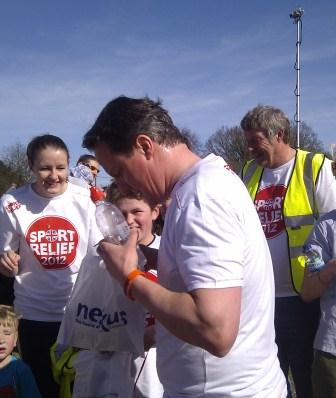
It was taken this morning after the Sport Relief mile at Prestwood. This is a village in the Chilterns, ironically quite close to the HS2 route, but also only about three miles or so from Chequers. I’ve done the Prestwood 10km race at least twice in the last few years, if not three times, and the first half of that course is painfully hilly — going up and down the rolling Chiltern slopes.

But the Sport Relief mile was confined to the sports ground from where the 10km starts and finishes and is totally flat — not a bad place for the Prime Minister to come and jog.

David Cameron After His Sport Relief Mile

This is my photo — I did actually get that close to him and it wasn’t my doing either — he just appeared next to me after he’d been in the sports club pavilion immediately after the run. It was all incredibly informal although there seemed to be a mobile CCTV surveillance van parked to keep an eye on things (the camera attached to a mast can be seen in the background).

And Cameron did actually run the mile with a couple of minders but also his wife and children and a few friends of his that I maybe should have recognised, but didn’t. By contrast, I can’t imagine anyone being let within a Sport Relief mile of Obama in an equivalent situation in the US.

I was on the lookout for some sort of celebrity when we arrived at the sports ground as I couldn’t see why else there were TV cameras plus four photographers with huge lenses if it was only a couple of hundred locals there — and just before the race started the Camerons appeared discreetly out of a little convoy of cars.

I’ve not watched any of the TV coverage but found a few links to the race. I’m on this one - just about…on the far left partially obscured behind a blonde woman with sunglasses…and I streak past in a blur in this ITV coverage on the Daily Telegraph site.

On a more minor scale I also saw David Lidington, who’s the Minster for Europe, in St. James’s Park last week and he recognised me and said hello (I’ve met him a few times, although I know his wife better to talk to — we saw her last time we went to IKEA Milton Keynes).

While Cameron was clearly on a photo-opportunity, he didn’t try and muscle in on the event and was quite approachable — something that is true of most of the politicians in this country and that we should perhaps give them more credit for? And the cost of this privileged access to the Prime Minister — £6 to charity.


Out of the Chaos — A Manuscript

I’ve been quiet on this blog for the last month or so for a a good reason, which is that I’ve been frantically trying to pull together a draft of the novel-in-progress to be professionally read by someone who knows me and my writing but has read little of this actual novel (I’ll reveal more later when she comes back and tells me what she thinks of it). However, how I got to this point — and the state of the manuscript — is a story worth relating first.

(There’s also a fairly tedious reason for the blog posts being more sporadic — the cumulative drag following the resumption of my daily grind into London to earn a crust doing the ‘day job’ — and even though I’m fairly new in this stint, my superiors seem to have twigged that the day-job, despite what it says on my CV is not actually my ‘passion’).

The most shocking discovery of the consolidation of many fragmentary files of novel was to find that I had 173,700 words — and that was after at least 20,000 words were dumped from the manuscript and with quite a few chapters either missing or in skeletal form.

I’d naively thought I could get the manuscript into reasonable shape before I started commuting again in mid January. This was way too optimistic but I eventually settled on a day I’d deliver a manuscript (early March) and then I had to push it back a week — partly because I fitted around work commitments in taking a couple of days leave to sit down and hammer out the manuscript. (That goodwill doesn’t feel as if it’s being reciprocated at the moment with a micro-managing boss who likes to suddenly appear at your shoulder and comment on what’s on my monitor — the kind of socially inept behaviour that one might hesitate to do with a trainee, let alone a supposed professional who he’s charging the customer a ridiculous daily rate for — that I don’t see much of. There’s a huge temptation to slip him in as a character in the next draft of the novel as revenge.)

But in the end, I managed to get a manuscript together of some semblance (it has a beginning, a middle and an end — of sorts). I wrote quite a lot of new material — including one piece for an MMU workshop that I stayed up until 6.45am in the morning to complete. Then I went to bed for an hour (it was a Saturday morning) and got the train into London for a 10.30am workshopping session with my ex-City friends on a piece I’d written earlier in the week.

To get the manuscript into one piece I worked for four days solid, getting up about 5.30am and working more or less steadily on it until about 10pm (quite a contrast with my enthusiasm for the day job). Even so, I know I’m still quite a way off getting anything that could be put in front of an agent. I was quite embarrassed that I’ve had to end up sending it in the state it is to my reader but at least I sent her something — perhaps this is some glimpse of what it may be to be a professional writer?

There were numerous ways in which it wasn’t wholly satisfactory:

  • Some sections were very sketchy (dialogue only) or even just brief notes
  • There were parts that are complete first drafts
  • There are, no doubt, many continuity issues involving times, plot events, minor characters (one changes nationality, people swap between driving a car and being a passenger), etc.
  • There were various duplications of exposition and no doubt many gaps too
  • Some of it is badly cut-and-pasted together so may not make complete sense.
  • There were definitely bits of content that I would have removed if I’d allowed myself longer to edit it.

While I think I’ve got lots more to do, I learned a lot from just pulling it together into one document (some of the files were so old that I had to do a bit of IT work with DOS command prompts and Excel editing to discover what was lurking in the mists of time on my hard drives — I even had to mine e-mail to get material that I’d forgotten to file away too).

One unique thing about writing a novel while on creative writing course is that the manuscript has largely been shaped by the demands of workshopping – and I’ve workshopped the pieces in a fairly random order as the novel wasn’t written sequentially. So due to the word count limits the novel tends to arrive in 3,000-5,000 word sections that are relatively polished then suddenly mutate into much rougher passages.

Also the sections of the novel were written over a period of a couple of years during which I ought to have learned something. I was quite dismayed when I went back to some material I’d written a couple of years ago, although I retained one chapter that was written in a completely different POV from the rest because I liked that one so much.

As it stands, from all the advice I’ve heard, the manuscript is probably significantly longer than publishers would want to consider for a writer’s first novel. If I could find an easy way of cutting it to a word count that publishers and agents might happily accept then then I’d be delighted. For example, I’ve just received some excellent feedback this morning from an ex-City coursemate who’s pointed out that I could easily lose about 5% of my word count in one recently-written section just by cutting out repetitions and echoing phrases in the dialogue and removing places where I explain in the narrative what the dialogue already states (or vice versa). I suspect a lot of the novel could be shrunk down by a similar ratio.

However, the question is whether to cut big sections and to leave the rest of the book fairly intact or should I edit down each and every sentence for brevity. I suspect that it’s a combination of both but I do think that novels with humour and social comedy will tend to, almost by definition, use more words for a given scene than thrillers and straight dramatic narratives. This because you’re often trying to surprise readers and to set up unusual situations to create the humour. My current MA writing tutor is a big fan of ‘what’s not said’ (or leaving material out). I’m intending to do this on a structural level in the narrative but, while I see the argument, I’m not convinced this can easily be done in a quirky humorous genre because a reader will inevitably fill in the gaps in the most straightforward and logical way — you can allow them to do this (as you might with suspense) in order to set up a punchline or joke but you still have to use the extra words in the end to create the humour.

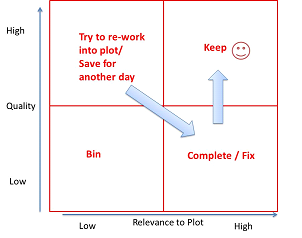
To illustrate the point, here’s one I drew up that I think illustrates the point I’m at with the novel. I have good bits and not so good bits and parts that are relevant to the plot and sections that are more tangential. These can be mapped on a quadrant a bit like this:

Novel Revision 'Magic Quadrant'

And a note to any management consultants reading this who fancy ripping this off — the quadrant is mine (maybe I’ll write a creative writing book one day for burnt out consultants who’ll love this stuff?). In the meantime, I’ll license it to you for big bucks if you grovel.

So basically that means I have badly written material that’s essential to the novel plot and better written material that’s not so crucial. Rather than the facile (and perhaps deliberately sabotaging) advice of ‘kill your darlings’, I think I’d rather be more eco-friendly and recycle them back into the plot.

I have a list already of many aspects of the novel that are inconsistent and wrong and just plain embarrassing. But I’ve also come up with a list of really good additions and tweaks from sitting down and assembling it as a whole. Seems scary to think of putting more in a 173k document but hopefully I’ll get a second opinion on the stuff that really needs weeding out.

However, I’ve also wondered whether I could get two novels out of this and whether that might be another option (although I’d need to alter the narrative and the general structure) — though if any agents are reading (one can live in optimism), my intention is to try and get to about 120,000 words eventually, if possible.

I guess it’s not surprising that the novel is so long when I routinely write blog posts that are more lengthy than virtually anyone else’s. I guess the tangential nature of this blog is also reflected in the novel text.

But it might be incoherent, full of faults and inconsistencies and, in places, mystifying to read but the draft is done. Now I can try and get more than 5 hours sleep a night.

Thatch

Red Lion Avebury from This Is Wiltshire
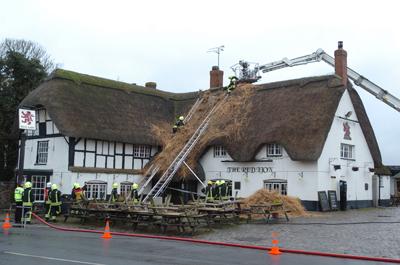
Fire At Red Lion, Avebury from This Is Wiltshire

I’ve always had a soft spot for the Red Lion in Avebury — it’s the most typically English thing imaginable — a half-timbered, thatched pub situated right in the middle of one of the most significant ancient sites in the world — the famous stone circle.

In a typically English prosaic touch, the pub isn’t preserved in an idyllic garden but has a busy A-road passing right by the front door — and, when I’ve visited, this had brought a load of bikers stopping off to provide the pub’s clientèle — not ruddy-faced yokels.

In the current draft of the novel, it’s mentioned at least twice (Kim and Emma are into the stones’ energy) — and the exterior looks quite like I imagine The Angel itself to look — particularly the thatching.

As the photo shows above, the Red Lion became one of the many thatched hostleries to catch on fire — fortunately this was contained in the Red Lion’s case but I know at least three pubs (at least two that were thatched) that have burned down into a shell in the last ten years within 15 miles of where I live: the Woolpack, Stoke Mandeville — rebuilt extraordinarily quickly; the Bottle and Glass, Gibraltar (between Aylesbury and Thame); and the Rising Sun, Ickford (a village in the wilds up near J8 of the M40). Fortunately all have been rebuilt and all are thriving.

So, thinking of plot ideas, if I have a lovely thatched pub in my novel, it wouldn’t be too improbable for some similar catastrophe to hit the building, would it?