Shardenfreude

Google Analytics tells me that there must be a lot of disappointed people who happen to land on some of this blog’s pages. Aside from my ardent and dedicated regular followers people land on the blog by via search terms that generally relate to subject that I’ve tended to mention in passing.

But today I can satisfy a  group of people who are fans of an iconic sight that’s slowly emerging by London Bridge — the Shard (otherwise known as London Bridge Tower).

The previous blog entry of photos of the Shard has had more hits than virtually anything literary (bar the write-ups of talks by agents and editors during the City Novel Writing course).
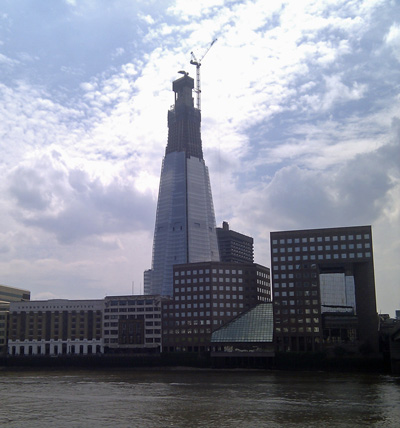
The Shard From The North Side of London Bridge
The Shard From The North Side of London Bridge -- 5th July 2011

So here’s another fix for those fans of the soon-to-be tallest building in Europe. All are photos I’ve taken while running from Westminster up to the City along the Thames — out on the north bank and back on the South Bank.
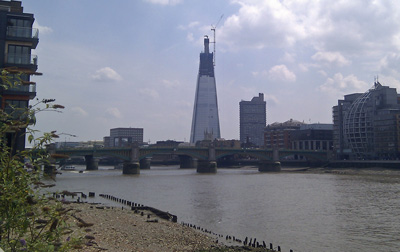
 

Shard from the North Bank of the Thames 5th July 2011

They’re taken on occasions separated by 20 days — and on initial impressions it doesn’t seem that the Shard has risen much higher over that period — perhaps they’ve all been on holiday? Or maybe it’s because the building is so huge that it’s an effect of its scale.
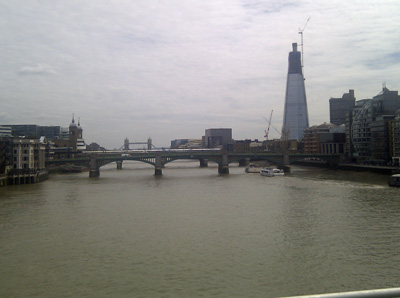
The Shard from Guess Where -- 25th July 2011

Actually, I’ve learned from Wikipedia that the concrete core has reached its ultimate height of 72 storeys and that it’s now the floors for each storey that are being added — at a rate of one a week. Three weeks’ progress can just about be discerned between the photos. (btw It’s not a cropping mistake that there’s so much of the River Thames on the above photo — there’s a little hint of where it’s taken from in the bottom-right corner.)

But why am I putting lots of photos of construction work on a blog that’s (meant to be) about my long and discursive journey towards completing my novel(s) — and, with a bit of luck, beyond that?

But I’d argue that the Shard is just the most prominent example of a theme that runs through The Angel. It emphasises the dynamic, changing environment of London — and, being designed by an Italian and financed with money from the Middle East, it’s also an example of the internationalisation of the city.

I have a character who’s been drawn to London because, compared with anywhere else, she really thinks it’s the place to be. And unlike many weary Britons who believe themselves over-familiar with the city, she’s enthralled by discovering the place and the rapid change that’s happening around her makes it even more enjoyable — there’s lots of tradition but there’s also a lot of re-invention.

It’s difficult to overstate the amount of prominent new building that has taken place in London recently — and how distinctive the majority of the new architecture has been. I happened to come across Kenneth Powell’s book ’21st Century London — The New Architecture’ in Tate Britain last week. It’s a superb book for anyone interested in the development of contemporary London.

The list of structures put up in the last 11 years is almost awe-inspiring – and, being an artist, Kim is going to have an eye for good architecture.

Firstly, there are the obvious but hugely popular Millennium projects, such as the London Eye, the Millennium Bridge and the derided but distinctive dome that has now turned into the O2 arena.

With public transport being a bête noir of Londoners, it’s easy to forget the huge investments in transport infrastructure. I was pleased to see that Powerll agrees with my appreciation of the Jubilee Line extension’s transformation of Westminster tube station, which is like something out of a science fiction film.
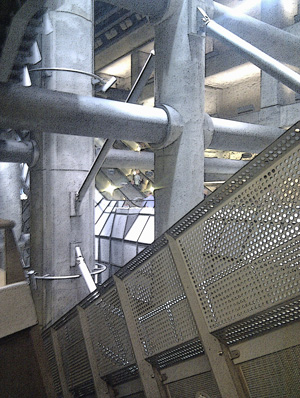
Westminster Tube Station
A Whole Series of Blake's 7 Could Have Been Filmed in Westminster Tube Station

Canary Wharf underground station is mind-blowing: it reminds me of the interior of a cathedral more than anything else — such a huge space suffused with natural light. The restoration of the huge canopy of the Barlow train shed over the tracks at St.Pancras station for the high speed rail link has been immensely popular, as has the development of the rest of the station — and there are much improved Thameslink and underground stations (I often used Kings Cross-St. Pancras on the way back from City University).

And there’s more on the way — right next to the Millennium Bridge (on the run I took the photos on), Blackfriars station is being transformed into something that will span both sides of the river. The corner of Tottenham Court Road and Oxford Street is also one huge building site (as I saw from the top of a number 24 last week), as is the area round Farringdon (and a few other locations) while Crossrail is being tunnelled. With Thameslink also being improved, London will have a couple of cross-city railways of the type people have always complained are commonplace in, for example, French or German cities. (There’s also the massive Heathrow Terminal 5, which like a few of these projects was derided at first and then eventually appreciated for being a tremendous piece of infrastructure.)

Then there are the marvellous renovations of iconic buildings: the Great Court at the British Museum, the Royal Festival Hall and, of course, most pertinently to my novel, the conversion of Bankside Power Station into the Tate Modern.

The office buildings in the City are probably the tallest and most noticeable developments. As well as the Shard, there’s the iconic Gherkin (30 St.Mary Axe), the newly finished Heron Tower, the Pinnacle (under construction in the City, which will be almost as tall as the Shard) and the Broadgate Tower (which looms over Village Underground — although less than originally planned as its height was scaled down).
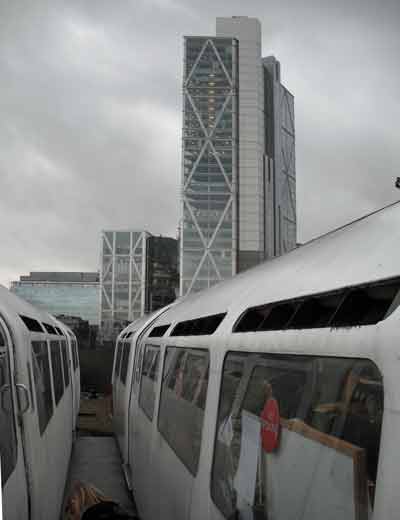
The City Encroaching On Shoreditch
City Encroaching On Shoreditch

Not all the big office developments are in The City. There’s the colourful Central St.Giles development (those yellow, red and green faced buildings), the Wellcome Trust building in Euston Road (a place I know some of my writerly friends use as a congenial venue to discuss their novels) and buildings I never knew had a great architectural pedigree, such as Palestra, near Southwark tube station, which reminds me a bit of a broken Rubik’s cube.

It’s not all work — there’s plenty of play. Two of the best stadiums in the world have been built in London in the last ten years. There’s the new Wembley Stadium, which is the second-biggest stadium in Europe and probably the best in the world for facilities (and I’ve just been extorted out of £92.50 for two tickets there to watch England vs Holland in a couple of weeks time). The Emirates Stadium shouldn’t be forgotten. I often used to fly over and think it reminded me of a giant Arse — quite appropriate for a club whose name oddly recurs in the names of its staff: a manager called Arsene and a striker named Arshevin.  (I’m a Man Utd fan).

There’s a huge amount of redevelopment in London since 2000  — but there’s even more to come. At the start of the novelKim lives around Homerton in a tall block of flats (on the number 30 route) so she’s also been able to look out on the progress of the biggest transformation of the lot — the 2012 London Olympic park. This is home to some apparently incredibly inventive buildings — but the public’s not allowed near them at the moment. We’ll only be allowed in on the first day of the event itself…

…which begins exactly a year today. London will then be even more the world’s most international city.

And I hope I’ll be able to put my feet up and watch it, which I’ll have to do almost entirely on TV — although I did get a meagre ticket allocation out of the farcical process. Some will not be surprised to know they’re for beach volleyball — my excuse is I was working my way through the alphabet — I was also going for athletics! And in a year’s time I also hope to have long since put the finishing touches to The Angel too.

Not Balderdash or Piffle

I always thought Victoria Coren — of Balderdash and Piffle and Only Connect was an intelligent person but now I realise she’s a rarer breed — an intelligent person who’s not a cultural snob.

In her column from today’s Observer (retweeted by Carole Blake) she ranges about familiar targets of intellectual derision, such as Harry Potter and Michael McIntyre, and exposes the very unpleasant assumptions that lie hidden beneath the snobbery.

However, it’s her story about how a King Lear DVD has become a surprise bestseller at Poundland that hits home because it ties in closely with the arguments in Jonthan Rose’s book The Intellectual Life of the British Working Classes (review from the Independent here and Guardian here). Coren’s comment is true of far more walks of life than the literary:

Give it six more months, a million more sales, and we’ll start hearing that King Lear is a rubbish play from a second-rate crowd-pleaser; John Webster was always the man.

This makes the powerful point that many people marginalised by traditional intellectual educational establishments still have a thirst for the pleasure and satisfaction achieved through classical, literary or artistic knowledge. It seems to me that one of the most grievious mistakes the left has made in the post-war era is to conflate a lack of formal higher education with philistinism.

The comments she makes about the demise of The News of the World also resonate with me. It certainy wasn’t my Sunday newspaper of choice but I can’t believe that everyone gleeful about its demise was motivated by concerns over voicemail privacy.

The same principles hold true in novel writing: the closer one comes to the language and experiences of ‘normal people’ the more people will try to dispute your characters motives and credibility. If one writes about a nineteenth-century, deformed, psychotic serial killer then few people in a creative writing workshop will try to put themselves in the position of the character and try to question his (or her) motivations — and they’ll discreetly leave it to the author to work on his or her impressive feat of the imagination.

Yet write something set in the present day about someone who’s been working in an office whose marriage is a little unfulfiling and there will be

Fields Inspired by Eric Ravilious

One of my favourite paintings — and one that is very germane to The Angel’s setting is John Nash’s The Cornfield, which I’ve blogged about previously. It’s relatively well-known, providing a motif for David Dimbleby’s BBC series on landscape painting a couple of years ago and can be viewed here on a link to the Tate Britain website.

Clearly the painting captures a specific moment in the agricultural year — the bringing in of the harvest — and as it was painted in 1918 it predates any mechanisation. The Nash painting depicts a line of wheatsheaves (amazingly the word ‘wheatsheaf’ isn’t in my wrist-sapping Oxford Dictionary of English). They’re portrayed almost anthropomorphically as semi-human figures (a little like monks with hassocks tied around their waists) and they look tired, weary and irregular, but still form a semblance of a line, much as one might imagine was the mood of the country at the end of the First World War.

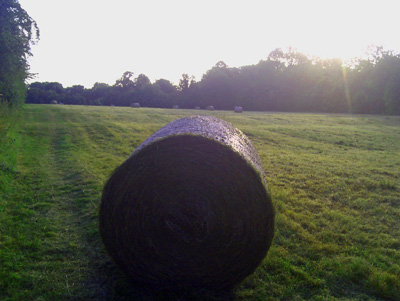
I took the photograph below at 6.30am on the 15th July (St. Swithin’s Day — as immortalised by David Nicholls) on the way to get the train. (This is my bucolic route to the local station, which is wonderful on a July morning but awful on a rainy, muddy January evening). I’d walked the opposite direction the previous night about 6pm, when the grass had been cut but not baled. One point about the reduction in the number of farmers is that when the remaining farmers are busy, then they’re really busy. When the wheat is ready to bring in the combine harvesters work through the night. So it’s not surprising that the cut grass had been baled over the course of the previous evening.

Modern Cornfield?
A 21st Century Cornfield?

Although these bales are of meadow hay and not corn (which meant wheat when Nash painted his picture) I later realised that there was something of a parallel. Rather than sheaves that are designed to be gathered in the arms, these cylindrical bales are so huge they can only be moved by a fork-lift truck (or its tractor equivalent) — there are no more than a dozen of them in the field, which must be a good three or four acres. So my photo, with its long shadows,  is similar in spirit to Nash’s painting but also shows the differences.

I was reminded of Nash because I paid a brief visit today to Tate Britain in Millbank, which is where The Cornfield is on display. I didn’t have time to go into their current Watercolour exhibition but I saw a few reproductions of the pictures elsewhere in the gallery. I was particularly struck by Eric Ravilious’s The Vale of the White Horse, featuring the genuinely ancient prehistoric monument which is just off the Ridgeway in Oxfordshire.

If you were to follow the Ridgeway from the Uffington White Horse north-east for about fifty miles, you’d end up at The Angel (in fact I might use a bit of artistic licence and have the Ridgeway go past the front door, as it does at The Plough at Cadsden). And Kim will be wonderfully excited about the connection between the land and  the art — she’s going to take the Nashes and Revilious as inspiration.

There’s also a profound irony about Kim’s interest in Ravilious — like the Nashes he was a war artist — but unlike them he died in action. He was killed in an air-sea rescue mission in 1942 off Iceland.

Another serendipitous connection is that there is a brewery named after the White Horse.Their beers include two that are well-known to me — Wayland Smithy and, er, Village Idiot.

Unlocking English as a Second Language?

I’m writing about a character who doesn’t have English as her native language, although she’s lived in London long enough for English  not to be accurately described, perhaps, as her second language — more her first through usage and acclimatisation.

I’m therefore always interested in the idiosyncrasies of how non-native speakers construct their English speech. Germans, like Kim, are generally very precise — although they often literally translate German grammatical construction (quite often possessives — like ‘the department of Mr Schulze’) and occasionally get tripped up on word genders (talking about inanimate objects as he or she).

But most young people who have constant exposure through living in this country will tend to speak very fluently — picking up English figures of speech and phrasing. They might sometimes want to draw attention to their ‘otherness’, though, as Kim does — which sometimes comes across on the page as inconsistency — although it’s deliberate on my behalf.

So I think Kim would have been more than bemused by this shop window in High Wycombe — on the main shopping street too. I’m sure she’d be horrified —  she’s a cultural snob and very proud of her own language abilities.

It’s hard to know where to start in terms of listing the errors in the huge poster — but, despite its mistakes, it makes itself understood — in a similar way to how very limited English speakers often get their message across — perhaps one of the reasons why English is such a ubiquitous language?

We Can Unlocking
Phone Shop Window in High Wycombe

Art for Art’s Sake?

I’m not sure about Kim’s personal taste in modern art but with her training she’d be sure to be able to hold forth about Cy Twombly, the American painter who died last week, and was the subject of some posts on this blog from around 18 months ago when I first saw some of his work in the Tate Modern. Here’s a link to the Deutsche Welle website report on his death to show his influence in Germany.

Cy Twombly's Work -- From the Telegraph web-site

I guess she’d quite admire the scale and audacity of the work as I did — and the vivid colours. Yet work like Twombly’s certainly encourages those who see modern, abstract art of displaying as much technical skill as a child’s painting and of suggesting those who proclaim themselves the arbiters of its undoubted quality are those who would insist that the emperor was fully clothed — as this blog entry on the Telegraph website by Harry Mount makes clear.

Kim will produce mainly abstract works — partly because it will be amusing to see James struggle to make head or tail of what they mean — but she’s be technically trained to a very high standard, something which will hold James in awe of her talent and provide a reason for his attraction to her — which is an engine of the plot. James won’t ‘get’ the likes of Cy Twombly but Kim will try and explain to him why Twomby’s work sells for millions — but perhaps she’ll question why it is that his does but her own doesn’t.

Speaking of silly money paid for art, BBC1 on Sunday featured a programme called‘The World’s Most Expensive Paintings’ in which Alistair Sooke, an art critic, did an Alan Freeman style reverse countdown of the Top Ten. As all were in the tens of millions of dollars bracket and the most expensive — one of the Picassos (Nude, Green Leaves and Bust) — was $135m then it was no surprise that super-rich collectors were the owners of these amazingly valuable artefacts. Sooke’s analysis of the painting, pointing out subtle expressions of eroticism, sadism and the painter’s own hidden initials, was persuasive in asserting its value as a work of art — but $135m?

The painting is currently on display in Tate Modern, having been loaned by its Georgian owner — perhaps I’ve walked past it? The gallery would no doubt try to avoid the vulgarity of drawing attention to the value of the work. However, many of the top ten are hidden in private collections or, according to rumour, may even have been burnt.

The programme raised many of the questions about the relationship between art and money that crop up in The Angel — almost all the art works were produced when the artists were relatively penniless — although the likes of Picasso made money later on his reputation. The artworks are valuable because they are scarce and in demand as much as anything intrinsic about their artistic quality. Often a painting is purchased because it had been part of the previous famous collection — its value being acquired through provenance. There’s an interesting paradox that art, which by definition is created for the intellect or to pleasure the senses, has such a close relationship with money to the extent that at the very high end, art is potentially only appreciated because it’s expensive.

While Kim’s art work doesn’t sell for very much, she’s still chasing the moneyed-rich for what income she does get: the proximity of Shoreditch to the City underlines the symbiotic relationship between the two. James, unlike most City types, actually tries to look at art for its aesthetic, rather than monetary value — and this will be a welcome change for Kim.

The BBC1 programme had a real-life story worthy of any novel about a Picasso, La Rêve, about to be sold for an eight figure sum in dollars by its Las Vegas casino owner, Steve Wynn, who then accidentally stuck his elbow through the canvas, reducing its value by many millions. He said the good thing about the damage was that he did it himself, not anyone else — one wonders what might have happened if it had been a cleaner or security guard.