A couple of weekends ago I decided, purely in the name of research for the novel, to research the area where Kim lives — what has been to me for many years the infamous borough of Hackney.
I organised a modest pub crawl (five pubs — a proper one for me goes into double figures) and was joined by my old drinking chums Andy, Jon and Simon (and later Antony) and Guy from the City course also joined in impromptu.
In my experience Hackney isn’t part of the ‘maggot-ridden cess pit that is London’s East End’ (as Alan Patridge described the land of jellied eels and rhyming slang). It seems less threatening than many areas of south-west London that I lived in or near in the late 80s and 90s (I had two Crimewatch murders within a couple of hundred yards of where I lived in Hounslow).
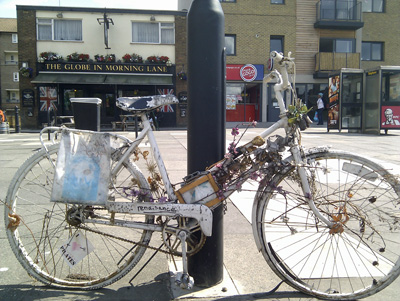
We started off at the Pembury Tavern — a cavernous beer hall of a place just outside the centre near Hackney Downs station. We then walked through the town itself to the Globe at Mornington Lane — a modern boozer opposite Tesco’s about whose staff the phrase ‘salt of the earth’ could have been invented. We went on to a couple more pubs before ending up in the marvellous Charles Lamb in Islington — something of a post-workshop regular now for Guy and myself.
Crossing the road towards the pub we got a glimpse of the Hackney that will have attracted Kim. An old bike had been painted and adorned with flowers and was apparently attached to a lamppost just over the pelican crossing. Guy was very taken with this piece of improvised street art — exactly the sort of object the artists in his novel would have created. Not a utilitarian street bike of the sort promoted by Boris Johnson but one that has no practical value whatsoever — it’s just mysteriously ‘there’ to make a statement.
And so it seemed to confirm to me that this is Kim’s domain in London — shuttling between Hackney and Shoreditch on the 55 bus — the one Guy and I took there from Mike B’s place after the Saturday morning workshop.
Having been thwarted twice by the incompetence of the Olympic ticketing system and having failed to buy any tickets for events at the nearby Olympic Park for 2012, I may go back to the area and have a look around at the changes associated with the games. Fish Island looks well worth a look.
I’ve recently been writing a very tricky chapter of The Angel in which Kim falls over and hurts herself and believes it might signify some sort of bad karma — which it may well be bearing in mind what she’s been up to. It’s quite a crucial point in the plot and I’ve found that I’ve put her in a situation that’s full of dilemmas and choices — which I suppose is good for the novel but quite risky to write in case I go off down a blind alley.
I originally wrote it predominantly with dialogue between Kim and James and relatively little interior exposition. When I workshopped this with the ex-City die-hards the majority view was that it would benefit from much more of Kim’s internal debate. (We also had a discussion about whether characters would have ostensibly frank conversations volunteering the number of sexual partners they’d had — which is perhaps the subject for another post.)
So I rewrote the chapter in a very different style — in places with long paragraphs of contemplation about what motivates one through life, etc. I then took advantage of a tutorial with Jenny Mayhew, our first term tutor on the MA at MMU, to get some feedback on the balance between interior/exterior. She thought it was generally about right — which shows the City feedback had helped but that there were some over-long deliberations which could be cut.
Jenny also gave some advice about increasing the amount of ‘stage-direction’ and playing up aspects of the fantasy and dreaming in the dialogue — things I’d deliberately toned down after having feedback in the opposite direction in the previous term. Jenny’s advice tends to echo my natural style and inclination, which is not particularly lean or taut, more observational and discursive.
I re-jigged again and added in some new ideas, some lifted directly from a conversation about different names for common field weeds in England and Scotland. The weeds discussion was in the office in London where I’ve now been working for the past four weeks, of which perhaps more in future posts. Time spent in this job explains the relative lack of blog posts as I’m burning the candle at both ends, catching the 0637 train into Marylebone and not going to bed correspondingly early enough as I’m trying to keep the writing still moving forwards — although to look on the bright side I’m close to some of my locations to return to do easy research.
Last night a dedicated group of the MMU MA students workshopped a revised draft of the chapter following Jenny’s comments (we do this without any tutor involvement from the university so shows we must be relatively dedicated and, to use one of Emma’s horrible HR phrases ‘self-starters’).
I’ve still yet to re-read the transcript of the online discussion, which is always very useful, but the material generated a lot of discussion — it must have done as we ‘chatzied’ for nearly an hour. (To get an hour of four people’s time — plus their reading in advance — on a piece of around 3,000 words was very fortunate — another student had to drop her piece at the last minute.)
We’ve got one more workshopping session left with Emily in about ten days time and then a long break for the summer — the MMU term finishes at the same time. As far as I’m aware, about four people from the City course have finished — or are close to finishing — their novels, including two who are in the workshopping group. Another four or five of us are making steady progress but aren’t there yet.
I must have written enough words for a respectable length novel — as an example I extended the original 2,500 word extract mentioned above by at least another 2,000 words in the rewriting — and I’m sure I can find a use for much of that, if not in the original chapter then elsewhere.
In our MMU workshopping session last night one of the other students presented a chapter-by-chapter breakdown of her projected novel, which reminded me that I’m long overdue a re-assessment of where I’m at. I don’t feel I’ve diverged too much from the original plot that I planned out with post-it notes well over a year ago but I’ve probably only covered about half the planned events or chapters, although what I’ve written has expanded in word count beyond that which what I originally anticipated.
Maybe because of Kim’s interest in karma, I’ve been noticing a few instances of Angel-related serendipity to inspire me to keep plugging on with the writing.
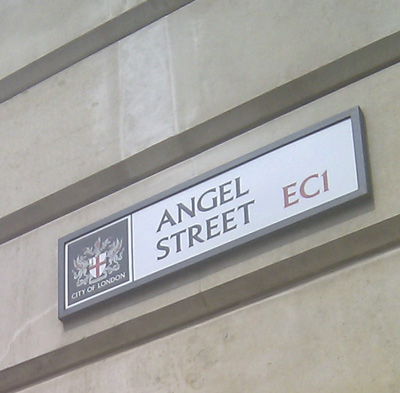
Angel Street EC1
The first was the name of a street I noticed in the City near Pasternoster Square and opposite bombed-out Christ’s Church Greyfriars, where I’m planning to have James and Kim sit and have a drunken conversation on their first day together — the street is, appropriately, Angel Street.
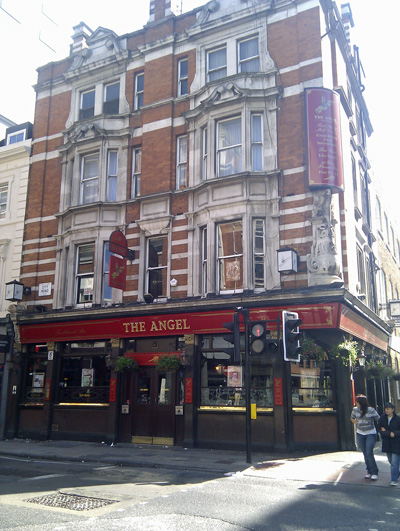
The Angel, Old Street
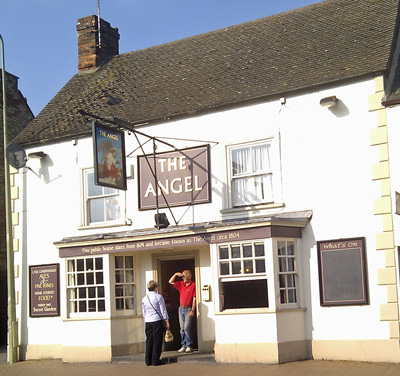
Then I also belatedly noticed that the pub over the road from Mike B’s wonderfully stylish apartment near Old Street where we’ve been meeting to do our Saturday workshops is also called, you guessed, The Angel — although looking like a traditional London boozer it’s a very different sort of Angel to the thatched country local I’m going to write about — but it’s a nice co-incidence anyway.
The Angel, Sheep Street, Bicester
And, just for completeness, although there’s no special connection to me, here’s another Angel — this time in Bicester. This is a town that Emma would never dream of living in but she goes there fairly regularly to snap up a few bargains or ten at Bicester Village — outlet store shopping centre for all brands she likes to dress in. Perhaps James might slope off for a pint there while she browses in Alexander McQueen, Diesel, Jimmy Choo, , Karen Millan, Radley, Hobbs, maybe buying Kim a cheap Superdry T-shirt and perhaps even nipping into Agent Provocateur.
The team travels to the Chilterns, an area steeped in ancient crafts and traditions, which is less than 50 miles from the centre of London. Paul Heiney meets the men still making bricks by hand, historian Bettany Hughes tells the story of boating on the Thames, and chef Mike Robinson visits a farm rearing a centuries-old English duck.
Countrywise seems like an ITV landlubbers’ version of the BBC’s Coast — a bunch of TV-friendly faces descend on somewhere very rural and quirky — and ‘discover the stories behind it’ or some such.
It’s presented by Paul Heiney, whom I still remember from being one of Esther Rantzen’s acolytes on That’s Life along with Glyn Worsnip and Kieran Prendeville.
They’re at Waterperry Gardens now, which isn’t really in the Chilterns — it’s in a place so flat it gets flooded by the River Thame — funny how they didn’t feature the nearby M40 too.
But the overall premise of the programme was that it was amazing that this area of beech woodlands, quaint hand-made brick houses, free-range ducks in the forests and so on was a ‘mere stones throw from the capital’. There was a view repeatedly shown throughout the programme which was filmed from Coombe Hill towards the south-west — if there was an incredibly high-definition TV picture you might have been able to see where I live. It’s exactly the same view as the first of the panoramic photos in this posting from a few weeks ago.
There were a couple of local pubs I saw in passing — The Stag and Huntsman in Hambleden (near Henley) and the George and Dragon in Quainton (north of Aylesbury).
The Chilterns must be almost unique in this country as an area of outstanding natural beauty that very few people actually go and stay away in. The North and South Downs are similar distances from London but I’d bet that the North Downs get more tourists — and the South Downs definitely would.
So the area is potentially rather good for a novel setting — very few places in the country can offer the contrast of amazingly well known and surprisingly unknown within the space of 40 miles.