Schumpeter on the Art of Management

My ex-City coursemate Michael Braga shares with me a love of The Economist newspaper that must be very unusual among writers — many of whom probably consider its readers as the evil spawn of the global capital machine. I must admit I often disagree with its often over-opinionated editorial stance but it’s an unfailingly fascinating publication. Almost every time I pick it up I find half a dozen immensely fascinating articles — not just on current affairs or business but it has superbly concise science section (where Dr Olivia Judson used to write some superb articles on evolutionary biology that might have started my interest in this subject) and a similarly focused arts sections which features some great book reviews (including novels).

The Economist is also exceptionally well-written — much better than any daily newspaper or other weekly magazine, publishing its own style guide. It ought to be a good example to fiction writers.

So when I came across an article in last week’s edition, written by the business columnist, Schumpeter (no bylines are allowed), titled ‘The art of management: why business has a lot to learn from the arts’, I was intrigued.  It starts by complaining that the liberal arts world really doesn’t understand business and often misrepresents it by caricature (e.g. ‘Wall Street’). However, it soon moves on to castigate the philistinism and macho-aggression of the corporate world — there’s even a popular management book called ‘A Good Hard Kick in the Ass: the Real Rules for Business‘ — written, naturally, by an ex-marine.

Schumpeter argues that this culture results in poor communication, dysfunctional attitudes to risk and the stifling of creativity — failings that corporations are constantly trying to argue they have overcome (partly through spending vast amounts of money on snake-oil management training programmes — the kind of ‘put on a blue hat and you’ll be creative’ or if you ban people from frowning then the workplace will become more productive). Instead of wasting money on pseudo-scientific brainwashing the article sensibly suggests that a study or appreciation of the arts might suggest better solutions to these issues.

The article concludes by saying that, if business can learn from the arts, then in return perhaps artists should also take business more seriously and calls for writers, among others, to be more subtle in their examination of commerce — which it calls a central part of human experience.

I thought that sounded quite reasonable and while this might be a potential gap in the market for fiction that might be readily identifiable, it’s uncanny how I might have unconsciously constructed myself a CV that qualifies me to write in this sort of genre. As I wrote in a comment on the article on the web site, I’m originally an arts graduate but also have an MBA and I’ve often thought there are many parallels between the arts (communication, motivation, psychology and so on) and business than the syllabuses of business schools care to admit (perhaps to boost their pseudo-scientific credentials).

I realised that I’ve also tended to gravitate towards roles in business that have played to my ability to put a few half-decent paragraphs down on paper or a word-processor — and it’s a constant source of amazement how poor are many of the most successful business types at expressing themselves with the written word. (An interesting hypothesis about business’s uneasy relationship with the arts might explore whether this is borne out of personal frustration and resentment at individuals’ own shortcomings.)

So it’s almost a logical extension that I’m now taking this a step further and have now spent more time on creative writing courses than I did on my MBA — which is now in the process of being complemented by an MA in Creative Writing.

And, Schumpeter would be pleased to learn, that this is exactly what I’ve been doing myself with The Angel which starts with exactly the premise that’s explored in the article — as it takes a City trader and explores his latent ambition to learn more from the arts. Its central premise is the relationship between business and the arts — both in the background of the two central characters and in the plot, one strand of which is all about the pair or them setting up and running a business. While it’s a comedy, hopefully I can make this a subtle enough examination on the page to redress the current balance a little.

Do It Like A Dude

The Angel has an old-fashioned love triangle at its heart and, while I know the eventual outcome I want to write, I’ve been gripped by an internal debate about how much of this tension should be shown in the novel in terms of what the BBC call ‘sexual content’.

This is a difficult question to wrestle with in various ways although I’m convinced that all writers of novels (or of drama) that involve adults in close, emotional relationships must at least consider, but not necessarily write about, the sexual behaviour of the characters — even just to establish that there is no sexual relationship between them.

In real life, as well as in literature, there are many relationships that seem to defy gravity on intellectual, social or various other personal issues but must obviously work at a deeper sexual level — women falling for the bastard or cad or men being mesmerised by a pretty girl are stereotypes that are clearly true. There are many biological and psychological reasons why relationships aren’t driven by rationality — and that people often pursue relationships that logically they know aren’t good for them.

Also, despite (or perhaps because of) much more openness about ordinary people’s sexual behaviour — look at the covers of most women’s magazines and a few men’s — no-one really knows with much certainty what everyone else is up to. There are plenty of surveys but they’re almost by definition self-administered so no-one can verify how truthful are the responses (it’s considered that men tend to exaggerate, women to under-report). This is probably truer the more unusual the behaviour is. Paradoxically, despite sexual behaviour being driven by very deep biological and psychological motivation, most people seem to be anxious to know what’s ‘normal’ — if only to then outwardly appear to be so.

For this reason it’s probably one area where workshopping might yield responses which would be not that representative of readers as a whole. I’ve participated in a few workshops where the writing has involved descriptions of illegal drug usage. People tend to be quite guarded in their reaction — ‘I have a friend who told me that this description is more like ecstasy than speed’ — not wanting to be thought too boring and unconventional as to never have tried the drug but certainly not wanting to admit anything like familiarity with it. And why should they do anything else? Participating in a writing workshop doesn’t oblige anyone to reveal their history of drug usage.

Assuming the feedback gets beyond the tittering ‘Bad Sex Awards’ stage and one gets an honest and adult discussion, it’s still probably true to say that a similar type of reaction applies to sex as it does to drugs: an understandable wariness of revealing personal experience through expressing views on the writing (although people’s experience of sex must be much more widespread and doesn’t (normally!) have associations of illegality). This is wariness is probably more true the more unusual, or even deviant, the behaviour. Consider what might happen if (say) a woman wrote a scene where a man pays a prostitute to perform something exotic for him and one of the men in a workshop starts to correct all the details — she might get useful feedback but no-one would look at him in quite the same way again. (There are all sorts of intriguing permutations about who may be bluffing who in this sort of scenario.) There may be an exception when the action described is so extreme and unusual that it can be thought of abstractly and impersonally — in the City course there was one novel that dealt with incest and this was so bizarre that it was surprisingly easy to comment about.

Reading fiction is also appealing to many people because of its privacy. If you’ve never touched drugs, and don’t ever intend to, you might still have a fascination for imagining what it might be like to snort line-after-line of coke at a glitzy party or have some hallucinogenic trip. Similarly, most readers of the Twilight books don’t want their blood sucked by a vampire but that doesn’t stop them being amazingly popular. So it is with sex in fiction — there’s no doubt people like reading about it but a lot of this enjoyment is probably down to its absolute privacy.

While I’ve been agonising about how much of my characters’ sex lives I show or tell or hint at, I’ve realised that I may being incredibly prudish by the standards of popular culture with which young people are familiar. One of the most popular songs of the last couple of years is about, to put it mildly, curiosity about the same sex — Katy Perry’s ‘I Kissed A Girl’ (‘and I liked it’). My eyes popped out last year when I saw my children quite happily watching Katy Perry’s video for ‘California Gurls’. While I think it’s pretty harmless and, in some places, quite hilarious (the whipped cream aerosols) — she ostensibly appears in it stark naked (albeit lying down) — see embedded video below from YouTube.

Katy Perry says she was brought up a strict Christian and has been critical of her current rival — Lady GaGa, whose exuberance I quite admire. My teenage, secondary school age daughter asked me if I knew what the song ‘Poker Face’ was about? ‘A card game,’ I said innocently. ‘No. It’s about a woman having sex with a man while fantasising about it being another woman.’ ‘Oh!’ Things have definitely moved on a bit since ‘I Want to Hold Your Hand’.

Similarly we were listening to the Top 40 rundown and I asked the title of the Rihanna song at number two. ‘”S&M”, dad.’ I’m not sure if my teenage daughters knew exactly what this meant but the lyrics of the song didn’t leave much doubt: ‘Sticks and stones will break my bones/But whips and chains excite me.’

People might argue that this is all about boundaries being pushed but I’m not sure where the limits will stretch to after the precedent set by a new singer from Essex, who’s just won a BRIT award, called Jessie J. Her first single was called ‘Do It Like A Dude’ and, while I’ve only heard the less explicit version, there’s no doubt what it’s about — something that ‘Lip Service’ pushed the boundaries of terrestrial TV (albeit digital BBC3) by showing — although even then Ruta Gedmintas was only shown from the back. (And I don’t think ‘Do It Like A Dude’ refers to same sex relationships either.)

When I was doing the Open University Advanced Creative Writing course I was picked up by the tutor when a female character says the word ‘twat’ (as an insult about a man) — ‘a woman wouldn’t say such a word’. While this could be the view of a certain demographic of readers, if the generation who have been brought up listening to Rihanna, Katy Perry, Lady GaGa and Jessie J take up novel reading then it  will take considerably more to shock them.

Infinite Universes

I watched an edition of Horizon on BBC2 a few weeks ago which attempted to discuss the utterly bizarre nature of what we perceive as reality once it’s considered by physicists — quantum, astro- and various other varieties. (It’s available to view again on iPlayer until 15th March.)

Many people are familiar with the ‘unreal’ concept that, under quantum theory, a particle can be in two places at once and can cease to exist and then re-appear and all kinds of weird behaviour that seems to be the exact opposite of what people like me, with an ‘O’ level in it, understand about physics.

I was reminded of this programme when I saw this page of writing ‘top-tips’ retweeted by Emma Darwin (whose ‘Itch of Writing’ blog is linked to on the sidebar). It’s by Irish author Joseph O’Connor and seems to be aimed at an Irish audience (but, of course, many of the finest writers of English come from that country) and is on Blake Friedmann’s website (the Blake being well-known Twitterer Carole Blake).

The tips are all very sensible. I thought the last one — about knowing who you’re writing for — was very useful for new writers as the ‘democracy of the creative writing workshop’ (or some may say tyranny) sometimes gives the impression that it’s possible for a writer to connect with every reader — or at least the dozen or so strong opinions who tend to be on these courses. People have different tastes and if a writer removes everything that doesn’t get a positive reaction from every person in a workshop then he or she is likely to produce something so bland that no-one will love it. Workshops are great for getting feedback on technical writing issues from most participants but it’s not likely that more than a handful of participants will really get excited by each writers’ work — no matter how outstanding the quality. So O’Connor is right to advise people to write for a specific reader or small number of readers.

The point that most resonated with me, however, is the start of tip number five — ‘Make Something Happen’. If his first two sentences are concatenated as ‘Stories are…records of the exceptional’ then it perfectly sums up a point that I think is lost in the workshopping culture. It also reminds me, returning to the Horizon programme about the bizarre but apparently perfectly plausible, infinite universes theory.

This suggests that, despite its unimaginable vastness, our universe is only one of a massive number (infinite in theory) of co-existing universes where, because of their infinite number any variant of any event that we might think of has actually occurred in some parallel universe.

It sounds odd but an example from my novel might illustrate it: take as a starting point the one day James gets fired. Every event subsequent to his firing over which he makes a decision or is affected by the actions of other people or things may ‘split off’ into its own parallel universe. So in one universe he might get the train home immediately, in another he might head to the pub with his mates and in another he might decide to go and buy the painting from the artist he met the night before. The first two scenarios are much more likely but if I wrote about events in the parallel universe where that version of James now exists then it would be less interesting than following the universe in which James strikes up with Kim.

The same goes for all plot events — there are often many choices a novelist and his or her characters make but, in general, the most interesting stories are those which follow the parallel universes of the unusual choices — or in Joseph O’Connor’s words ‘records of the exceptional’.

Of course there needs to be a degree of plausibility and too many random events will make a reader feel cheated but the main source of credibility should be whether the character would behave in the way that the novelist chooses. For important drivers of the plot, it’s almost required that the character chooses an option that, while still credible, is less likely than the choice he or she would normally make. The day that’s really interesting is when your main character’s boss decides to fire him rather than all the days he doesn’t.

It’s the debates over plot and character that seem to be most problematic about writing workshops. Most people will come with an idea of the stories they want their novels to tell. These ideas may range between teens having their souls taken over by ancient evil spirits or they may be about unrequited love where most of the action occurs in a character’s imagination. Some are fantasy or magic realism, some are comic, some are totally realistic — but they are all stories to be told that require a suspension of disbelief from the reader, albeit at different levels. Central to this bargain of the suspension of disbelief is the concept of storytelling — i.e. reading is not a co-operative, interactive experience. The danger of workshopping is that the readers approach each others’ writing from a completely artificial perspective — that the story can be changed to match their personal preferences — ‘I think the character would appear nicer if he didn’t leave his wife’.

As with the point above about writing for a select group of readers, the novel has to be about what the author cares passionately enough to devote the massive amount of time required. While films now have endings changed by the initial reactions of advance screening, not even Hollywood seems to create its films solely by focus group.

The Shard Rises

I was in London yesterday around Oxford Circus then went to St.Paul’s and Southwark to have a walk around the settings I’m using for the first few chapters of The Angel — including the Tate Modern again where it was amazing to hear the number of French and German speakers.

Walking across the Millennium Bridge I was impressed again by the height of the internal core of concrete core of the Shard, which I think I heard became the tallest building in London in the last week or so.

Here’s a photo I took from the Millennium Bridge and the scale of the Shard can be seen in comparison with Tower Bridge and One London Bridge (the square building at the foot of the Shard).

The Shard Rising -- 18th February 2011

The literary agent Carole Blake  (who I follow on Twitter) tweeted about this interesting article on the Shard’s construction from today’s FT which is currently available for free.

It does present a conundrum for my novel though as when I started it the Shard was a hole in the ground and by the time it’s finished then the Shard will be an unmissable landmark. However, although my novel is set in the present the time elapsed in the plot will be shorter than the time I’ve taken to write it. I suppose it might be a nice little touch at the end to mention the erection of the tall, central shaft (also adding in a bit of the rest of the book’s symbolism there too!).

I also solved a slight problem I had in the early chapters where I have James and Kim around St.Paul’s but doing something that would probably need a bit more privacy than they could find in the piazza around the cathedral. I think I’ve found an ideal replacement location on the way between St.Paul’s and the Viaduct Tavern — Christchurch Greyfriars. This, like the Aegidienkirche in Hanover, is a bombed out shell and has a rose garden where the nave of the church used to be — although it currently is closed off for some sort of refurbishment. It will be a very suitable place for the two of them to sit and I won’t need to be too heavy with symbolism — the location will do it on its own. I read on Wikipedia that the church, before the war, had a huge angel on its spire, which now sits in the entrance of a nearby (non-ruined) church.

It’s also opposite the Boots pharmacy where Kim will later go — my research for this section is pretty anal!

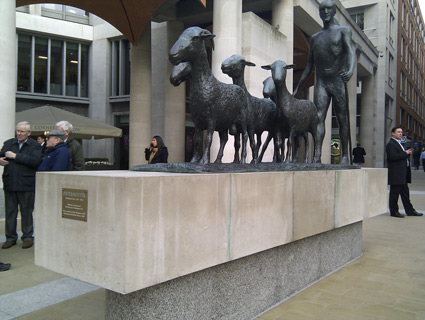
Also to get to Christchurch Greyfriars they will walk through Paternoster Square and there’s quite a curious sculpture there that marks its ancient use as a livestock market. It’s by Elisabeth Frink, a sculptor who liked to specialise in the human male nude form — and perhaps there’s something quite symbolic for the book about that sculpture as there are plenty of sheep where the two will end up. Despite the German sounding name, Frink was English but I read on Wikipedia that she was taught by an Austrian refugee from the Anschluss. Amazing how it all comes together.

Shepherd and Sheep - Elisabeth Frink - Paternoster Square

On Misinterpretation

If I ever get very rich (from writing or otherwise — though neither possibility is likely) one thing I may do is go to every bookshop I can find (possibly not that many if they keep closing at the rate they do), buy every copy of Stephen King’s ‘On Writing’ and hide them somewhere safe from over-eager creative writing students. If a few copies were removed from circulation I don’t think it wouldn’t be a terribly bad thing — at least not for people in writing workshops.

It’s not that I dislike Stephen King or think it’s a poor book — I have my own copy and read it with great interest. In fact it’s in many ways too good: the advice it contains is so directly and unambiguously argued that it works like a loaded weapon — let a gun get into the wrong hands and you’re asking for trouble (and I don’t exclude myself from this as I’m now questioning whether some of my own writing style has been too directly influenced by its recommendations).

The book is subtitled ‘A Memoir of the Craft’ — which is something that most of its proseltyizers  fail to read — but that is exactly what it it is. It’s King’s account of the techniques of the craft that have worked well for him — and he’s an outstandingly successful novelist who is also a fine writer and much underrated by literary snobs who look down on genre fiction. However, some of the justified anger that he perhaps feels about the lack of seriousness with which his work is taken seems to me to translate into a rhetorical rebuttal in which he passionately defends his position but, simultaneously, appears to some readers as ‘this is the way it must be done’ — or worse, ‘follow these golden rules and you’ll be a bestselling writer’.

King is, no doubt, sensible enough to have put a disclaimer in the book saying that it’s not a ‘get-rich-quick’ manual (and he’s by no means the first person to have given similar advice, as he acknowledges by referring to Strunk and White’s ‘Elements of Style’). However, it’s ironic that, given the poor esteem in which he says he holds the writing workshopping mentality, his book appears to have provided a source of ammunition that feeds the exact behaviours he criticises.

There seem to be a lot of dubious ‘rules’ whose current popularity could be perhaps be traced back the ten years or so to when ‘On Writing’ appeared — which was probably not co-incidentally a time when many creative writing classes and courses were becoming much more popular. (Disclaimer: I’m not remotely suggesting that any of my fellow students on university creative writing courses are guilty of this sort of crass simplification — they’ve all been selected by interview and on the basis of their writing ability — nor the excellent tutors. However, it doesn’t take long to come across really stupid examples of misinterpretation and perversion of King’s advice if you browse a few writing blogs or exchange experiences with other student writers.)

Possibly the most notorious example of dangerous over-simplification is King’s injunction that ‘the adverb is not your friend’. This seems quite a nuanced phrase to warn writers off using adverbs as an unnecessary crutch — for example using an adverb in a phrase like ‘he walked quickly’ rather than  ‘he dashed’ or similar or in stating something that should be obvious to the reader from the context like ‘he said threateningly’. King doesn’t say adverbs are bad — he just asks, because adverbs are modifiers of verbs, the reader to consider their use carefully — which is a variant on the good advice that every single word in a novel should have to justify its place.

However, after this fairly considered section he later casually refers to ‘all those lazy adverbs’ and — a remark that is interpreted by some as implying that any use of an adverb suggests a lazy writer. This seems to have metamophosised into a dictat that all adverbs are bad — partly because it’s a ‘rule’ so simple that idiots can follow it (‘if it’s a describing word that ends in -ly it is a sign of Bad Writing).

I found a post on a writing blog (Novelr) titled ‘Why Adverbs Suck’, which starts by taking examples of sentences with adverbs and proceeds to rewrite them minus the adverb — but usually including some extra element of detail that ‘shows’ the sentiments that the dreaded adverb ‘tells’ (illustrating that the adverb is a casualty in the philosophical battle between show and tell — see Emma Darwin’s excellent post on this issue). In most cases the sentences become considerably longer. (The insertion of such ‘reportage’ is something I tend to do — and, as it’s recently been pointed out, perhaps over-do.)

The Novelr blog post is worth following for the debate that follows in the comments in which the pro- and anti-adverb camps state their positions in the religious war. Imho those writing in defence of the adverb have more logic and evidence on their side and those arguing against it seem more motivated by dogma and simplicity. It’s asked why adjectives are far less reviled than adverbs (I’d suggest it’s because most of them don’t end with the same two letters and are less easy for pedants to identify).

I’d also suggest that a piece of writing which is marred by clumsy over-use of adverbs is also likely to be littered with unnecessary adjectives, rambling sentences, bad grammar and other evidence of incompetence or perhaps ‘first-draftiness’ (what an adjective — shows you can make one out of a noun by suffixing -ness just as you can make an adverb by adding -ly to a verb!). (Time constraints mean the stylistic quality of the writing on this blog is sadly very much an example of this first-draftiness.)

Just as bad writing isn’t just typified only by use of adverbs (or any use of the passive voice or dropping in back story or other of King’s bêtes noir) then their use in the right context can be extraordinarily skilful. On the City course, one of the students (who is a professional writer) sprinkled her prose with adverbs — in some cases they had a breathtakingly subversive influence on a sentence, or even whole paragraph.

Of course much is in the context, the talented writer on our course was writing about suburbia from an ironic narrator’s perspective, whereas Stephen King writes horror: there’s less need to describe the nuances of exactly how a character might sink an axe into someone’s head than to describe the action itself — and I don’t mean this disparagingly to the genre as I recently workshopped an action scene myself and probably followed King’s stylistic advice to the letter on that.

Stephen King says he thinks adverbs (and the passive past tense) have been designed for the ‘timid’ writer. That may be true if they’re over-used as some sort of extra insurance policy that is meant to affirm that the reader understands what the writer is trying to say. But, in an example of extreme irony given the general low opinion that King has of writing groups, courses and workshops, his uncompromising stance towards the adverb has led to a situation where it’s the timid writers who now avoid adverbs — because of the possible mauling they will receive for any use of them whatsoever if given feedback from one of the many people who has simplified King’s own stylistic advice to the point of absurdity.

Other resources, given in good faith, can also be horribly misinterpreted. In its creative writing assessment booklet, the Open University gives a list of points for students to check through before they submit their short piece of fiction for assessment (probably based on the guidance given for marking). It’s a long checklist and includes pretty commonsense questions like ‘does description utilise the senses’, ‘are metaphors or similes used’, ‘does the story move forward’ and ‘is the point of view consistent’.

The danger is that some people misconstrue this checklist (which is principally for short stories) into rules that say: all description must utililise the senses; there must be metaphors and similies; the narrative should always move quickly forward; the point-of-view must not change and so on. The last two points, while probably necessary in short stories, certainly shouldn’t be dogmatically applied to novels.  So what starts off as a useful aide-mémoire becomes a bible for the workshop pedant. Lists like this also seem to encourage people in writing workshops to read a text in a way that would be alien to any reader who might pick up a novel in a bookshop.

Imagine a contemporary creative writing workshop sent back in time to early 19th century Hampshire — considering the opening lines of a possibly timid female writer. ‘You’ll never get this published — you use an adverb only five words into the book — an example of a lazy, profligate writer. Wouldn’t it be better to write “It is a truth acknowledged’ or, better, “It is an acknowledged truth that a single man in possession of a good fortune, must be in want of a wife”. The word universally is clearly unnecessary as it merely re-inforces the meaning of the word truth.’  And you wouldn’t want to be there when they start on the length of her sentences…or the pace.


The Oak and the Book Club

I went to three pubs in Aston Clinton tonight (a village about 4 miles south-east of Aylesbury).  The last one we went to, The Oak, is probably about as similar to The Angel as any pub could be. It was even struggling and rumoured to be on the point of closure at the end of last year. However, Fuller’s (the brewery owners) spruced it up a bit and brought in an entrepreneurial landlord called Steve who, with a partner called Joolz in the kitchen who handles the food, has turned the place around. I’m not surprised as the bar staff were extraordinarily attentive.

Oak, Aston Clinton
Oak, Aston Clinton (from Fuller's Website)

The place was buzzing tonight — the public bar area was absolutely jam-packed and a bunch of locals were sitting around the bar — two of whom I was introduced to by a mutual friend.

One of the tables was occupied by about eight or nine women and when I saw the distinctive orange and white of the cover of David Nicholls’s ‘One Day’ I realised they were holding some sort of book club or reading group there. I saw other books being handed round the table but couldn’t identify the titles.

I thought this was all good research for the novel but also thought that there might be a wonderfully circular scenario here to aspire towards — if I was to have the novel published and then it be discussed in the book group of a pub it was partly based in — and then perhaps I could write about that? Maybe that’s too much circularity?

Yellow

I’ve been writing a part of the novel where Kim is painting and she uses the concept of colour association to both tell James what she’s thinking and also to send him a coded message and ultimatum, should he be perceptive enough to pick it up.

It’s something of a Rothko-inspired meditation on colour and I’ve tried to come up with a rough approximation of what it might be like. Click on the picture to find how the character’s thoughts might be represented in another way. I won’t say what she titles the painting.

Kim's Rothko Yellow
Kim's Rothko Yellow

The Girl With The Sun in Her Hair

My friends at Village Underground posted a link on their Facebook page to the video below on You Tube shortly after it was announced that John Barry, the music’s composer, had died. Its nice to know that the people who run one of the ‘coolest’ venues in London have a similar appreciation to mine of the man’s music.

I love the music’s sense of drama, romance and vulnerability — a little like the atmosphere I’d like to convey in certain parts of my novel. If Village Underground like the track then so will Kim, who would appreciate its archetypal sixties nostalgia without being remotely naff or cheesy. It apparently originally started off as the music for a Sunsilk shampoo commercial in the 1960s but was also used elsewhere — including in the Bond film which has my joint favourite John Barry theme — Nancy Sinatra’s superb ‘You Only Live Twice’ — a song that has the most unexpected melody.

My other favourite is Lulu’s hilarious ‘Man With the Golden Gun’ which is so packed more full of double entendres than the whole script of a Roger Moore Bond film. The subject of the song has ‘got a powerful weapon’, ‘who will he bang?’ with his ‘golden shot’ — lines that Lulu sings with such verve.

What I really liked about John Barry’s music, particularly his Bond music, is how he managed to work in recurring themes and motifs. I always admired how songs like Duran Duran’s ‘View to a Kill’ wove in the original Bond theme. His work also had the quality of being commercial and accessible but simultaneously often quite unconventional — such as using the harmonica in ‘Midnight Cowboy’ or the cimbalom in ‘The Ipcress Files’.