Co-Incidences Do Happen

Yesterday, in an example of complete chance the first non-league team in the FA Cup 5th round for 17 years, Crawley Town, drew Manchester United away — for anyone who doesn’t know, Manchester United are unbeaten in the Premier League and Champions’ League this season (and haven’t lost a league game since April).

This was the sort of draw that has the pundits talking about the romance of the cup — with by a club that normally plays in front of a crowd of 2,000 going to Old Trafford, which is, at 76,000, by some distance the biggest club football stadium in the country. (It’s fifth largest in Europe after Barcelona’s Nou Camp — the biggest by quite a long way — and not far behind Real Madrid, Dortmund and the tw0 Milans at the San Siro).

I’m not sure of the odds of the draw happening (I’d guess several thousand to one) and it attracts interest because these Cup pairings are unusual — but it has still happened. And this is a lesson, I think, to writers — just because something is very unlikely doesn’t mean it won’t happen.

I experienced a very odd co-incidence of my own on Saturday in London. I’d gone to Emily’s first post-course workshop (after Alison had filled in over the autumn due to Emily’s maternity leave) at Mike B’s very stylist apartment near Old Street.  (Emily has a different approach to Alison — as she reads the extracts in advance then she sees no reason for the writer to read material out loud so we ended up having quite interactive discussions on more general themes in the novels rather than each of us examining and then commenting on the individual pieces of writing in detail. At the point that most of us are in our novels then this seems to be a good approach.)

I then ended up with Guy in the Wenlock Arms in Hoxton for a couple of pints (a dangerous 6% porter in my case) — the Wenlock appears under a pseudonym in the novel so it was good research to go and check it out again. That’s my excuse.

Getting back to the mainline station was complicated by the Metropolitan line being out of service so I had to take a series of buses and, of course, arrived at Baker Street at the time when my train was pulling out five minutes walk away at Marylebone. So to kill a bit of time I wandered into the Metropolitan Bar (a huge Wetherspoons over Baker Street station) and almost literally bumped into Dave, someone I know very well from Aylesbury. Neither of us had an inkling we’d be in London on that day but we still walked into exactly the same place within a minute or two of each other — and I’d not been in the place for at least a year. We both had a quick drink and then got the next train back together.

However, I thought that this sort of chance meeting was exactly the type of event that, were it in a novel, would be mauled in a workshop discussion — being considered implausible or lazy on the part of the writer.

Of course, in this case, the odds of the co-incidence happening weren’t as high as if we’d bumped into each other in some quiet place elsewhere in London — it was in a place near the station we both knew — and in a busy pub at a transport interchange — and it was a Saturday afternoon when it was more likely we’d be making our way back but the timing was very strange as Dave was was the first person I saw when I walked through the door.

Novelists and dramatists are often condemned for using co-incidence in plots — the argument being that all action should be directly related to the effects of the characters of the protagonists on their environment. But co-incidences may actually be less accidental than they may otherwise appear to a reader — in my case it was more likely we’d meet in a pub than in a coffee shop, for example.

Also, it’s intrinsic to the appeal of almost all novels and dramas to the reader or audience that they concentrate on unusual events or stories that are atypical — that’s what makes them interesting. Quite often in writing workshops people will consider the ‘plausibility’ or motivations of a character’s behaviour — would that character in reality strike up a conversation with a stranger on the tube, for example? The answer may be no — 99% of the time that character would ignore eye contact and stare at the Poem on the Underground — but it’s the 1% of events where something different happens that makes an interesting story that people want to read.

‘The Angel’ has some co-incidences — it opens with one, of a sort. Someone questioned why so much happened on one day — would someone suddenly hang around with an artist all day when he’d been fired that morning. Well, perhaps most City types would either go home and lick their wounds or go out and buy a Ferrari with their redundancy. But I want to write about the one in several thousand who doesn’t do that — the one that interests me (and hopefully enough people to want to read beyond the novel’s first few pages).

Francine Prose in ‘Reading Like A Writer’ questions tacit assumptions that are often taken for granted: ‘as anyone who has ever attended a writing class knows, the bottom line of the fiction workshop is motivation. We complain, we criticise, we say that we don’t understand why this or that character does something. Like Method actors we ask: What is the motivation? Of course, this is based on the comforting supposition that things, in fiction as in life, are done for a reason.’

She uses Chekhov’s short stories and letters to contradict many of the supposed truths that are routinely deployed in creative writing teaching and literary criticism — including often, she says, those she has taught herself. She quotes Chekhov’s letters to argue that everything in fiction should not necessarily be explainable through deconstruction of motivation and cause-and-effect because the world’s not like that: ‘It is time for writers to admit that nothing in this world makes sense. Only fools and charlatans think they know and understand everything…And if an artist decides to declare that he understands nothing of what he sees — this, in itself, constitutes a considerable clarity in the realm of thought and a great step forward.’

Francine Prose then elaborates the argument, saying that what she finds most unique about Chekhov is that his ability to reflect his characters rather than interpret or understand them allows him to write without judgement.

We had an example of what happens when characters are judged in our City group when someone wrote a very funny and realistic chapter that was predicated on a character unknowingly having had her drink spiked with drugs. When workshopped, a lot of debate centred on the morality of the other characters having done this to her — and how could we as readers forgive them for it?

I was in the minority in not thinking that the morality of the action wasn’t that relevant to the success of the incident as a piece of writing — while it’s a Bad Thing to spike someone’s drink, it does happen and between friends and those people quite often stay friends. Maybe that’s the exception but because it’s not the most likely, nor the most comfortable, course of action that doesn’t mean it shouldn’t be written about.

Fortunately, the author has kept the incident in the novel but addressed many people’s concerns by having a later section where the offending characters are taken to task over the irresponsibility of their behaviour.

Of course, by extension, fiction shouldn’t over-use chance situations or unpredictable characters because that too would be unrealistic but people behave oddly and irresponsibly and, as with co-incidences, it is more realistic to include the inexplicable in fiction than to exclude it on the basis that we can’t easily rationalise or understand it. And we tend to be more interested in the mysterious too.
The Gravediggers

A close friend of mine, Charlie Mackle, has come up with a series of short pieces (almost flash fiction in some cases) about a fictional pub that sounds like the dark twin of ‘The Angel’ — it’s ‘The Gravediggers Arms’. There seems to be some cross fertilisation going on (some names are oddly similar) but the style is much more comic and plays to the gallery of its intended audience and, I have to say, is somewhat less polished than ‘The Angel’s later drafts (there may even be typos).

But it’s been published and has a few fans who have even written in to the editor to complement Charlie. Should I be getting  jealous?

He’s let me post a pdf of the first nine instalments in ‘The Gravedigger’s’ story in the attached pdf. Click on the pub sign to open the file.

The Gravediggers' Arms

Elegy for the Pub?

The Economist’s Christmas-New Year double issue had a fantastic article on the current challenges facing British pubs — both economic (recession and the rise in energy costs), legislative (smoking ban, ratcheting up alcohol duty and being paranoid about upsetting the supermarkets) and social (rise of many alternative forms of entertainment and the general trend towards eating out rather than drinking — last year saw the biggest drop in alcohol consumption for a long time — see this BBC News report).

The whole article is happily available for free here on the Economist website (most articles there are subscription only and this may eventually go the same way).

However, despite being a good read, the original article is over 2,000 words long so I’ll try and summarise some of the arguments it makes that are most pertinent to the themes in ‘The Angel’.

Many pubs, particularly in lovely villages such as the as-yet-unnamed fictional community that will be home to The Angel, are worth far more developed as private houses than they are as businesses that generate cash. Within five miles of where I live I can think of at least three very desirable private houses that were pubs not so long ago — I’ve visited one on several occasions that still has its sign outside — The White Star I think it used to be.

Similarly, pubs often sit on valuable plots of land and many are bulldozed to be replaced with infeasible numbers of new-build houses all jammed together where the beer garden used to be. Sometimes the developers have the nerve to allude to the land’s former use by naming a new development ‘Innkeepers Court’ or ‘Red Lion Mews’. (Often developers will demolish a pub without planning permission for any other use — they smash the pub to pieces to prevent anyone else taking it over and making a better go of running it.)

And no planning permission is needed at all to change a pub into a businesses that the government and planning departments (but no-one else) regards as similar to a pub — usually restaurants. That’s why so many pubs have metamorphosised into the Olde Village Tandoori. Not that there’s anything wrong with a curry every so often but a restaurant performs a fundamentally different social function than a pub — where people interact casually at the bar and pop in and out.

As the Economist’s correspondent says (they don’t have names in the magazine, except for very special reports): ‘the vanishing of a pub means, by common consent, the loss of the beating heart of a community, in town or countryside. A pub can become a sort of encapsulation of place, containing some small turning’s grainy photographs, its dog-eared posters for last year’s fete, its snoozing cats, its prettiest girls behind the bar and its strangest characters in front of it.’

Some of the comments made on the website about the piece compare it to George Orwell’s famous ‘Moon Under Water’ essay that appeared in the London Evening Standard in 1946. I love the imagery of the snoozing cats and the prettiest girls behind the bar. The latter comment, predictably, drew accusations of sexism. I’d argue that the ‘pretty girls’ are more metaphorical than literal (although Nick at the Whip Inn in the village of Lacey Green seems to consistently deliver this attribute in practice as well as keeping some excellent beer).

Tim Martin was so inspired by the essay that he named many of his early Wetherspoon pubs after it — while Orwell might not have been too impressed with Wetherspoons barn-like interiors and supermarket type promotions, he might have seen some merit in its offering of staggeringly cheap food (£1.99 for ham, egg and chips in some) and reasonably priced real ale.

Whatever their merits, Wetherspoons don’t represent the profound continuity with the past of traditional pubs. As the Economist writes: ‘pubs are meant to preserve [history]. They hold ghosts, myths, the memory of kings; Green Men live on in them, White Horses carry Saxon echoes, Royal Oaks keep the drama of civil war and restoration. The world before the hunting ban still thrives in the Hare and Hounds and the Tally-Ho; old trades survive in the Compasses, the Woolpack and the Wheatsheaf.’

The pub is also a democratic institution and social leveller: ‘the origins of pubs [were] in the kitchens of wayside farmhouses, where a man exchanged his own hearth for another. He was not, however, alone there. In the pub he met his fellow men and, with them, formed a society of musers and drinkers. He mingled with people he might not otherwise meet, had words with them, was obliged to take stock of their opinions. In a highly stratified society of worker, merchant and lord, the pub was open to everyone.’

This may seem slightly exaggerated but in her excellent book, Watching the English, social anthropologist Kate Fox devotes a chapter to pub etiquette in which she explains how this democratic social interaction usually occurs only at the bar — and there’s a tacit understanding that the further one sits from the bar in a pub,  the more privacy one is granted.

As the Economist says ‘Most pubs retain a peculiarly English blend of socialising and privacy’. Fox makes many other fascinating observations which support her claim that  ‘it would be impossible to even attempt to understand Englishness without spending a lot of time in pubs’. (Download the magazine from this link and scroll to pages 20 and 21 to read a review of the book I wrote in 2005).

Writing a novel about a pub I was pleased that the Economist agrees that ‘drama suits pubs. They are places for pushing limits, and not just in the sense of jars and fists…In pubs normal wariness is suspended in favour of live and let live, of free speech and free space… Americans have their guns; but the Briton has always had pubs, liberty glowing in thousands of small corners, as his weapon to beat back tyranny. John Bull lives there. When pubs are swallowed up, or die, something very much more than a beer-shop perishes with them.’

And the last paragraph is probably the most impassioned that I’ve ever read in the Economist — an exhortation, almost, that some things are more important than mere economics: ‘Time slows; company gathers; speech is freed; beer flows, like the very lifeblood of the land. Pubs are needed, even when every social and economic indicator is running hard against them.’

The ‘very lifeblood of the land’, indeed.

The German Fourth Plinth 2013

Here’s me for various complicated, meandering reasons, writing a novel about a German artist in London, which seems a bit esoteric but, come 2013, almost every visitor to London is going to see a memorable work by a German artist — in the form of a huge blue cock. German sculptor Katherina Fritsch has been chosen to fill the fourth plinth in Trafalgar Square for the whole year — see photo below from the Fourth Plinth website.

Katharina Fritsch's Blue Cockerel

It seems there’s something of a Zeitgeist at the moment for finding out more about Germany. One of the biggest selling non-fiction books at the moment is Simon Winder’s Germania, which I’ve bought but only dipped into — hopefully I can blog about it when I’ve finished it. In the introduction to the book, he suggests that it’s only now, with the passage of more than sixty years since the last war, that preconceptions and prejudices are being dropped and the rest of the world now realises that, unlike, say, France or Italy, that Germany is relatively little known.

In fact the most read and commented on post on this blog recently has been the one on the BBC4 Germany series where I comment on the Al Murray documentary and the art and walking programmes.

So, bizarrely enough and certainly without any specific intention, I might have stumbled on to some themes in the novel that people are suddenly getting more interested in. I’d better hurry up and finish writing the thing.

Good Night on BBC2

A couple of novel-related programmes on BBC2 tonight.

The Great Outdoors is a short series that was on BBC4 last year. It’s about a group of ramblers enjoying the countryside and features Ruth Jones of Gavin and Stacey fame and who’s shortly to star as Hattie Jacques — who, in turn, I remember well from Sykes along with Derek ‘Corky’ Guyler and his washboard — if this means zilch to you then congratulations on being young — as well as the Carry On films.

I watched a few odd bits of when it was on BBC4 — mainly on the prompting of local newspaper The Bucks Herald which said it was written by local writers and was filmed largely on the Ridgeway locally around the Chilterns. While I’m not exactly sure where the embedded clip below was filmed, the beautiful landscape shots are very typical of the local area where The Angel is set and it’s quite  incredible to think these areas are within forty miles of the centre of London. The beauty of the countryside is one thing that Kim will fall in love with.

Earlier is Michel Roux’s Service. I caught the last half of the programme last night. It’s a series a bit like The Apprentice and Masterchef (without the cooking) whereby the eponymous restaurateur will train some young people (for whom the term ‘rough diamond’ may have been invented) into developing the service skills required for a Michelin starred restaurant. Needless to say, in the first episode they were hopeless in a pizza restaurant and we’re now promised they’ll go back to basics in a greasy spoon and curry house.

I’ll watch this quite carefully as my novel has a restaurant customer service angle — it won’t be the main focus but it will provide some incidental materials. I’m also quite intrigued by the systems that are used to manage restaurant service delivery. As with making a Christmas dinner at home, it seems simple because lots of people do it but it’s very difficult to get right.

I’ve not often eaten in Michelin starred restaurants but I did once have a wedding anniversary spectacular at Raymond Blanc’s Le Manoir Aux Quatre Saisonspushing the boat out with a surprise bouquet of roses waiting on the table after the champagne in the garden before we got started on the however many course meal it was. Of course it cost more than the monthly shopping budget but demonstrated how excellent customer service makes you think it’s all worth it — until the credit card bill turns up.

My Dissolution and the American Canon

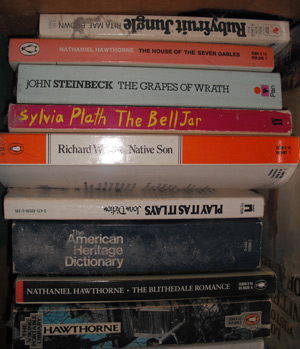
Over Christmas I came across a box of old books that had been gathering dust in an attic ever since I left university. A lot were pretty useless, except as curiosities — a book on American foreign policy that goes up to about 1982 would give quite a rose-tinted perspective.

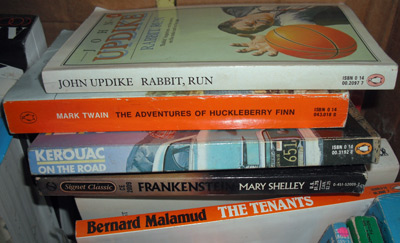
However, I managed to pick a good dozen or more novels that are taught just as regularly now as they were a couple of decades ago.

1980s Paperbacks
1980s Paperbacks

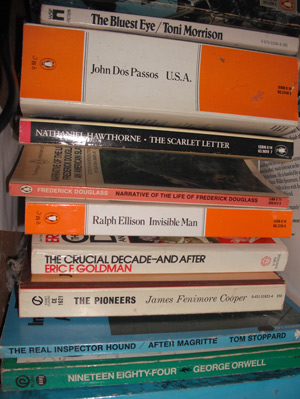
Quite a few books (Ralph Ellison, Toni Morrison, Frederick Douglas, Rita Mae Brown, Richard Wright) probably date back to a course I did on American literature at the University of California Santa Barbara, which probably should have been more accurate called Afro-American literature. It was taught by a lecturer called Elliott Butler Evans who saw the whole canon of American literature through ‘cultural semiotics and ethnicity’. (The quotation is taken from this page on the UCSB website, where he still appears to be teaching.)

I must have learned to read literature to take into account the Afro-American perspective reasonably well as I think I got a B+ on that course.

There’s also quite a few books by 19th century American novelist Nathaniel Hawthorne. I did a year-long course in my final year at Birmingham taught by Brian Harding, this country’s greatest expert on the writer (at least at the time), who’s since edited many editions of Hawthorne’s work.

1980s Paperbacks
1980s Paperbacks

That was in the days when we were taught in a weekly tutorial for five students — all sitting in Dr. Harding’s office (at the time the one next to David Lodge’s) around a big table: great for in-depth discourse on one of the most influential authors developing the American literary tradition but not so good if, like me, you’d been in the pub instead of reading the works beforehand.

Somehow I managed to get a decent mark in my finals on Hawthorne but the enduring image I retain from that course was when an attractive but quiet female student called Gill (I wish I could remember her surname) once turned up in fishnet stockings and leather boots. I still remember watching her, quite stunned, walking down the English department corridor.

1980s Paperbacks
1980s Paperbacks

The Orwell ‘1984’ as well as Mary Shelley’s ‘Frankenstein’ came from another UCSB class — taught by Professor Frank McConnell who was the most popular lecturer at the university. He was described as being  ‘known for his renegade lifestyle and his love for teaching’ — unfortunately this was in an announcement made by UCSB when he died in 1999 aged only 56. Sadly, his renegade lifestyle probably contributed to his early passing away. I remember him doing Roger Daltrey impressions, swinging his microphone in front of a huge lecture theatre full of hundreds of students — rather different from the Hawthorne seminars.

There are other iconic books in the pile — Steinbeck, Updike’s ‘Rabbit Run’, Kerouac’s ‘On the Road’. I don’t have any recollection much of what’s between the covers of John Dos Passos’s ‘U.S.A.’ — I was never going to let a book that thick stand between myself and the student bar or pub.

The Tom Stoppard play was one I appeared in when I was in the sixth form — not sure how that got in the box.

Any guesses what subject I studied at Birmingham?