The K Factor – So You Think You Can Knit

After a long day thanks be for Harry Hill and the Knitted Character. He rose from the flames to have his own reality competition: the K Factor.

TV Burp is a masterclass in building humour from the compounding effect of repetition and self-deprecation. Now I’m not sure which is the best of the two. Which way to decide?

Political Research

Seeing as Frances Cross, the MP’s wife, is a principal character in ‘Burying Bad News’ it was quite nice to bump into Helen, my local MP’s wife briefly at the weekend. I don’t know her particularly well but certainly well enough to say hello to and have a chat. I know David, her husband and a shadow minister, slightly less well but I’ve met him on quite a few occasions and enough to say hello. (For the sake of their confidence I won’t say exactly where or in what circumstances I met her or even how I know them but it’s not in an overtly political context). Unlike Frances, Helen is a completely approachable, friendly and level headed person as is her husband, who’s pretty likely to become a minister should the Conservatives win in May.

I’ve also met quite a few other MPs and Ministers. I used to live in Vince Cable’s constituency and once took a deputation of neighbours to his surgery (an experience that I allude to in a chapter of BBN). Phil Woolas, who’s Minister of Immigration, came to my mother in law’s birthday party a couple of years ago and I had quite a chat with him. My mother-in-law used to have a photo taken of herself with Tony Blair every year at the Labour Party conference. She’s not managed it so far with Gordon. I told her before last year’s conference that she’d better be quick in getting one.

The Shock of the New

It’s going to be quite an intense day on Saturday for a few of us: Rick, Nick and myself have both a reading and a tutorial. The reading is c. 2,250 words and the tutorial extract can be up to 3,000. I slightly exceeded the word limits on both so I’ve got about 5,600 words in for feedback in one way or another — in two different novels, which might land me in trouble.

I really wanted to make a start on ‘The Angel’ and I began by trying to do something clever and writing a scene which, like Alan Ayckbourn’s ‘Norman Conquests’, brought together characters from different works and had them interact in scenes which were interchangeable. I will probably still use the scene. It’s when Sally(from ‘Burying Bad News’) wants to bone up on wine. It turns out she knows Kim (from ‘The Angel’) from London and Kim persuades James to put on a wine tasting at ‘The Angel’. Sally brings Jez along and meets Emma and Gordon, Emma’s doctor father who tries to take over the wine tasting duties. Both Sally and Emma get smashed and Sally sees glamorous Emma as someone who can help make her image over and persuades her to accompany her to Bicester Village Designer Outlet to buy some discount brand label clothes cranking up the balance on the credit card she’s just wangled. In the course of this Sally would give Kim the third degree about why she’s left London and come to the sticks to work for an ex-banker. Kim would show Sally the space in the pub that she’s planning to turn into her studio. Quite a nice little scene I thought but it was quite dialogue heavy and didn’t really get into the meat of the story so I thought it might be a bit of a missed opportunity to present that for the tutorial.

Interesting that I referred to Alan Ayckbourn as I’ve long admired his plays — the way he works within a limited scope and is marvellously funny but still exposes the deepest recesses of his characters’ psyches. What I’ve described above is not too dissimilar to one of his plots.

So I decided to put the wine tasting writing on hold and write something different — and I had about two or three days to do it and last night’s class to fit in as well (in addition to work). I had a very firm image in my mind about how I wanted the novel to end and, bearing in mind feedback about how a reunion on the Millennium Bridge was a bit of cliche, I decided to construct an ending to the novel that took the cliche and subverted it.

I worked pretty obsessively on the piece as there’s not much opportunity for ‘face-time’ with the tutors and I wanted to deliberately address a lot of my concerns about the novel in the submitted extract. I got up at 5.30am this morning so I could send it in before midday (I failed by 8 minutes).

I also put my fieldwork research in the Tate Modern to good use by setting almost all the action in the gallery. I don’t know how successful a strategy it will turn out but I had the characters look at painting that were then used to reflect concepts and emotions from the plot. I tried to use paintings that readers would have a good chance of knowing, such as Warhol’s ‘Marilyn Diptych’ and Lichtenstein’s ‘Whaam!’. My reference to the latter wasn’t very subtle but it’s not a subtle painting. I really want to use the Cy Twombly paintings I saw last week but can’t find them on the internet. I’m planning another trip to the Tate next week to check. I also ensured that my semi-mystical experience inside Balka’s huge box was put to good use (see blog posting below). I hope Alison says that this works because, if it does, it could be quite a hook for the novel as I would see it being marketed at the kind of people, like me, who are reasonably educated and open to new ideas but who know very little about certain types of culture (in this case modern art). It works very well with things like Morse and his fixations with Wagner and Mozart.

I’m not sure how the piece hangs together. Because of the word limit (yes I came up against the word limit and had to edit it down even though it was put together quickly) it’s probably more rushed than I’d anticipate in a full length novel. For example, I’m concerned that I’ve telescoped the plot a bit too rapidly into the dialogue so there might be some cliches in there. However, some of the most basic emotions must transcend cliche. If a character says ‘I love you’ or ‘I want you’ is that a cliche? I don’t think so but I still feel like there must be cleverer ways of writing that or something like ‘Be there for me.’

I wanted to write something that had both dialogue and some extended description but I think I would want to hone the diction and rework some of the imagery in a re-draft. However, I wanted to use the extract to bring in and work on some of the themes I would see running through the novel, such as obsession, depression, communication, misunderstanding, ambition, modern art, etc. There’s also themes pubs and urban-rural tension but these aren’t so evident in the extract.

Now I’ve sent it in I’ll probably do something completely different tonight like watching television — I thought the new Rab C. Nesbitt wasn’t bad last week (I watch it with subtitles as I like to read how the dialogue is written) and ‘Bellamy’s People’ was ok last week.

And I’ve got six absorbing chapters from the other class members to read in detail before Saturday.
I’ve read through two or three quickly already but I’ll read them all through, let them stew away in my subconscious for a while, and then annotate them with any detailed comments I might have.

First Extract Sent Off

I was hoping to write something brand new for the reading in the class on Saturday but got a bit bogged down. I’m still hoping to write something on the new novel, even if it is a collection of fragments, for the tutorial with Alison.

For the reading I looked at what I’d written most recently for ‘Burying Bad News’ and was guided by the 2,250 word limit more than anything else in picking two of the sections set in Oxford, which came to about 2,500 words. They are when Sally and Ana are roaming the streets and when Sally argues with Emily Smiley. They’re mostly dialogue, which will be interesting as I’ve had a quick scan through some of the other extracts sent around for reading and, as might seem sensible at this part of the course, they’re first chapters of novels so set the scene for the rest of the story and tend to have a lot less dialogue. I wonder if picking something out from the middle of my novel will totally confuse everyone. The problem is that the novel doesn’t have a chapter one yet!

I knocked off a quick 500 words of ‘Gravediggers’ for Swan Supping. This is basically a more comedic version of ‘The Angel’ but allows me to try a few things out for ‘The Angel’. Again it’s almost exclusively dialogue with a reference at the beginning to a famous work which might set some expectation about what may happen in the end. Click here to read: Gravediggers Part 3

Best New Novelists of 2010

I came across a couple of interesting articles on the Telegraph website that may be of interest to some.
 
The first is one of these predictive pieces that tips the ‘next big thing’ — in this case new novelists. It’s interesting to see what type of novels are due for publication (and, perhaps, more importantly, promotion). Charlotte’s friend Simon Lelic is in the list. I saw his book being promoted in the window of Foyle’s at St. Pancras station last week.
 
The other one is a top 20 books of the decade thing (not just novels). Quite a few of the novels and authors we discussed last term are featured, including interesting choice like Persepolis. 
Now to try and work on something to send out for reading over the weekend.

Some Research

I was in London yesterday for work purposes and had two quite contrasting experiences that could be used in research for my novels in progress. I had a meeting with a management consultant at Price Waterhouse Cooper’s famous office at 1 Embankment Place — this is the semi-circular roofed building over Charing Cross station that was featured in the last series of The Apprentice (the toga wearing corporate hospitality task episode) and it’s even recreated in plastic bricks at Legoland. We used a little wood-panelled boardroom with all services and facilities laid on by attentive staff (obviously meant to impress financial movers and shakers — I turned up in jeans and a jumper).

My PWC friend and I did a conference call to Palma de Mallorca where the chap I’m doing some work for is based. He was rather pumped  up on testosterone and threw in phrases like ‘we really want them to drop their pants for this one’.

I had an hour or so to kill before I had to head back so I decided to take the tube to Mansion House and walk across the Millennium Bridge to the Tate Modern — both of which are mentioned in one of my synopses. On some previous occasions I’m ashamed to say the free toilet facilities in the Tate Modern have been more of a draw to me than the artworks. However, I had a more considered look around this time, albeit briefly.

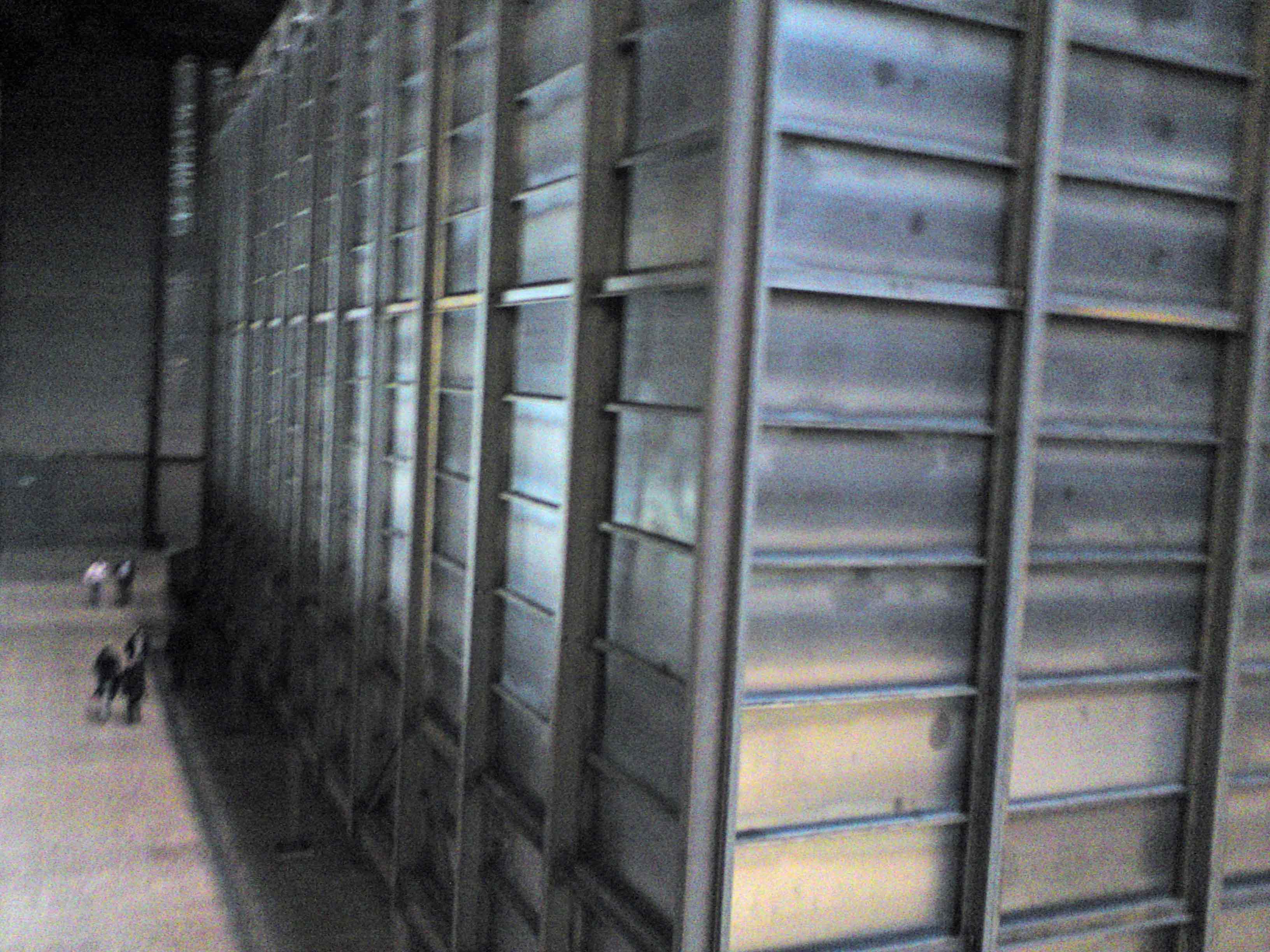
I’d seen Miroslaw Balka’s huge empty container from the outside previously but this time I ventured inside. I even got to the back wall — something that seems quite a challenge when you make the first tentative steps. (Basically the box, which is 13m high by 30m long is completely dark and empty inside.) Although one wall of the container is completely open, surprisingly little light penetrates inside so as you enter and walk straight ahead, it’s really like entering a blank void (apparently one of the allusions the artist wants to make is to the Holocaust). Once you get to the back of the container and turn round you realise you can see reasonably well in the opposite direction (towards the opening) but framed against the light are other visitors to the gallery who you observe facing you and tentatively making their way forward into the void. This is quite clever and the most effective part of the experience.

I took a photo of it on my phone which is a bit blurry but perhaps the more effective for it — see the people by the side for an idea of the scale of the box.

Miroslaw-Balka----How-It-Is

I don’t consider myself a great fan of modern art. I can’t make my mind up whether I need to work harder to understand it or if that’s pointless because it’s all a big con. (I imagine there’s some truth in both positions.) However, I did enjoy three huge paintings by Cy Twombly which were basically red spirals and loops on a big white canvas. I’m a bit annoyed as I forgot their title — something to do with wine I think and they’re quite new. I can imagine some scenes in my novel where the characters go round the gallery and have difficult conversations while they look at particular works and those Twombly paintings would be very good (and not too hard to describe!).

Today I went to corporate IT land — Thames Valley Park in Reading which is home to all sorts of corporations including British Gas, Oracle and Microsoft (who I was visiting). On the way back I decided to do a (very long) detour to Oxford to visit a location I’ve written about in a section of ‘Burying Bad News’ — the Cowley Road. I deliberately took a less direct route so that I could drive right along the length of the road from about 10 miles outside Oxford at Stadhampton. I could see the industrial part of the city looming up from a few miles away and then drove past the Mini factory and right down the road itself through the suburbs and outer city centre in the rush hour traffic ending up at the roundabout with the Angel and Greyhound at the bottom of Magdalen Bridge and then back again (getting stuck in big jams on the ring road).

I’m not sure whether to fictionalise the name of the road. I’ve certainly used artistic licence to make it seedier and grubbier than it actually is — although I noticed a few sex shops and dodgy bars. However, I’ve managed to doublt check that virtually everything I’ve described is really there — particularly a lurid row of takeaways, lots of newsagents and small grocers. In fact I may add in the pawnbrokers and cheque cashing shops…and there are plenty of buses going up and down so that’s true to life as well.

John Banville’s Character

Just watched another old episode of ‘The Book Show’. This one had an interview with Man Booker prize winning author, John Banville. He was asked about a literary character that intrigued him and he chose Cheeta from ‘Me Cheeta’ — which is a book that I’ve dipped into but not fully read. He said it might be best interpeted as a gay love story as Cheeta is clearly in love with Johnny Weismuller.

A Useful Resource for Novelists?

“Most of the time I just lie there and make lists in my head. I grunt once in a while so he knows I’m awake, and then I tell him how great it was when it’s over.”

I was watching an old edition of The Book Show with Mariella Frostrup and they asked novelist Tony Parsons what was on his bedside table.  Among other books he said he found ‘Why Women Have Sex: Understanding Sexual Motivation from Adventure to Revenge (and Everything in Between)’ by  Cindy M. Meston and David M. Buss to have been a fascinating and invaluable resource, particularly for a male novelist (and it’s not just about women it has plenty in there too about men).

I found this interesting review from The Guardian — which cites the above quotation from the book, which I thought might not be out of place in a novel.  

Up Against The Clock

Useful e-mail conversations today gave me a bit of a shock when I realised I’m both a reader for Saturday 30th and also down to do my tutorial with Alison.  She recommends a week’s notice for readers so that means trying to send something out by Saturday. I’d quite like to do something new but I might work on the new novel for Alison and maybe bring in something to read from the current one. Up against time whatever…and today was fun with a vomiting daughter to tend to at 2.30am and a visit to A&E at Stoke Mandeville with my son all morning (he’s ok but the doctor wanted him seen in a hospital).

Two Sections of ‘Burying Bad News’ to Read

 Here are the fruits of my labours of approximately the past six weeks — about 12,300 words in two sections. That’s about 12-15% of a whole novel by a rough estimation so I’m reasonably pleased with the amount I’ve done. The longer piece (working title ‘Bird and Baby’) is the more revised and redrafted of the two. It’s taken an awful lot of hours to produce that. The other one could probably benefit from a couple more redrafts.

Taken together, they give a reasonably good overview of the characters in the novel — the five principal characters are all featured between the two pieces. The two are fairly contemporaneous in terms of plot sequence too. I would probably divide the longer piece and use the shorter one to intercut it.  

In both I’ve tried to combine some character exposition with plot development. In ‘Bird and Baby’ I’ve also tried to reveal my character Robert Cross’s political views (I’ve actually made him a secret lefty) so I go into his opinions on things as weighty as the Iraq war. Hopefully the political exposition isn’t too tedious as I’ve brought in other characters and plot elements.

I found that this section expanded enormously as I was writing it — almost in the fabled way that writers talk about when they say characters take over. I threw in a few chance meetings to break up the scene and found that the interaction with the characters created whole new scenes I’d not anticipated. The same happened with a pair of shoes.

There’s a bit of self-reflexiveness in that there’s a fair amount that discusses writing and the English language — and there’s also a bit of a rant about getting published.

A read of the latest synopsis should hopefully give some context to these two sections.  This first (‘Bird and Baby’) comes when Sally has got to know Robert Cross (the minister) reasonably well in her subterfuge as a supposed wine-writer. She’s arranged to meet him in Oxford when he’s doing constituency business so she can hopefully try to press him on his political views. She starts the novel as a committed enemy — the references to the demonstration outside the Oxford Union and the aggressive woman are to Sally as a political agitator — she was the tormentor but is trying to keep that hidden.

Sally is also responsible for having started a rumour that Cross is having a sexual affair with Ana. This has reached the press, via her political contacts. The story is just starting to break in the second section — Wendover Station.

Spot the carefully hidden references to Nancy Sinatra and Little Richard.

Click here to read ‘Bird and Baby’ (9,024 words): Bird and Baby — v44 — featuring Sally, Robert and Ana

Click here to read ‘Wendover Station’ (3,323 words): Wendover Station v12 — featuring Frances and Declan

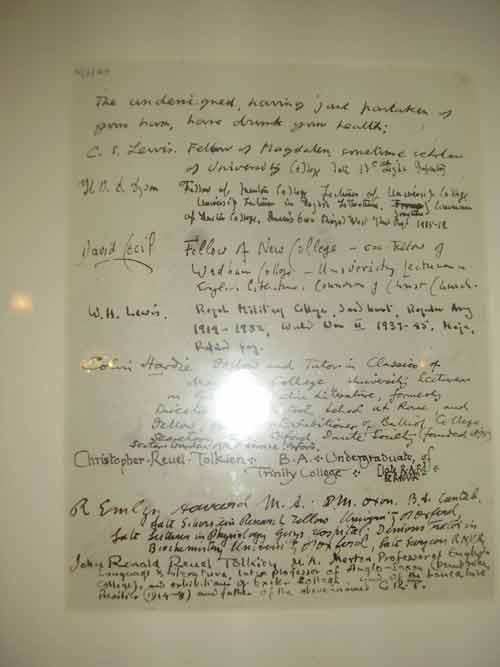
The letter referred to in ‘Bird and Baby’ really exists and is exactly in the place described. I referred to my own photo when I was writing about it.

Inkling Letter from Eagle and Child

Should anyone have any comments then it’s possible to add them to the end of this blog post. I can also mail Word files if anyone’s really keen to suggest any changes.

Re-Think

One book I bought a while ago and have been trying to start reading in the New Year — it’s ‘Too Big To Fail’ by Andrew Ross Sorkin — subtitled ‘Inside the Battle To Save Wall Street’. It’s not a novel but is written very much in a novelistic style with the author taking considerable artistic licence to describe the actions of the principal characters in a very realistic way — ‘leaning over, Fuld swept his arm across Kaplan’s desk with a violent twist, sending dozens of papers flying across the office.’

The book is notorious for its colourful language. I’m looking forward to reading its infamoususe of the word ‘grinfucked’.

It’s given me an idea for developing the synopsis of ‘The Angel’. I had James, somewhat arbitrarily, as a headhunter — mainly as I imagined him doing the kind of job that relied on personal charm. However, I also have to have a device that moves him out of the corporate background into the pub. I’d settled on redundancy but I the Sorkin book has given me a better idea. I’ll give him a background in some sort of City firm. This will allow me to use the background of the credit crunch — which I may use as an analogy to the pub’s ups and downs (big crisis at the end when everything threatens to collapse into catastrophe). I don’t want him to be a red-braces type trader as that wouldn’t give his subsequent character development much credibility. I’m thinking of making him one of the kind of very clever financial manipulators whose computer models ended up causing so much damage — if not the cause of the crash in the first place they certainly exaggerated the faults. And he will get fired because his clever financial scheme has lost lots of money. In fact, as he’s not terribly senior he’ll be the scapegoat for a whole management chain, which will cause him some bitterness.

This will also use a bit of my own background, to some extent, in business administration and IT. I could have chapters of his previous life coming into the novel as flashbacks. However, I want to keep this more as backstory than intrude into the main plot.

I think that might fill a few holes and inconsistencies and give another angle to the novel.

Annoying Space Bar Problem

My writing is suffering from a serious impediment. The space bar on the laptop I use most often has gone faulty and rarely works with pressure on the right hand side only. This is extremely irritating as I can sometimes type quite fast and I keep having to stop and backtrack to insert a space.

I did a bit of research on the web and it’s quite feasible to mend keyboards although if you cock it up you’re left with an unusable machine. It might be a precaution to order a whole new keyboard and install it myself.

The laptop is a Dell and is not very old. The keyboard quality is far inferior to an older Toshiba laptop and less robust than probably a plug-in USB keyboard that can be bought for about £10 at Tesco.

‘The Angel’ Changes

I reworked the synopsis of ‘The Angel’ based on the feedback I’d received.

Probably the biggest change was that I gave James and Emma a different backstory that changed the start of the novel — I married them — unhappily of course as there wouldn’t be much of a novel otherwise. Actually, in terms of a catalyst for action, he doesn’t actually fully realise that he is unhappy until the relationship develops with Kim. Emma will have some good qualities but I think theirs will be one of those functional sort of relationships that people drift into, ready to be shocked out of them at some point.

Because James will be newly married then his relationship with Kim will need to start more gradually — and this will hopefully give her decision to run the pub with him some more plausibility. She’ll need to be running from something in London, however, as much as being attracted to the countryside. James and Kim can still go on their massive bender round London — that’s a slightly environmentally friendly approach as I’ve already written something very similar for an OU course (albeit as a screenplay). It should be good for location and setting, though.

Most of the middle of the synopsis has stayed the same but Kim’s story follows a simpler narrative arc — she arrives, settles in eventually, deals with some crises which eventually lead her to move away again — and at the end the big question is ‘does she come back again?’ She does undergo some change, however — a development of calm and spirituality.

I’ve cut some of the ending of the previous synopsis — the bit about the abortion and so on. It was a bit too rushed to properly do justice to in the synopsis and I need to think whether it’s appropriate in the light of the other changes. The way the synopsis now reads, she could be motivated to leave by the fire.

One thing that’s not in the synopsis that I’ve been considering is making Kim even more of an outsider by having her as a non-white character. I think it would make a negligible difference to the plot – but it might give the outsider theme some more resonance. It would also be a challenge to write — and a potential minefield.  However, I’ll carry on considering this as it’s not something I’d want to take over the novel.

I kept the locations at the end in (Tate Modern and Millennium Bridge) mainly to give some sort of sense of location.  In practice I may well go for something more original — or perhaps subvert expectations by having them set-up to meet on the Millennium Bridge but things don’t go to plan and they are reconciled somewhere else — the skateboard park under Waterloo Bridge perhaps?

I created a spreadsheet based on Emily’s list of questions/attributes for characters. I still need to properly fill it in but it made me realise another flaw in my synopsis — I don’t seem to have enough characters. I can see this might have been a reason behind some of the feedback. There’s really only two who play a role all the way through — James and Kim. If you don’t like them then you’re not going to like the book. I have Emma and her predatory father as additional characters in the synopsis but I think I need a couple more significant characters.

So I’ve simplified my original ideas but I think I need some new ones for the actual novel. The synopsis itself is much improved, however. Here’s the version I handed into Emily.The Angel Revised Synopsis v4 — Distributed Dec 09

Revising Synopses

After Emily’s feedback I sent round the revised synopses to everyone in the class and we then workshopped both — the result being, obviously, that only half the time was spent on each one.

As with everyone else, it was an intense but fascinating and immensely valuable experience.

Having been the only one in the class to bring along two ideas we had a unique vote at the end of the session to see if there was any consensus about which should be developed further in the class. Surprisingly the vote was inconclusive — this reflected the previous discussion in some ways with certain members of the class having strong preferences for one synopsis or the other. I think this is positive as it shows that neither of the ideas was rubbish and also that there was a diversity of appeal between the two synopses.

‘The Angel’ (which I’d renamed from the working title ‘Pub Story’) brought out some fairly strong reaction. This is partly because, as Emily had picked up, it was a much more recently developed idea (in truth underdeveloped) and so it was more raw. That gave much more of sense of immediacy but it also showed a lot of defects. I needed to do a lot more thinking about Emma — James’ unattractive girlfriend.

I would also have a challenge to make some of the main characters appealing to the reader — the fact James was a drinking, rugby-playing headhunter branded him as the spawn on the devil to some people (in fact, I generally loathe such types as well).

There were also some comments on implausibility of parts of the plot — would Kim really follow James to the country on the spur of the moment? Also some of the settings were thought a bit clichéd – the Millennium Bridge, for example. There are plenty of other places I can think about while I write.

However, this is all good for the purpose of the course as it gave me a lot to revise and food for thought for the novel in general — and I’m still having quite radical ideas about changing it now it’s January (see later prospective later postings). I was also offered to be shown round Brick Lane and Hackney for my research, which sounds fascinating.

‘Burying Bad News’ was preferred by quite a number of people who liked the potential in the themes of wine and politics — useful comments received about making analogies to grape varieties and so on. Others picked up on probably the biggest question mark about this novel — that come May this year a lot of the political context may look like ancient history. Given the length of time still needed to finish a first draft then the subject matter could end up being quite stale. On the other hand it might appeal to nostalgia. I’ve been conscious of this while writing parts of the novel (I’m now up to 45,000 words of a first draft) and have been careful for a number of reasons to try and keep the political references incidental to the main plot, which is about human relationships. If need be I could probably change the political context that anticipated future developments, although it would take a bit of the fire out of my belly as I try to excoriate some of the excesses of New Labour. 

As a contrast to ‘The Angel’ some people thought the synopsis was a bit antiseptic and was a bit distant from the character. This might be partly because some perform roles that tend to have preconceptions — such as a scandal-hit MP and a dirt-digging journalist. It may also have been because I’m so familiar with the characters through writing that I’m taking it for granted that they will be similarly known to readers of a retrospectively written synopsis.

Even though I’ve worked a lot on this novel, I found the comments tightened up the synopsis itself immeasurably.

I revised both synopses in the light of the feedback. I worked more on ‘The Angel’, which I submitted to Emily as coursework because it was clearly in need of more development and I had used techniques learnt on the course to do this.

I found all the other synopses that were workshopped to be highly enjoyable and had great potential. It was interesting to see that some other writers were touching on similar themes. I loved Guy’s creation of a bohemian seaside community of exiled arty city types and was interested that they’d come out of the same sort of urban maelstrom that my artist character Kim does.

Real Life Did Intervene

The best of intentions…but real life has intervened leaving a two month hiatus in the blog. Apart from Christmas, New Year and the snow I’ve been recently quite busy writing but more of that later.

As of the last posts I was discussing my synopses which were going to be workshopped both in class and also in an individual session with Emily.

I’ve put both original synopses on their own pages in the blog. There are links on the navigation pane or else click below to read each one.

Burying Bad News — the politics and wine one.: BBN 500 Word Synopsis v2 500 words

The Angel — the pub one: The Angel Synopsis as of 17 Nov 09

I’ll outline the feedback and the main changes I made in the next post.