Twenty Five Things Every Writer Should Know

Seems every writing blogger has come up with a few of these and apologies but I’m still working through mine — been stuck with writer’s block at number six.

So here is a link to an amusing, if forthright, list from a blog by American writer Chuck Wendig and tweeted by Claire King.

http://terribleminds.com/ramble/2011/04/26/25-things-every-writer-should-know/

There’s a simile in number 14 which I thought I’d never see used in a writing context!

I hope number 15  (‘Act like an asshole, get treated like an asshole’ ) applies to the world of writing because, in my experience, it doesn’t always tend to happen in real life although it could be the logline of many a successful novel.

I do like number 20 a lot, ‘Writing is about words, storytelling is about life’, as it gives a satisfying feeling of validation to my visceral dislike of the sort of Sunday supplement article you get at the year end: ’20 Important New Writers Under 21 You Must Read’. I do think the most interesting writers are those who’ve actually had life experiences and have got out and done things rather than just start writing about themselves and their clique of friends at university. As the blog says: ‘Experience things. Otherwise, what the fuck are you going to talk about?’

And as a footnote this article from The Guardian is a worth a scan: http://www.guardian.co.uk/edinburgh/2011/apr/21/writing-literary-commercial-sara-sheridan

What’s most interesting is Sarah Sheridan’s point near the start that the publishing industry has only recently discovered how unprofitable ‘literary fiction’ actually is — with an audience not much bigger than the people writing and reviewing it and teaching and studying courses in it (which seems to be the situation poetry is in).

An Off Stage Question

I was wondering about the point in the last post where David Nicholls mentions the impact of having important event happen ‘off stage’ and their impact being made greater when viewed from the perspective of their subsequent impact on characters’ lives — the example he used was a wedding in One Day.

It raises an interesting point about the distinction between author and narrator and the limits of narrative voice. A narrator can act as voice that’s independent of the author — being a first person fictitious character or unreliable or a different gender or even a wine bottle (in the case of Joanne Harris’s Blackberry Wine).

But it’s the author who makes the crucial decisions about which parts of the characters’ stories are related in the text — such as where to start and end, the timescale of the novel, which plot events and interactions with other characters are represented and so on. These decisions are crucial for all novels, but the plots of genres such as mysteries and detective fiction hinge on precise choices about what the author shows. For every saga that stretches over decades, there are novels that concentrate action into one day, like Ulysses.

There’s a huge amount of debate in creative writing classes and on writing blogs about narrative voice but sometimes it seems these underlying structural elements are less discussed, perhaps because they’re much more abstract and can’t be illuminated by textual analysis. The plot itself gets a fair amount of attention. Although it’s more difficult to teach by analysis of passages in novels, the principles of plotting and the enigmatic narrative arc can be found discussed in plenty of books and blogs.

But having an established plot is not quite the same as deciding how to show the plot action to the reader. David Nicholls, once he came up with his concept for One Day made it fairly simple for himself — he showed events that happened on that one day, even though life-changing plot points occurred on other dates. For most novelists, the decisions about what to reveal to the reader are much more potentially difficult to choose.

This might be my biggest problem at the moment — that I can write at such length about so many incidents that are connected to my novel’s plot that I end up combining the detail of the novel-in-a-day approach with the scope of the saga (well, I don’t see my plot lasting longer than a year or so but that’s still a lot longer than a day).

I’m not convinced about the ‘less is more’ approach to this sort of dilemma, which seems to be the standard sort of advice that’s given but I’m sure a lot harder to apply successfully as it depends on the recipient of the advice having the skill to retain all the ‘more’ while discarding all the ‘less’ . If I cut out everything that’s not directly plot-related then I’d lose a lot of what I enjoy about the writing, such as humour, and it would be a different sort of book entirely. It looks as if I’m going to have to resign myself to producing a long-ish book.

While I’ve been musing about how the novel seems to be lengthening overall, there is a particular issue that I’m wondering about that relates to both point-of-view and revelation of plot. I alternate point-of-view between two characters, male and female, although not equally, probably about 60-40. This has its issues in terms of ensuring that important plot events can be witnessed or experienced feasibly by the character whose point-of-view is being used. It can also, however, be used to withhold information.

I’m wondering if it’s acceptable to use this withholding of the reporting of direct experience for one character to allow its discovery later in the plot by the other character’s point-of-view.  It’s not crucial to the overall narrative arc but I’d like to introduce a temporary relationship for one of the characters which the reader will know has happened but only through the perspective of the character who isn’t involved in that relationship (if this makes sense). Then later this character discovers more about what happened — and this has a bearing on the overall plot.

My question is simply whether the reader would be satisfied by this selective revelation of information through use of point-of-view. Would they say ‘If we were told her point-of-view about event X then why didn’t we find out about event Y at the time — and not later?’

My instinct is that this is probably OK and selective revelation like this occurs all the time in books I read but, obviously, don’t analyse in this sort of depth. But if anyone has any ideas about this, especially if it looks like ‘cheating’ then I’d be fascinated to read any comments.

One Day I Went to Listen To David Nicholls

I’m rather late in posting about this but last week I went along to the Sunday Times Oxford Literary Festival at Christ Church College, Oxford. I was hoping to spend the best part of a day there but one session that I was hoping to attend — an interactive culinary lecture in the college’s kitchen had been booked up before I arrived.

I did get to see the main event I’d planned to see — a conversation between the Sunday Times literary editor, Andrew Holgate and David Nicholls, the author of the phenomenally successful novel One Day, which I’ve mentioned a few times before on the blog.

I arrived in plenty of time and got a good seat in the marquee in the grounds of the college. I was interested to see the size of the audience, which probably numbered at least a couple of hundred and its composition, which was probably 70-80% female, as was the gender of the questioners at the end of the session. While it’s true that women read the majority of books, it seemed from the interest in the author and the nature of some of the questions that Nicholls has done something fairly unusual in being a man writing a book about relationships that has a broadened appeal beyond conventional genre boundaries.

This seems to send some commentators into confusion, such as in this article on the Orange Prize on the Guardian website by Jean Hannah Edelstein that states: ‘Then there’s the fact that David Nicholls’s One Day has been such a runaway success among both men and women, despite the fact that it succeeds as a novel because of its careful adherence to the tropes of so-called women’s commercial fiction (but, hey, it has a manly orange cover).’ After reading this many times I still don’t understand this sentence because I’m not sure which qualifiers apply to which phrases and its internal contradictions (e.g. despite it succeeding, tropes that are so-called). I’m still not sure whether she approves of men writing books that appeal to women — women who can be marketed to by the ‘tropes’ of this ‘so-called’ genre (obviously not Guardian readers or columnists). And if it doesn’t really matter to the argument about whether there should be an Orange Prize then why has she thrown it in — maybe to say that here’s a man invading traditional women’s genre-gender territory so that perhaps justifies a prize that excludes men? And ‘manly orange cover’ — what does that say about the Orange Prize?

Perhaps the answer to why Nicholls works so naturally in this genre is explained by his unusual background for a novelist. The discussion spent rather a long time, a bit too much for my liking, on Nicholls’s biography rather than his novels. He studied English and Drama at Bristol and tried to make a career as an actor — which has supplied him with a library full of self-deprecating anecdotes. Through working with friends and colleagues he branched out into drama writing, eventually giving up acting altogether and working mainly on film and television, including the third series of Cold Feet, which has a demographic of principal characters and audience that’s very similar, I imagine, to One Day.

A few critics, and Amazon reviewers, have said that One Day is a visual novel to the point that they think it’s half-way, if not more, to being ‘a screenplay in disguise’ (Nicholls’s own quotation). The author refutes this — he’s written screenplays and deliberately used fiction as a form when he realised that it was more suitable for the idea he was developing into what became his first novel (Starter for Ten). One Day is his third novel and the first one he wrote in third person — a narratorial style that he found almost like cheating because ‘you can tell the reader things’ rather than have to carefully choreograph exposition using action, as in drama.

While the novel certainly uses the tropes of fiction generally, it’s probably true to say that a lot of its commercial appeal is because it is reminiscent of film and TV drama — partly in theme, style and structure. Perhaps the duality of the characterisation borrows from drama more than fiction — it’s both Emma and Dexter’s story — neither really predominates, although I do think Emma is his real favourite. This goes against a lot of creative writing course advice — ‘a novel must be one character’s story above all others’. Hmm.

The clever premise — of revisiting characters on the same day of the year for twenty years — definitely has the air of the dramatic set piece. I didn’t realise how autobiographical the novel was — all the locations where the action is set on those 15th Julys were places (apart from the one in Goa) where David Nicholls actually was at the time — Edinburgh, a Greek island, a tawdry London fast-food restaurant, Paris and so on. The device of using the same day of the year also allowed some of the biggest life-events, weddings, for example, to happen ‘off-stage’ — another effective dramatic technique where sometimes it’s more powerful to relate important moments in a plot via the reactions of characters rather than depict them literally.

It was interesting to listen to how the idea for the novel developed and, then, to see in hindsight what universal themes Nicholls had tapped into. If I remember rightly, he started thinking about the novel as a reaction to the prospect of becoming a father himself (parenthood features in the novel but not as a major factor in the plot) and also reaching the wrong side of forty — what happened to my life? He said he looked back in eternal regret that he’d been at university a couple of years too early and had missed out on the party and rave culture of the early 90s, unlike many of his friends and Dexter in the novel.

Looking back through the lens of impending parenthood also made Nicholls reflect on the changing nature of friendships — in your twenties you feel you had intense relationships with friends for whom you felt you’d sacrifice anything but by your forties, while you were still perhaps good friends, the relationships were more measured and different. It was this maturing process that he was interested in capturing in the book.

He also said, relating back to the hedonism he felt he missed out on, that some of his male friends had behaved like complete idiots, ostensibly self-centred, egotistical and destroying relationships in their twenties and this may have been related to circumstances —  and that monstrous as they may have become, these people weren’t actually bad.

The hero of One Day, Dexter fits this mould and Nicholls said he used two techniques to humanise him. Firstly, he is given a foil in Emma — the woman who comes from a contrasting background and who sees the germ of decency and attraction in someone who becomes a New Laddish oaf. Secondly, he said he was able to use the odd piece of interior dialogue to signal that Dexter had a twinge of regret when behaving badly and that redeemed him to many readers in a work of fiction — something that would be more challenging in drama. It also fits an archetype of a misguided man being put on the straight by a good woman.

Nicholls also said something interesting about romance as a genre that he’d learned through writing drama — romances are only really interesting if there are obstacles in the way of the lovers. And many of the traditional obstacles that provided sport for writers in the past were no longer relevant — particularly sexually. Class is also much less of an obstacle, although it features in One Day to some degree. I realised that I must have unconsciously realised this myself with my own plot because it hinges on an obstacle that is still problematic enough to create conflict — adultery and the lure of another.

I also got an interesting insight into the work involved in being a writer. David Nicholls said his biggest frustration at his novel’s success was that he’d spent two years not having time to write a follow-up — being involved in promotion and the book’s film adaptation. I also felt sorry for his arm as a long line of people queued in the marquee afterwards for book signing. I tagged along right at the end of the queue so saw that he was genuinely keen to engage with his readers, given the time constraints.

When it was my turn, I had a brief chat with him in which I mentioned I’d e-mailed him last year through the book’s website to comment on his compilation tape playlists (which I’ve mentioned on the blog before). He remembered my e-mail (as he mentioned The Smiths before I’d had a chance to prompt him). I mentioned my creative writing courses and he was interested enough to ask where I was studying, asked after the progress of my novel and wished me luck in pushing on with completing it. And if someone who’s just sold 600,000 copies of his book in this country wishes me luck then I really ought to get on with it.
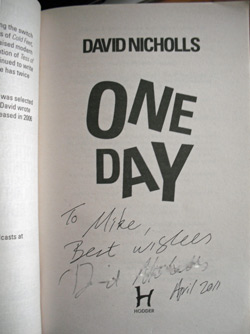
My Signed Copy of One Day

Here’s my signed copy of One Day — David Nicholls’s signature really isn’t that messy — I just obscured it a bit in photoshop so it can’t be copied.
I Wondered If This Would Ever Happen Again…

…but the new Kate Bush single was revealed today — released properly tomorrow. At least it’s only five and a half years after the last one, as opposed to thirteen, although it’s a remix of a tune released twenty three years ago. It was on Kenn Bruce’s show (the spelling is deliberate, see previous post), which I missed, but thanks to Graeme A. Thomson’s tweets, I’ve found it on YouTube.

Not sure what I think after the first listen. The original wasn’t one of my favourites and this version has some very nice sounds in it — but also some very weird vocals.

The Foolish Joys of Spring

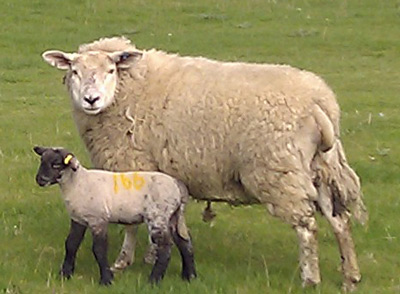
Here’s a photo of a sheep…

Newborn 166
Newborn 166

…and a lamb which must have been a day or two old. I took this about three minutes into a run earlier in the week. The land use around here is a varied mixture of livestock, lots of horses, sheep, cattle and a few goats and pigs and arable, mainly wheat but there’s an absolutely massive field — about 3/4 mile by 1/4 mile — very close which has been sown with oilseed rape this year and will soon be a block of bright yellow that I imagine will also waft a pungent smell for a couple of weeks.

It’s fascinating to observe the rhythm of the seasons in events like lambing and it’s something I want to do in the novel — both literally and metaphorically in terms of the plot — decay and rebirth and so on. It’s been re-assuring, after the persistent snow and extremely low temperatures in December — I calculated about -15C at least in my garden — that hibernating wildlife seems not to have been affected. I’ve seen plenty of bumblebees and loads of ladybirds.

I get BBC Countryfile magazine and the new issue comes with a ‘free CD of British birdsong’. I guess there’s a trainspotter aspect involved — learning the individual songs of each bird if you can really be that diligent — but I imagine that the people who will play it most are those who don’t get the benefit of natural birdsong. (Before Classic FM was launched the engineering test transmissions played birdsong, which proved very popular with listeners.)

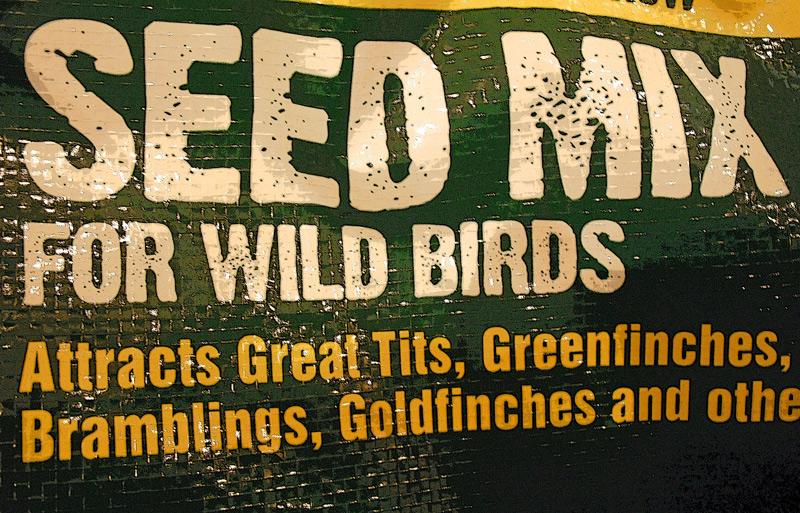
Fortunately I haven’t dashed to play my CD as the birdsong in the garden is at its seasonal peak — with the birds busy pairing off and making nests. We’ve got a few resident blackbirds who sing most beautifully perched on the tops of trees, especially at dawn and dusk. It makes me realise one of the best investments I’ve made in a long time was a 16kg bag of bird seed which saw us through most of the winter and has meant the residency of countless sparrows, finches, blackbirds, robins, starlings has continued. But I’m not sure it’s delivered on the promise of the first species on the sack, I’ve not had the pleasure of seeing those in the garden in the winter, more’s the pity.

Great Tits
Did It Do Exactly What It Said On The Tin?

Another joy of spring in the non-natural world is the April Fool. I was a bit remiss myself as I’ve enjoyed doing a few spoofs myself in the past — all I could do is post a very unconvincing status update on Facebook at 11.55am. Maybe it’s because of the recession but there were a lot of amusing hoaxes this year — there’s a round up here.

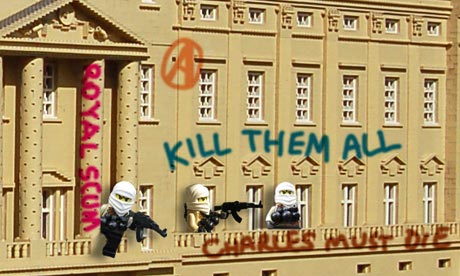
Legoland Vandalism
Legoland Vandalism

The Guardian has done some good April Fools in the past and this year it tried to convince its readers that it had changed position to wholeheartedly support the royal wedding. If you accepted this unlikely reversal of its stance then there were some very amusing stories on a supposed live wedding blog. My favourite was the desecration of the Legoland model of Buckingham Palace — a suspected trial run in miniature for the big day (see photo below linked to Guardian website).

Best of all — and my favourite for a long time — was the spoof Ken Bruce show on Radio Two. Like all the best hoaxes, and the sort of humour I like in general, this was done with such a light touch that it might just possibly have been serious.

I turned on in the car mid-way through the show and thought ‘this isn’t Ken Bruce, I wonder who’s sitting in’. But the lightly-accented Scottish voice claimed he was Ken Bruce. I twigged fairly quickly, especially after ‘Ken’ completed a whole link by burbling gibberish, that this was an April Fool and tried to identify who was the impersonator. Many other people took it literally and complained that it was Ken Bruce himself having his own joke — or that he was even drunk (which isn’t too far fetched given the rumours about another recently departed Radio Two presenter).

I nailed it as Rob Brydon fairly quickly — although the fact he’s on just about everything anyway helped narrow down the odds. His impression of a lecherous, incoherent egotist was so spot on that I felt a bit sorry at the end when the real Ken came on as he’d been so thoroughly skewered. (From a personal note I used to work for someone with a very similar drawl to this ‘Ken Bruce’ and he was also an occasionally lecherous, alternate monstrous egomaniac and paranoid neurotic so I did particularly enjoy Rob Brydon’s creation).

I’ve listened to the first half hour on the iPlayer — and I’ll try and listen to the whole thing again as it’s so funny.  There was perhaps a bit too much smutty innuendo for my liking — not because I’m prudish about these things (as some blog postings will attest) but because remarks about knobs are a bit lazy, like shock swearing, for a comedian to resort to — thankfully I didn’t hear any puns about garden birds and female anatomy.

But there were some inspired moments — particularly when the other presenters were trying to be serious. Hearing ‘Ken’ saying that Jeremy Vine had come in to ‘bore us all to death’ was priceless but I think my James might have been shaking the radio in rage.