Voice

Christmas Bestsellers 2011

There’s a lot of discussion in creative writing courses about how authors can find their voice. It’s quite a difficult concept to articulate — most simplistically it’s what defines the distinctiveness of an author’s style. This may, depending on the author, be generic to all their output or restricted to a subset of their work. Also there is debate about how some authors use a consistent voice whereas others vary their narrative voice according to the tone of different parts of a book. In this post I’m mainly concerned with the sort of authorial voice that suffuses most of a writer’s work.

Maybe one of the best ways of capturing an author’s voice was to do what we did in the most recent term of the MMU MA course — when every week a couple of us would contribute a short piece of original writing ‘in the style of’ whichever author we’d discussed the previous week in the Reading Novels module.

So I contributed short pieces inspired by Vladmir Nabokov, Margaret Drabble and John Banville (in the guise of Benjamin Black). I couldn’t help my examples of writing go beyond even pastiche and into the territory of parody — but with different degrees of subtlety they seemed to work.

It was fascinating to see how the other students tackled the exercises too. Who were the literary chameleons who could identify the elements that made another writer’s work distinctive and impose these on their pieces — and who were the types who would nod in the direction of the writer’s style but still make the piece recognisably theirs. Sometimes there were students who alchemically combined the two — both embracing the writer who inspired the piece and also making it unerringly their own.

Writing parodies or pastiches is an incredibly useful exercise — according to one of my friends at Metroland Poets, W.H.Auden said that if he was to teach poetry then he’d restrict it to parodies only.

But imitating other writers, even if it gives a fascinating insight into their techniques, isn’t going to establish a new writer with an unmistakeable voice – the sort of semi-mythical, startling new voice that agents say leaps off the slush pile and transfixes their attention for hours. I guess agents spend enough time reading submissions that they’re the experts at spotting voice leaping from the written page. I tend towards the romantic notion that your writing personality is like a fingerprint or indelible watermark: uncontrollably unique like your spoken voice and the result of hundreds of thousands of experiences and encounters as well as reflecting your genetic personality. How it’s formed must be the subject of many literary PhDs –also witness the popularity of books like Claire Tomalin’s biography of Charles Dickens.

The spoken voice analogy is where the horribly blurry photo comes in at the top of this post. It shows books on promotion as Christmas presents at a local W.H.Smith branch.  It’s a collection mainly of celebrity memoirs and TV cookery tie-ins — which as the Guardian’s round up of Nielsen’s Bookscan sales figures shows comprised the bulk of the top sellers this year (apart from David Nicholls’s ‘One Day‘).

My wife was reading the Michael McIntyre book and said ‘You can imagine him speaking every single line of this’  and then I realised the stunningly obvious fact about the whole selection: the common factor shared by virtually every single one of these books is that they are purportedly written by (or about) people whose spoken voices are very familiar to the reading public — clearly McIntyre, the Hairy Bikers, James Corden, Lee Evans, Hugh Fearnley Whittingstall but also, in the collective memory, Steve Jobs and Jonny Wilkinson.

Knowing the public persona of the (supposed) author immediately changes the way a book is read. There’s no discovery process about the author (or the voice of the author) — if the author’s meant to be a celebrity then it immediately contextualises the words on the page for the reader.

I was flicking through Alison Baverstock’s ‘Marketing Your Book’ and noted another glaringly obvious (but revelatory) point she made: unlike repeatable commodities such as bread or milk or shoes, books aren’t bought more than once (except on occasion for presents and the like). That’s why publishers must love franchises. Readers might spend ages deliberating and prevaricating about trying something new but once they know they like an author then they’re hopeful of the same pleasurable experience again and will repeat purchase — part of the reason why book series are so attractive to publishers. It’s also inherent in the behaviour of book buyers — people go out to get the new Terry Pratchett, Lee Child, Sophie Kinsella and so on because they know they’ll encounter something familiar — if not the same characters then certainly the authorial voice.

Perhaps what’s most terrifying for putative writers who aren’t celebrities is the question of whether theirs is a voice that people want to hear? For a comedian or celebrity chef their written voice is something they don’t need to worry about making their own — the cover page and their TV appearance should see to that. But if it’s a first novel then the authorial voice will be new and unfamiliar (unless it’s an attempt at bandwagon-jumping and imitating someone else). That’s why activities that promote new writers, such as literary prizes and competitions, are so important. (Speaking of which, one of my ex-City coursemates — Bren Gosling whose blog is linked in the sidebar — has had the great news that the manuscript of his recently finished novel — ‘Sweeping Up the Village’ has been put on the longlist for the Harry Bowling prize 2011.)

A final point on the W.H.Smith display is to note how little fiction it contains — only the Martina Cole and the Christopher Paolini — and the Wimpy Kid book (if that counts). Perhaps that’s a little unfair as next to the shelves was a rack containing Richard and Judy’s latest seasonal selections — all recently-published fiction. What’s also startling is the predominance of books about sportsmen, comedians and cookery.

I guess a humorous novel about an ex-rugby-playing, TV cookery show contestant who leaves an IT job to run a gastropub might have a bit of appeal to a publisher’s marketing department at least. Let’s hope 2012 at least sees it finished.

Happy new year everyone — I’m hoping the next 12 months will see the publication of some of the great writing that’s been produced by my coursemates and other writing friends.
Wenlock Saved

I have a short update to the story of the Wenlock Arms in Hoxton, mentioned below, which is relevant to the fate of many pubs across the country.

The Wenlock is a spit-and-sawdust, East-end style local (which looks from the outside rather like a more downmarket version of the Queen Vic from EastEnders). It’s typical of an urban pub style that would have been found on virtually every street corner in Victorian London. However, the triple threats of German bombing in the second world war, post-war redevelopment and the consequences of changing leisure time activites leading to changes of use have led to such pubs becoming increasingly rare. If the buildings still stand as pubs then they’re likely to have been either gentrified into ‘bar and kitchen’ gastropubs or be vile drinking dens full of pool tables and fruit machines.

Not so the Wenlock. Mainly due to the pub’s promotion of real ale from small and microbrewers and the consequent patronage of the members of the Campaign for Real Ale (CAMRA) and like minded drinkers, the Wenlock has continued as a genuine community pub — for example hosting regular live music. The phrase ‘unspoilt by progress’ (used by Banks’ for their beers in the West Midlands) could be applied accurately to the interior, which appears to have been under an informal preservation order that has seen a moratorium on any discernible interior decoration — which to the generally stylistically challenged CAMRA members is seen as a Good Thing.

As mentioned in the post on Shoreditch, the Wenlock sits in an area that is on the fringes of the Hoxton-Shoreditch urban renaissance — had it been any closer it would probably have been converted to a bijou neon place called Bar Frottage or something. However, the economic winds of redevelopment finally reached the Wenlock and an application was made to Hackney Council earlier this year.

As suggested above, planning laws mean that there’s no requirement to request permission to change the use of a pub into a similar sort of establishment, like a bar or restaurant, so long as it’s used to sell food and drink. This has been why many pubs have been ruined by being turned into failed restaurants. You could probably turn a pub into a kebab house quite happily.

However, permission is required to change the use of the building to any other sort of commercial use and, particularly, for private housing. As the price of housing is so expensive in large parts of the country, particularly London and the South East, the physical building of a pub (or even just the land it stands on) can be worth far more as an asset than the pub will ever hope to generate as a business. That’s why so many pubs are owned by speculators or giant pub companies that securitise their property portfolios in the City in exchange for cash.

In the case of the Wenlock, developers wanted to build at least five apartments on the plot. These would no doubt have sold for well over a million pounds collectively — creating a profit that would probably take a back-street boozer decades to realise. Therefore, all but the most successful pubs in this country, are only protected from the raging forces of market greed by local planning regulations. In the case of the Wenlock Hackney Council rejected the change of use application and many locals and real ale supporters celebrated this in the autumn.

However, there is a loophole which those wanting to redevelop the Wenlock sought to exploit. Premises can be denied permission for change of use but, unless a building has listed status or is in a conservation area, then the owners can do more or less anything else to it — including demolish it. This tactic has been used ruthlessly in the past where pubs have literally vanished overnight when developers have sent in bulldozers at midnight. (The famous Tommy Ducks in Manchester was an example, which was razed to the ground one night in 1993 at 3am in the morning. This pub used to have women’s knickers pinned to the ceiling — I was once taken there after a school trip to the theatre by the teachers!)

The Wenlock was just outside the Regent’s Canal Conservation area and so its locals were disturbed to see a notice of demolition attached to the building at the end of November. This is apparently a technical process to inform the council of an intention to demolish a building and normally the council can only object to the method of demolition proposed (unless the building is listed or in a conservation area). So it appeared that the Wenlock was going to be turned into a patch of waste ground — with the presumed intention of later lobbying for the original residential development once the pub had become only a memory.

But the pub’s supporters mounted a huge campaign (there’s a Facebook group called Save the Wenlock, which I belong to) and mobilised a coalition of beer drinkers and lovers of vernacular architecture to lobby Hackney council themselves. The pub could have been demolished, as I understand it, from about the 22nd December.

On Monday 19th December at a meeting of Hackney Council, the conservation area was extended to include the Wenlock Arms. The pub had been, possibly, days from demolition but has now been preserved — the fabric of the building and its permitted usage at least — whether the owners want to hang on to it with no prospect of it being anything other than a somewhat down-at-heel looking boozer is an open question. (There’s a very detailed historical and architectural account of the area — and an adjoining pub, the King William IV — on the council website.)

Fortunately there won’t be the traditional, short-lived rush to celebrate the preservation of an amenity that few people actually used — as happens often when economically struggling pubs are denied permission to change use. The Wenlock has never seemed to want for customers, which shows what a bleak outlook there is for less busy pubs when customers have less disposable income, beer duty is rising and inflation (especially utility prices) is rising fast.

As with most retailers, Christmas and New Year are the best times of year for pubs and there will be many publicans who will trade up until New Years Eve, bank the Christmas takings, and then shut down for good. The Wenlock’s success story is rare but it’s salutary and an example of what community action can achieve.

Broad Beans and Sea Urchins

Writing-in-Situ---Tate-Modern
Writing in the Field -- Tate Modern Espresso Bar

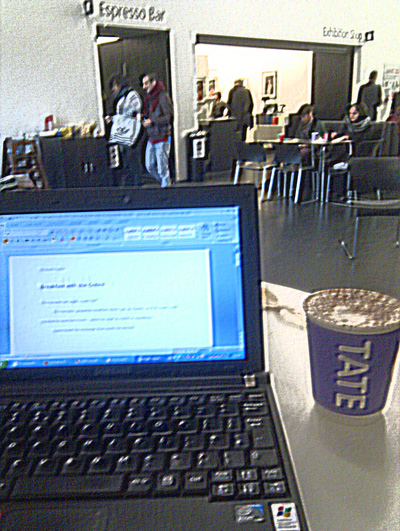
I was in London today and took the time to do a bit of novel-related research. I’m planning on setting a small part of my novel in the Tate Modern and so thought it might be in the spirit of the novel to actually write some of it there.

So, as the picture shows to the left, my netbook is out next to my Tate cappuccino while I wrote a few hundred words about what my characters were doing in the same place — I’m not sure if that does anything for the authenticity of the words on the page but it probably helps me feel that I have some sort of credibility in attempting to use this as a location.

I guess the photo is a bit symbolic in showing the subject of the writing along with the means by which it’s intended to be captured — the Word 2007 screenshot.

The floor where I was sitting is home to the current Gerhard Richter exhibition. This is an incredibly well-reviewed exhibition featuring the works of one of the world’s leading artists, who happens to be German, which fits a little with my novel.

I went to see the exhibition (it’s one of those you have to pay to go in) about five or six weeks ago and was actually very impressed with it. Richter is an incredibly versatile artist who’s created abstract art as well as fascinating landscapes and portraits and still lives — two of his works are exceptionally well known: one of his daughter turning her head and another of a candle that was used on a Sonic Youth album cover .

The Aphrodisiac Encyclopaedia
The Aphrodisiac Encyclopaedia at Christ Church Greyfriars

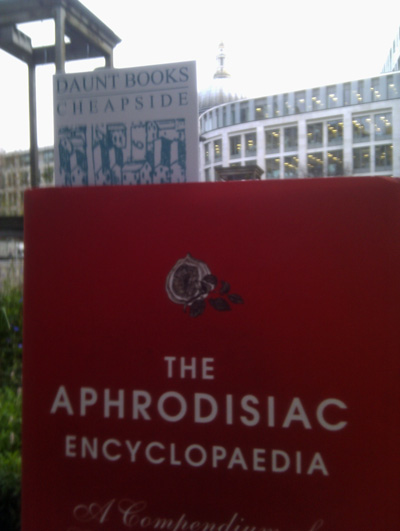
I then had a look around Daunt Books’ new Cheapside shop.

Nowadays I have to enter bookshops with a resolution of steel — I WILL NOT BUY MORE BOOKS (because I haven’t even got room for all those I currently have — let alone time to read them all). But as soon as I set foot over the threshold I’m ready to be seduced.

And seduction was on the menu for the book I found on one of the tables in the store was The Aphrodisiac Encyclopaedia by Mark Douglas Hill. And seeing as my novel has lots of food in it and relationships then it immediately attracted my interest.

Co-incidentally I was pleased to see this book as I’ve spent an amount of time on the web trying to see if I could get any more seriously foodie information on this subject myself and oddly enough the range of websites that come up tend to be a bit gimmicky or commercial.

I won’t reveal exactly what my intentions are for purchasing this particular volume of literature to peruse but I think some of the more unusual combinations might give me a bit of fun.

Looking through the table of contents, I initially wondered what wasn’t an aphrosidiac — there were quite a few foodstuffs that are pleasant to eat but perhaps not best known for their aphrodisiac qualities — e.g. steak, honey, caviar, chocolate (although I guess a lot depends on how one might use the last three on that list).

Then there are the sensual or symbolic foods that would go on any Valentine’s night menu — oysters, asparagus, truffles, figs and maybe a few others.

I was quite puzzled over the aphrodisiac qualities of some of the book’s contents — watermelon, celery, pine nuts, quince, anchovies, cheese (which sort — presumably not Stinking Bishop, which I bought recently from Neal’s Yard). Having read some of the foods’ entries these less erotic inclusions appear to made on the strength of their vitamin and mineral content — zinc being a favourite plus various amino acids or similar, like trpytophan, which apparently triggers the release of the feel-good hormone dopamine. Apparently, the book says, eating a banana mimics in a presumably more muted way the taking of ecstasy.

The book gives a recipe (for two, obviously) for each of the ingredients — and some look rather nice. I’d guess most lovers would appreciate a well-cooked meal, even if the ingredients were fairly commonly eaten anyway — like eggs or pineapple. However, some choices seemed utterly bizarre — such as broad beans. How a food so unavoidably associated with flatulence can be considered at all sexually alluring is something of a mystery — apparently it’s all something to do with the ancient Greeks and Pythagoras and the supposed similarity in the bean’s shape to the male gonad (and it also produces dopamine, apparently — better tell the ravers).

At least broad beans are quite familiar unlike some of the aphrodisiacs. The most unusual include pufferfish, sea urchin and iguana. I’d probably rather breakfast on cold pizza in the morning or a leftover kebab heated in the microwave than eat sea urchin. But, then again, in the words of 10cc, eating pufferfish might be one of the things we do for love.

As for iguana, I don’t think even the characters in my novel would go so far as serving that up in pursuit of seduction. (Apparently iguanas have some powerful glands in their inner thighs that produce powerful sex pheromones, which causes them to be turned into an aphrodisiac stew in their Native Nicaragua.) It’s a shame as the book has a recipe for ‘Roast Iguana with Chipotle and Oregano Marinade’, which would have been an interesting dish to feature in my novel. Maybe I’ll go instead for symbolism and have a character with a pet iguana which the cognoscenti will know is a symbol of their hidden, raging sexual passion.

Of course, the Aphrodisiac Encyclopaedia doesn’t take itself very seriously (see the link to the author bio above). This is a point that seems to be missed in a rather humourless and contradictory review of the book in the Observer — stating that the way to spot a mediocre novelist is the inevitable use of a meal as a metaphor for sensuality but then goes on to equate eating with sex and states that an intimate meal involves ‘wearing your elemental self on your sleeve’ (maybe it’s OK to use the metaphor in a review but not a novel or maybe I’ve missed some self-reflexive irony?).

Of course  there’s not much science behind the claims for most aphrodisiacs — although the social and cultural associations of some of the better known foods in the book are enough to make the consumption of these foods in the right context a suggestive and potentially innuendo laden act. I’m sure I can put the research to good effect.

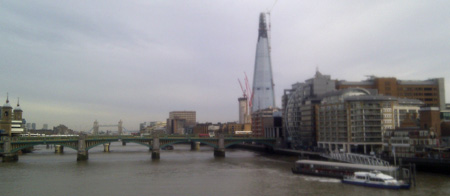
And on the way between the Tate Modern and Daunt Books where I was seduced by this volume, I walked over the Millennium Bridge, which gave me the opportunity to monitor the progress of the Shard again. This time I’ve got a smeary-lensed, city scape with what my blogging acquaintance Female PTSD describes as a giant Issey Miyake perfume bottle (that’s an analogy as a male I never would have got).

The Shard 6th December 2011
The Shard Nearly Finished -- 6th December 2011